
Last updated: November 19, 2026
Key Takeaways
- Keep your spine neutral, your temperature steady, and your sleep space easy to use.
- Use a stable frame with full mattress support and enough room to move around the bed.
- Pick bedding for weight, weave, and breathability, not marketing claims.
- Temperature, light, sound, and airflow drive comfort; room temperature is often missed.
Your bed setup can feel wrong even when the mattress is fine, the room is quiet, and you went to bed early. The fix is usually a few small controls: support, temperature, light, and fit. This guide to Bed setup, sleep space, and comfort controls — The Complete Guide shows what to change first, what to leave alone, and how to tell which problem you actually have.
What actually determines the right bed setup?
The right setup is the one that keeps your spine neutral, your body temperature steady, and your sleep space easy to use. If one of those three is off, comfort drops fast, even with an expensive mattress.
Picture this: you’re in bed at 11 p.m., the sheets twist around your legs, the pillow is too tall, and the room feels stuffy. The problem is not one thing. It’s usually the mix of support, bedding, and controls around the bed.
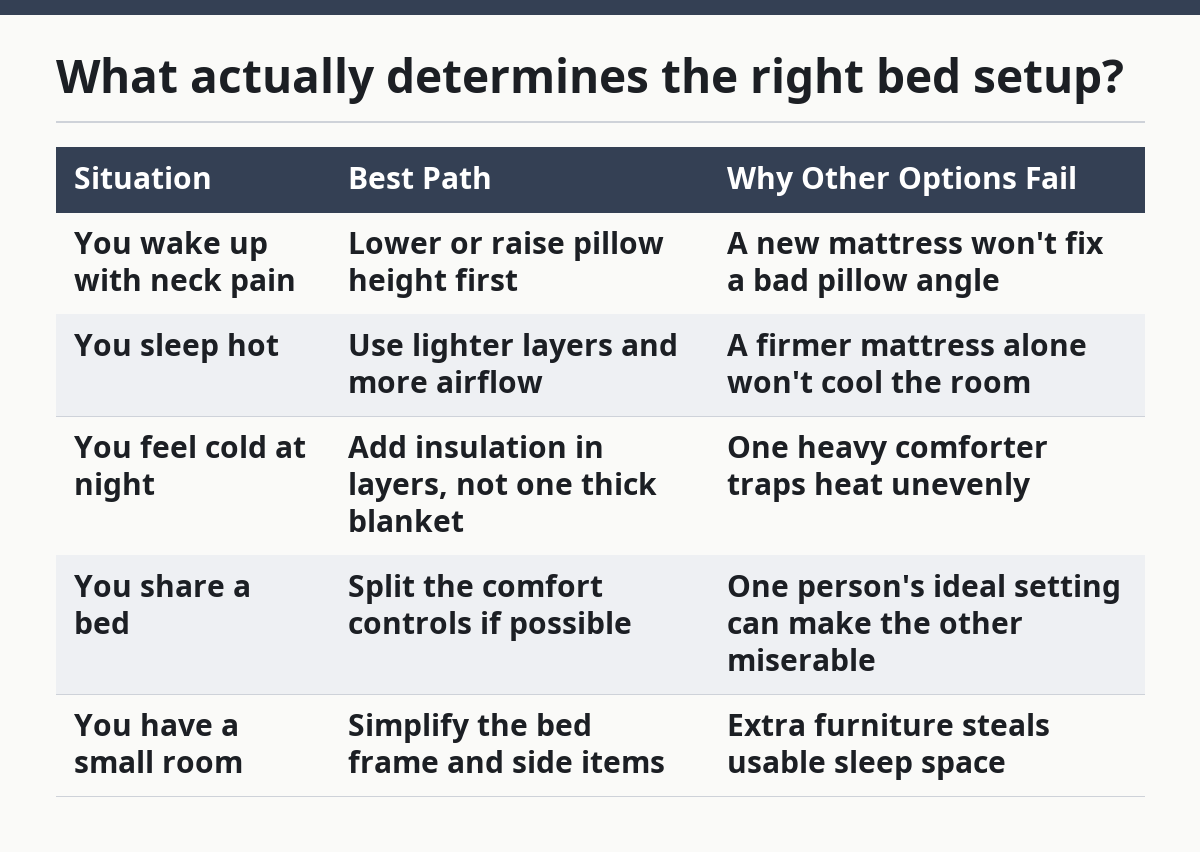
A simple way to sort it out is to match the symptom to the most likely fix:
| Situation | Best Path | Why Other Options Fail |
|---|---|---|
| You wake up with neck pain | Lower or raise pillow height first | A new mattress won’t fix a bad pillow angle |
| You sleep hot | Use lighter layers and more airflow | A firmer mattress alone won’t cool the room |
| You feel cold at night | Add insulation in layers, not one thick blanket | One heavy comforter traps heat unevenly |
| You share a bed | Split the comfort controls if possible | One person’s ideal setting can make the other miserable |
| You have a small room | Simplify the bed frame and side items | Extra furniture steals usable sleep space |
The best way to think about this is simple: mattress, pillow, bedding, and room settings all work together. If one piece is wrong, the others get blamed. That leads people to buy the wrong fix, like replacing a mattress for a pillow problem.
Start with this order:
- Check pillow height first.
- Check mattress firmness and edge support second.
- Check bedding weight and fabric third.
- Check room temperature and light fourth.
- Check noise and clutter last.
- Change only one thing at a time for 3 to 7 nights.
That order matters because the biggest comfort problems are often the easiest to miss. A pillow that is 2 inches too high can create more trouble than a mattress that is merely average.
Quick check: if you wake with stiffness, not pain all day, start with pillow and bedding before you touch the mattress.
How should you set up the bed frame and mattress?
Set the mattress on a stable frame with full support, flat contact, and enough clearance to move around the bed. If the base flexes, sags, or squeaks, the rest of the setup starts fighting itself.
Picture this: you’re making the bed and notice the mattress dips near the middle, the frame creaks when you roll over, and the fitted sheet slips at the corners. That usually means the support under the mattress is the first thing to fix.
A bed frame should do three jobs well:
- Hold the mattress level.
- Keep the mattress from shifting.
- Leave enough space for cleaning and getting in and out.
If you use a platform bed, look for close-set slats or a solid deck that matches the mattress type. Many foam mattresses want more even support than old-fashioned wide slats. If you use a box spring, make sure the mattress maker allows it; some modern foam and hybrid beds are not built for that kind of base.
A good setup also gives you room to move. If the frame sits too low, getting in and out can strain hips and knees. If it sits too high, the bed feels awkward and the room starts to feel crowded. A standard bed height often lands around knee height for many adults, but comfort is more useful than any fixed number.
Use this checklist:
- Tighten all bolts before you blame the mattress.
- Check that the center of the bed is supported.
- Replace broken slats or warped pieces.
- Keep at least a little clearance under the frame for airflow and cleaning.
- Make sure the mattress fits the frame size exactly.
The mattress itself should also match your sleep style. Side sleepers usually need more pressure relief at the shoulder and hip. Back sleepers usually need more even support in the middle. Stomach sleepers usually need the least sink. If the bed feels soft at first but your lower back complains after 20 minutes, the surface is probably sinking too far.
You do not need a luxury frame to sleep well. You do need one that stays still, stays flat, and matches the mattress design.
Quick check: if your bed squeaks, sags, or shifts, fix the base before buying a new topper.
How do I choose bedding that actually helps comfort?
Choose bedding by weight, weave, and breathability, not by label hype. The wrong sheet fabric can make a good mattress feel hot, scratchy, or cramped.
Picture this: you’re tired, you crawl in, and the top layer feels either clammy or too heavy within minutes. That is usually a bedding problem, not a mattress problem.
The parts matter separately:
- Sheets: Cotton percale feels crisp and airy. Sateen feels smoother and warmer. Linen usually breathes well and feels textured.
- Blankets: Thin layers are easier to tune than one giant comforter.
- Duvet insert: The fill weight changes warmth more than the cover does.
- Protectors: A waterproof protector can help with spills, but some add heat and noise.
If you sleep hot, start with lighter sheets and fewer layers. A breathable sheet set and a lighter blanket often help more than buying a new comforter. If you sleep cold, add layers you can pull off in the night. A thin quilt plus a midweight blanket gives you more control than one heavy piece.
The texture can matter too. Some people hate the friction of rougher fabrics on bare legs. Others hate slick sheets that bunch up. That preference is real. No single fabric works for everyone.
A simple bedding setup looks like this:
- Mattress protector.
- Fitted sheet.
- Flat sheet or light blanket.
- Duvet or quilt with removable cover.
- Extra throw at the foot only if needed.
If allergies are part of the picture, choose washable bedding and protectors that you can clean on a regular cycle. Dust and skin flakes collect fast in soft materials. If the room is warm, wash bedding more often and avoid heavy quilts that trap heat.
Do not confuse softness with comfort. A very plush top layer can feel nice for 5 minutes and still cause overheating later. What matters is how the bed feels after an hour, not how it feels at first touch.
Quick check: if you kick off covers at 2 a.m., your bedding is too warm or too dense.
What comfort controls matter most in the sleep space?
Temperature, light, sound, and airflow are the main comfort controls, and room temperature is the one people miss most. If the room is wrong, even a perfect mattress feels off.
Picture this: you’re tired enough to fall asleep fast, but the room feels stuffy, a lamp shines from the hallway, and a small noise keeps pulling you half awake. The bed is only part of the sleep space; the room is the other half.
The most useful controls are plain:
- Temperature: cooler rooms often feel easier to sleep in than warm ones.
- Light: block stray light from windows, hallways, and screens.
- Sound: reduce sudden noise, not just constant noise.
- Airflow: keep air moving so heat does not pool around the bed.
If you sleep hot, start with airflow before expensive cooling gadgets. A fan placed to move air across the room can help more than a higher-cost gadget that only changes one spot. If you sleep cold, make the room slightly warmer and use bedding layers instead of cranking one control too hard.
Light deserves more attention than it gets. Even a small LED or streetlight can keep a room too bright for some sleepers. Blackout curtains, an eye mask, or even better lamp placement can solve that. The point is not darkness for its own sake. The point is fewer signals hitting your brain when you want it to settle.
Noise works the same way. A door that slams once can matter more than a steady hum. If your room has sharp sounds, softening them with a rug, draft stop, or white noise machine may help. White noise is not magic, but it can cover random peaks that wake you.
A simple room reset can look like this:
- Set the thermostat to a sleep-friendly range for your own comfort.
- Close gaps around curtains or blinds.
- Move bright LEDs out of sight lines.
- Add a fan or keep a window open if outdoor air is safe and comfortable.
- Remove noisy clutter near the bed.
- Test one change per night for a week.
That is why the National Sleep Foundation recommends a cool, dark, and quiet sleep environment, and the American Academy of Sleep Medicine also emphasizes sleep-environment habits. The best part is that these fixes are often cheaper than replacing major furniture. They also make the bed feel better without changing the bed itself.
Quick check: if you sleep better in a hotel room than at home, the room controls are probably the issue.
How do I set up pillows without wrecking my neck?
Set pillows to fill the gap between your head and shoulders, not to prop your head high like a chair back. If your neck bends up or down, the setup is wrong.
Picture this: you’re on your side, the pillow collapses, and your head tilts toward the mattress. Or you’re on your back and your chin drops toward your chest. Both are signs that the pillow height is off.
The rule changes by sleep position:
- Side sleeper: usually needs a taller pillow to keep the neck level.
- Back sleeper: usually needs a medium loft that supports the curve of the neck.
- Stomach sleeper: usually needs the thinnest pillow, or none at all if that feels better.
Pillow fill changes the feel a lot. Down, down alternative, latex, shredded foam, and solid foam all behave differently. A shredded fill can be adjusted. A solid foam pillow usually gives a more fixed shape. If you move around a lot at night, an adjustable pillow may make more sense than a one-shape-fits-all model.
You can also stack pillows, but stacking is a fix, not a finish. Two thin pillows can be better than one thick one if the height lands right. If the top pillow slides, use a pillow protector with a firmer surface or a pillowcase that grips better.
After that, test the setup in the position you use most:
- Lie down in your normal sleep position.
- Check whether your nose points straight ahead or tilts up or down.
- Add or remove pillow fill.
- Recheck shoulder space on your side.
- Sleep on the setup for 3 nights before judging it.
- If one position feels good and another feels bad, choose the pillow for the position you use most.
If you share a bed, pillow height can vary by person. That is normal. Two different necks do not need the same pillow.
Quick check: if your neck feels fine but your shoulder hurts, the pillow may be too low rather than too firm.
What should I do if the standard advice is wrong for my situation?
Change the plan when your body, room, or bed makes the usual advice fail. Some setups need a different fix because the real problem is not mattress softness at all.
Picture this: you’re reading sleep advice that says to cool the room, get a firmer mattress, and use fewer blankets, but your problem is one specific thing that doesn’t fit the script. This is where generic advice breaks down.
| Situation | Best Path | Why Other Options Fail |
|---|---|---|
| You share the bed with someone who runs cold while you run hot | Split layers and use separate blankets | One shared comforter forces one person to compromise |
| You have a small bedroom | Reduce bed-side furniture and keep paths clear | Big nightstands and benches steal movement space |
| You have back pain that improves on a firmer surface | Add support before you add softness | A thick topper can hide a support problem |
| You have shoulder pain as a side sleeper | Add pressure relief at the top layer | A firmer pillow alone won’t fix shoulder compression |
| You wake from noise more than discomfort | Focus on sound control first | A mattress swap won’t block hallway noise |
| You live where the room stays humid | Prioritize airflow and washable bedding | Heavy layers trap moisture and feel sticky |
If you share a bed, separate the top layers first. Two blankets or a split duvet can solve temperature fights fast. If the mattress itself is fine, do not turn the whole bed into a compromise for one person.
If your room is small, the bed setup has to leave space for movement. A cramped room can make sleep feel worse because you are bumping into things before you even get into bed. Keep the path clear on both sides if possible, and avoid overfilling the room with storage under the bed if that blocks airflow or access.
If pain is part of the picture, be careful with easy guesses. A firmer mattress can help some people and hurt others. The same goes for plush toppers. If pain is severe, persistent, or getting worse, consult a qualified clinician before treating the bed as the whole solution. The American Academy of Sleep Medicine and other clinical sources recommend getting medical help when pain is ongoing or worsening.
Use this decision order:
- Identify the main problem: heat, pressure, pain, noise, or space.
- Change the smallest thing that fits that problem.
- Sleep on it for several nights.
- Keep only the change that helps.
- Avoid changing three variables at once.
- Revisit support only after the smaller controls are right.
The truth is, most bad sleep setups have one dominant flaw and two minor ones. Find the dominant one first.
Quick check: if your issue changes by season, roommate, or room size, standard advice is probably too blunt.
The 3 conditions that change everything
The three biggest dealbreakers are sleep position, shared sleep, and temperature control. If those three are right, the rest gets much easier.
Picture this: you’re trying to fix your sleep setup, but every solution seems to help one problem and worsen another. That usually means one of these conditions is driving the whole setup.
-
Sleep position
- Side sleepers need more contouring at the shoulder and hip.
- Back sleepers need flatter support through the middle.
- Stomach sleepers need the least lift and the least sink.
- If you change position during the night, choose the setting that serves your longest position first.
-
Shared sleep
- If two people sleep differently, separate layers solve more than one shared comforter ever will.
- Split blankets, separate pillows, and room for movement matter more than matching decor.
- A bed that works for one person and annoys the other is not a good setup.
-
Temperature control
- If you wake sweaty, focus on airflow, bedding weight, and moisture control first.
- If you wake chilled, build warmth in layers you can remove.
- Temperature problems often show up more clearly after 90 minutes of sleep, not at bedtime.
A useful benchmark is this: if a change only feels better for 10 minutes, it may not be the right fix. Comfort has to survive a full sleep cycle. That means you need to judge changes over multiple nights, not one sleepy evening.
If you want a simple way to rank changes, use this order:
- Pillow height.
- Bedding weight.
- Room airflow.
- Mattress firmness.
- Frame support.
That list is not magic. It just matches how often each piece causes a fixable problem. Most people skip straight to the mattress because it sounds big. The smaller parts are usually cheaper and faster to correct.
Quick check: if you know your sleep position and temperature preference, you can usually rule out half the wrong products.
Edge cases: when normal advice breaks down
Edge cases are where the usual bed rules stop working and the setup has to fit the real room, real body, or real schedule. These are the situations that catch people off guard.
Picture this: you’ve done the obvious fixes and still don’t sleep well. That doesn’t mean you failed. It means the setup needs a different answer.
-
You work nights or odd shifts
- What changes: daylight and household noise hit at the wrong time.
- What to do instead: use blackout curtains, an eye mask, and a consistent pre-sleep wind-down, even if it happens at 8 a.m.
-
Your room runs very humid
- What changes: bedding holds moisture and feels sticky.
- What to do instead: favor airflow, washable layers, and lighter insulation. A fan may help more than extra fabric.
-
You have a very firm mattress but still hurt
- What changes: the issue may be pressure, not support.
- What to do instead: add a thin pressure-relief layer or adjust pillow height before assuming the mattress is the villain.
-
You have a very soft mattress but feel fine at first
- What changes: the problem shows up later, after sinking.
- What to do instead: look at edge support, base support, and whether the mattress is sagging in the middle.
-
You sleep in a tight studio or shared room
- What changes: bed placement affects movement, light, and noise.
- What to do instead: keep the bed accessible, reduce clutter, and place light sources so they don’t shine straight at the pillow.
-
You have a partner with a very different sleep style
- What changes: one setup can’t satisfy both people equally.
- What to do instead: split blankets, choose separate pillows, and treat mattress choice as a joint decision with trade-offs.
If you have reached this point, a normal article that says “pick the best mattress” and stops there misses the real world. Bed setup is often a chain, and the weakest link is not always the mattress.
Quick check: if your sleep problem changes with weather, work schedule, or another person, you need an edge-case fix, not a generic one.
Can a better sleep space fix bad sleep by itself?
Yes, a better sleep space can fix a lot, but not pain, sleep disorders, or stress by itself. If the room is the problem, the room can do a lot of the work.
Picture this: you’re doing everything “right,” but you still wake up tired. A cleaner setup can help, yet it cannot solve every sleep problem on its own.
The best setup helps in three ways:
- It removes small annoyances before they pile up.
- It keeps your body in a steadier position.
- It gives your brain fewer reasons to stay alert.
That said, if you snore loudly, wake gasping, have persistent pain, or can’t sleep despite a good setup, the bed is not the whole story. Sleep hygiene matters, but so do health issues, stress, medication effects, and schedules. A sleep setup is a tool, not a diagnosis.
If you want to judge whether the room is helping, give it a fair run:
- Keep the main setup steady for at least a week.
- Change one variable at a time.
- Track whether you fall asleep faster, wake less often, or feel less sore.
- If nothing changes, the problem may be beyond the sleep space.
Useful standards and guidance can help here. The National Sleep Foundation has practical sleep environment guidance, and the American Academy of Sleep Medicine publishes sleep-health education that can help you separate environment issues from other causes. If pain or breathing problems are part of the picture, a qualified clinician should weigh in.
This is the line that many articles skip: a good setup should make sleep easier, not act like a cure-all. That expectation keeps people from buying five products to fix one problem.
Quick check: if your sleep issue follows you from room to room, the bed is only part of the answer.
Frequently asked questions
What is the first thing I should change in my bed setup?
Start with the pillow and the layers over you, not the mattress. A pillow that is too high or too flat can cause neck strain fast, and bedding that is too warm or too heavy can ruin sleep even on a good mattress. Change one thing for 3 to 7 nights before moving to the next.
How do I know if my mattress or my pillow is the problem?
If your neck or upper shoulders hurt, the pillow is often the first suspect. If your lower back, hips, or whole body feel unsupported, the mattress or base may be the issue. The quickest clue is where the discomfort shows up first after you lie down.
Is a firmer bed always better for sleep?
No, firmer is not always better. Some sleepers need more support, but others need pressure relief at the shoulder and hip. A bed that is too firm can cause soreness just as a bed that is too soft can cause sagging.
What is the simplest way to make a hot sleep space cooler?
Use lighter bedding and better airflow first. A fan, breathable sheets, and fewer heavy layers often help more than a major furniture change. If the room still feels hot, check the thermostat and any direct heat sources near the bed.
How do I set up a bed for two people with different comfort needs?
Use separate top layers and individual pillows. One shared blanket often creates the biggest fight over heat and movement. If firmness needs differ a lot, start with bedding and pillow changes before replacing the mattress.
How often should I rethink my bed setup?
Recheck it whenever your sleep position, room temperature, or schedule changes. Seasonal shifts, a new partner, a different work schedule, or pain that changes over time can all make the old setup stop working. A good setup is one you can adjust without starting over.
Final take
The best bed setup is the one that matches your body, your room, and the way you actually sleep. If you fix support, bedding, and room controls in that order, you avoid the expensive mistake of treating every sleep problem like a mattress problem.
Start small. Tighten the frame. Adjust the pillow. Change the layers. Then control heat, light, and noise. The right answer is usually sitting in one of those parts already.
Drafted with AI; not yet reviewed by a person.
