

Last updated: November 19, 2026
Quick answer: for most pregnancies, the best sleep setup is the one that keeps pressure low, position stable, and heat manageable, and the right bedding fit is the one that supports that setup without fighting it. In this guide to Pregnancy sleep products and bedding fit — The Complete Guide, speak to a qualified professional about your own situation if you have pain, snoring with breathing pauses, bleeding, contractions, high blood pressure, or anything that changes suddenly.
This guide settles which sleep products actually help, how bedding fit changes as your body changes, and what to stop using when something no longer fits right. It also keeps the focus on Pregnancy sleep products and bedding fit — The Complete Guide, so the advice stays tied to the same topic from start to finish.
Key takeaways
- A good sleep setup in pregnancy is usually about position support, mattress feel, pillow shape, and sheet fit, not fancy extras.
- A product can look “pregnancy-friendly” and still fail if it traps heat, shifts at night, or crowds your hips and ribs.
- Bedding that fits well should stay smooth, stay on the mattress, and leave enough room for changing positions without tugging.
- Side-sleep support often matters more than a giant pillow. Big can be less useful if it creates heat or crowding.
- If pain, breathlessness, swelling, or snoring suddenly changes, the sleep setup may no longer be the only question.
What pregnancy sleep products are actually for
Picture this: you’re tired, you turn over, and the pillow you bought is either too tall, too floppy, or too warm to stay useful. The goal of pregnancy sleep products is support, pressure relief, and easier position changes, not perfect sleep every night.
On PubMed, 20 human studies matched the query used here for 2016–2026, and the 20 most relevant records were read; the median publication year was 2022 and 5 (25%) were tagged “Review” by the NLM. That gives a snapshot, but not a final answer. Source: PubMed (NCBI), computed on 2026-11-09 using pregnancy[Title/Abstract] AND sleep[Title/Abstract] AND products[Title/Abstract] AND humans[MeSH Terms], date window 2016–2026, sorted by relevance.
That is why the key question is usually not “What is the best pregnancy sleep product?” It is “What problem am I solving?”
That is the real filter.
A useful product usually aims at one of these jobs:
- keeping you on your side without constant rolling back
- supporting the belly so the lower back does less work
- reducing hip or shoulder pressure
- helping the knees stay apart so the pelvis feels less twisted
- making it easier to breathe, turn, or get out of bed
Here’s the catch: if the mattress is already too soft, or the sheets bunch up under you, even a good pillow can feel wrong. Bedding fit and product shape have to work together.
Which sleep setup fits the stage of pregnancy?
Therefore, it helps to think about the setup by stage as well as by product. Picture this: your body still fits your old bed, but not in the same way. The same pillow that felt fine early on can become too low, too hot, or too narrow once your belly grows and your hips start taking more load.
The sleep setup often depends on which problem is showing up first. Early pregnancy often needs less structure. Later pregnancy often needs more side support, more room for the belly, and less sinking into the mattress.
A practical way to think about it:
- Early pregnancy: a standard pillow between the knees or under the abdomen may be enough.
- Middle pregnancy: many people need more stable hip support and less twist through the lower back.
- Late pregnancy: room to roll, a stable side-sleep position, and easier bed mobility usually matter most.
Not every setup needs a full-body pregnancy pillow. That is a common mistake.
Too much bulk can create new problems.
The truth is, the best fit is often the least dramatic one that still solves the pressure points. If a smaller pillow does the job, that is usually easier to live with than a giant wedge that traps heat and hogs the bed.
How to choose pregnancy sleep products that fit your body
Because the body changes through pregnancy, the first step is to match the product to the way you sleep now. Picture this: you’re standing in the bedroom trying to judge a pillow by shape alone. What matters is not the label. What matters is whether it matches your height, your mattress, your shoulder width, and the way you move at night.
Start with the body first, then the product. Choose around four fit questions: where is the pressure, how much space do you have, how hot do you sleep, and how often do you change position? A product can only solve one or two of those well.
- Measure your current sleep space. Check the mattress width, the amount of room beside you, and the gap between your knees when you lie on your side. Verify that you can roll without fighting the pillow. If your knees still collapse together or the pillow pushes your top leg forward, the setup is too narrow or too short.
- Match pillow height to body shape. Use a pillow high enough to keep the neck level, not bent up toward the shoulder. Verify that your head does not sink lower than your torso. If you wake with neck strain, the loft is off.
- Support the belly without lifting it too high. A small wedge or curved side pillow should take load off the front, not shove the abdomen upward. Verify that you can breathe and rotate without feeling braced. If the belly feels compressed, the angle is wrong.
- Keep the knees and hips aligned. Place support between the knees or thighs if your hips twist in sleep. Verify that the top leg no longer drifts forward and pulls the pelvis. If the low back feels worse after one night, the spacing is not helping.
- Check heat and breathability. Choose breathable covers and avoid layers that trap heat. Verify that you do not wake sweaty in the first part of the night. If you get warm fast, thick foam or heavy fills may be a poor match.
- Test bed height and exit ease. Make sure the pillow setup does not trap you in a hard-to-exit position. Verify that you can sit up and swing your legs out without removing half the bedding. If getting out of bed takes extra effort, the layout is too bulky.
- Use the mattress as part of the system. A very soft mattress often needs less pillow bulk than a firm one. Verify that your hips do not sink so far that the pillow has to rescue the whole alignment. If the mattress does most of the collapsing, the pillow is carrying too much.
A few fit clues help fast:
- if the pillow keeps slipping, the cover or shape is wrong
- if your shoulder gets jammed, the profile is too tall
- if your lower back arches more, the support is too far under the belly or legs
- if your feet fall asleep or your hips ache more, the setup is twisting you instead of lining you up
No single shape works for everyone. Side sleepers, back sleepers, and people with twins often need different arrangements. The bed has to meet the body you have now, not the one you had before pregnancy.
What bedding fit matters most?
Meanwhile, the bedding has to keep up with the support system you choose. Picture this: the pillow is fine, but the fitted sheet pops loose at the corner and the blanket creeps off your feet at 3 a.m. Bedding fit sounds boring until it starts waking you up.
The biggest bedding issue is usually the fitted sheet. If the corners are too shallow, too tight, or too loose for the mattress depth, the sheet shifts when you turn. A loose sheet bunches. A tight sheet can pull at the mattress corners or make bed-making a fight.
Look for these fit details:
- Mattress depth: the fitted sheet should cover the full depth of the mattress plus any topper without skating off the corners.
- Pocket depth: deeper mattresses need deeper pockets. If the pocket is too shallow, the sheet creeps up.
- Elastic quality: strong all-around elastic usually holds better than weak corner-only stretch.
- Fabric stretch: some stretch helps movement, but too much can let the sheet wrinkle under pressure.
- Top sheet size: a top sheet that is too short can tug around your feet or chest when you turn.
The trade-off is simple: tighter bedding can look neat, but if it fights your movement or feels hot, it is the wrong fit. A smooth sheet that stays put is worth more than a perfectly tucked bed that you can’t sleep on comfortably.
If you use a pregnancy pillow, check whether the sheet set still fits with the extra bulk. Some pillow shapes make the bed feel smaller. That is not a comfort problem only; it can affect how easily you reposition at night.
What are the common mistakes with pregnancy sleep products?
Next, it helps to look at the mistakes people repeat even after buying the right category of product. Picture this: you bought the thing everyone recommends, but sleep still feels worse. That usually means the setup is wrong, not that pregnancy sleep products “don’t work.”
The most common errors are about fit, not brand names. A pillow can be well made and still be the wrong size, shape, or firmness for your body. Bedding has the same problem.
- Buying for the label instead of the body. A “pregnancy pillow” may be too tall or too wide for your shoulders and mattress. The fix is to match loft, width, and sleeping position first.
- Using one giant pillow for every problem. A full-body pillow can crowd the bed, trap heat, and make turning harder. The fix is to use only the support you actually need.
- Ignoring sheet depth. A too-shallow fitted sheet slips when the pillow setup changes how you move. The fix is to match pocket depth to mattress plus topper.
- Letting the knees collapse inward. That twists the pelvis and can make the lower back feel worse. The fix is a pillow between the knees or thighs, not just under the belly.
- Choosing heavy bedding for comfort. Warmth can feel cozy for 10 minutes and miserable by midnight. The fix is lighter layers you can adjust without wrecking the whole bed.
- Assuming more support is always better. Too much lift under the belly or neck can create strain. The fix is neutral alignment, not maximum stuffing.
Here’s the catch: the wrong setup often feels “almost right,” which is why people keep it too long. If you keep waking up to adjust the same pillow, that is the clue.
When should you stop using the same setup?
After the basics are in place, the next question is whether the same setup still fits your symptoms. Picture this: you’ve adapted to one arrangement, but now the same setup feels off in a new way. On a pregnancy sleep question, that matters. A change in symptoms can mean the sleep setup is no longer the main issue.
Sudden pain that is sharper or different: it may not be a bedding problem anymore — stop blaming the pillow and speak to a qualified professional about the change.
Breathing feels harder when lying down: position support is not enough on its own — get checked promptly.
Bleeding, fluid leakage, or contractions: this is not a pillow issue — seek urgent medical guidance.
Snoring with pauses, gasping, or waking unrefreshed most nights: the pattern can point to a sleep breathing issue — ask a qualified professional about it.
Severe swelling, headache, vision change, or high blood pressure concerns: don’t try to solve that with bedding — get medical advice right away.
A sleep product is useful when the problem is fit and support. It is the wrong tool when the problem is a symptom that changed.
On the practical side, also stop using a setup that causes:
- shoulder numbness
- hip pain that is worse each morning
- neck pain that returns every night
- overheating that wakes you repeatedly
- a feeling of being trapped or unstable getting out of bed
That is a sign you need a different plan.
What does good bedding fit look like in real life?
Then, once the support and safety checks are clear, you can judge the result by how the bed behaves overnight. Picture this: you make the bed in the morning and it still looks smooth at night. That is a good sign. A good setup stays in place, leaves room for motion, and does not create new pressure points.
A good result usually looks plain:
- the fitted sheet stays on all night
- the pillow does not need constant re-fluffing
- your hips feel more level than twisted
- you can turn once or twice without rebuilding the bed
- you wake less from pressure or heat
If the setup works, you should not have to think about it every 20 minutes. The sleep system should fade into the background. When it does, it has done its job.
Good fit often comes from small changes, not expensive ones. Sometimes the right answer is a thinner pillow, a deeper-pocket sheet, or one extra wedge under the top leg. Sometimes it is removing a bulky layer that looked supportive but wasn’t.
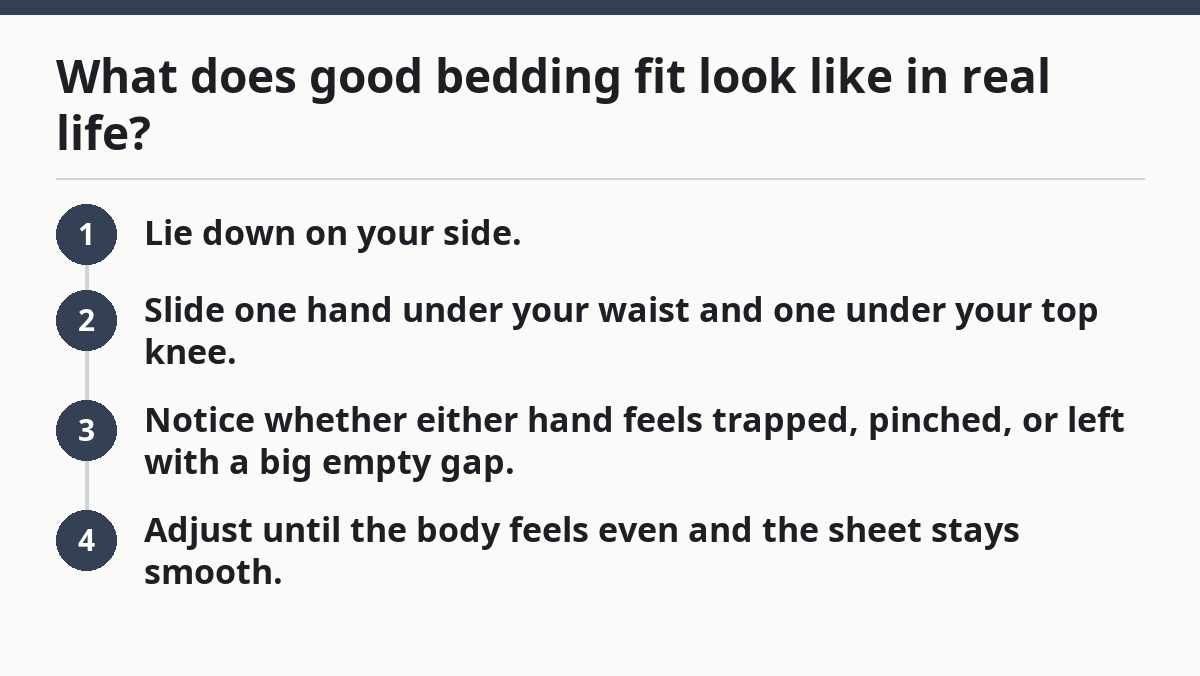
A simple check before bedtime helps:
- Lie down on your side.
- Slide one hand under your waist and one under your top knee.
- Notice whether either hand feels trapped, pinched, or left with a big empty gap.
- Adjust until the body feels even and the sheet stays smooth.
If you need to keep adjusting after the lights are out, the fit is still off. That usually means one of three things: wrong size, wrong height, or wrong sheet depth.
Does the material matter as much as the shape?
Meanwhile, the material can change how the shape feels after a few hours, even if the outline looks right. Picture this: two pillows have the same shape, but one feels hot, stiff, and slippery while the other disappears under you. Material changes how the shape behaves, especially over a whole night.
Yes, the material matters, but not in a mystical way. Foam, fiberfill, microbeads, and cotton covers all behave differently. Foam can hold shape longer but may run warmer. Fiberfill can feel softer but may flatten faster. Covers affect skin feel, heat, and how much the pillow shifts.
A few practical rules:
- If you overheat: favor breathable covers and lighter fills.
- If you need firm support: choose a fill that resists flattening.
- If you move a lot: avoid slippery surfaces that slide out from under your knees or back.
- If you want easier washing: removable covers matter more than the fill.
This is where many generic guides get it wrong. They talk about “comfort” as if it is one thing. Comfort in pregnancy is a mix of temperature, pressure, movement, and how much effort it takes to keep the setup in place.
You do not need the fanciest material. You need the one that behaves predictably after a few hours, not five minutes.
Which sleep products are usually easiest to live with?
Because the easiest products are the ones that solve one job cleanly, this section is less about novelty and more about daily use. Picture this: you want help, not a bedroom full of gear. The easiest products are the ones that solve one job cleanly and do not make the bed hard to use.
In practice, the most livable options are often:
- a knee pillow or small body pillow
- a wedge under the belly or back
- a pillow with a washable cover
- a fitted sheet with deeper pockets
- a lighter blanket that does not trap heat
A huge U-shaped pillow can work for some people, but it can also dominate the bed. It may be harder to turn around, harder to share the bed with a partner, and harder to adjust once you change positions. That is the trade-off.
If you want the least complicated route, start with the smallest change that addresses the biggest issue. If the hips ache, use knee support. If the belly feels unsupported, use a wedge. If the sheet slips, fix the sheet first.
The right sleep setup is not the one with the most parts. It is the one you can actually keep using at 2 a.m.
What should you ask before buying anything?
Overall, a better purchase starts with a few practical questions, not a bigger shopping list. Picture this: you are one click from checkout and the product photos all look soothing. That is the moment to stop and ask a few blunt questions.
Use these checks before you buy:
- Will this fit my mattress depth and any topper?
- Will this make turning easier or harder?
- Does this add heat?
- Can I wash the cover without a fight?
- Does it solve one problem clearly?
- Will it leave enough room if I share the bed?
A product that scores well on all six is usually safer than one with a long list of “extras” you may not need. Extra zippers, extra fill, and extra bulk are not always benefits. Sometimes they are just extra hassle.
When the choice is between a compact, targeted support and a giant all-in-one shape, the compact option often wins for day-to-day use. It is easier to move, easier to clean, and easier to replace if it does not suit you.
That said, the right answer depends on the body and the bed. A twin mattress, a queen mattress, and a shared king bed do not create the same fit problem. The bedding has to match the room you actually sleep in, not the showroom version.
Questions people ask about pregnancy sleep products and bedding fit
Do I need a pregnancy pillow, or can I use regular pillows?
You do not automatically need a pregnancy pillow. Many people do fine with one or two regular pillows placed between the knees, under the belly, or behind the back.
The real test is whether the arrangement stays put and reduces pressure without making the bed too hot or crowded.
What kind of bedding fit matters most?
The fitted sheet matters most. If it slips, bunches, or pops loose, the whole setup feels worse even if the pillows are right.
Pocket depth should match the mattress and any topper, and the elastic should hold corners securely.
Why do I feel worse after buying a bigger pillow?
A bigger pillow can crowd the bed, hold more heat, and make turning harder. It may also push your neck or hips into a worse angle.
Sometimes a smaller, better-placed pillow works better than a large one.
Is side sleeping always required?
Side sleeping is commonly recommended in pregnancy, especially later on, but sleep needs and positioning can vary by person and stage. If you’re unsure what fits your situation, speak with a qualified professional.
The bedding goal is to make the position you’re able to use feel stable and comfortable.
What if my pillow setup helps for a week and then stops working?
That usually means your body changed, not that you did something wrong. As pregnancy progresses, the belly, hips, and rib cage keep changing, so the same setup may stop fitting.
Adjust the height, add or remove a support layer, or switch to a different sheet depth if the bed itself is part of the problem.
Drafted with AI; not yet reviewed by a person.
