
Last updated: November 19, 2026
Quick answer: choose a pregnancy body pillow shape that matches how you already sleep. Side sleepers usually do best with a c-shaped pregnancy pillow or u-shaped pregnancy pillow, while a full-length body pillow can work better if you want less bulk and easier turning. If you have a medical issue, talk with a qualified professional about your own situation first.
Key Takeaways
- The right shape supports the parts of sleep that keep breaking down.
- The main difference is how much of your body the pillow holds and how much bed space it takes.
- Fill material, length, and firmness decide whether the shape works in real use.
- If that sounds like you, choose the shape that props the knees and belly without extra bulk.
The guide below shows how to match shape, fill, length, and firmness to your sleep position without buying the wrong pillow twice.
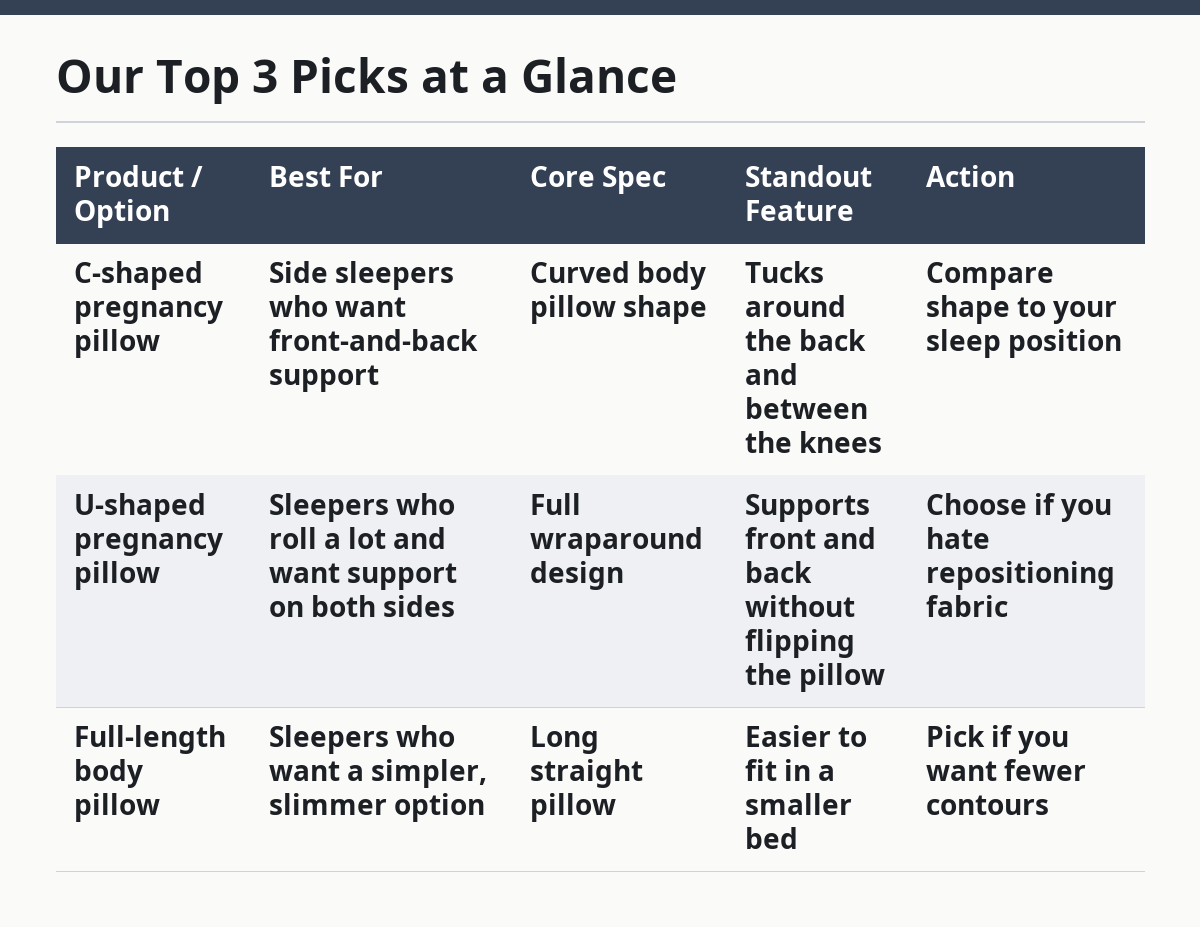
Our Top 3 Picks at a Glance
| Product / Option | Best For | Core Spec | Standout Feature | Action |
|---|---|---|---|---|
| C-shaped pregnancy pillow | Side sleepers who want front-and-back support | Curved body pillow shape | Tucks around the back and between the knees | Compare shape to your sleep position |
| U-shaped pregnancy pillow | Sleepers who roll a lot and want support on both sides | Full wraparound design | Supports front and back without flipping the pillow | Choose if you hate repositioning fabric |
| Full-length body pillow | Sleepers who want a simpler, slimmer option | Long straight pillow | Easier to fit in a smaller bed | Pick if you want fewer contours |
A quick note on the research behind this topic: 20 PubMed records match this query for 2016–2026; the 20 most relevant were read and every median, range and share below is computed across those records. The median publication year was 2022. Of those 20 records, 5 (25%) were tagged Review by the NLM.
Which shape matches your sleep position?
Picture this: you’re trying to stay on your side, but your knees drift apart, your shoulder drops forward, and the pillow slips out of place by 2 a.m. The right pregnancy body pillow shape can reduce the parts of sleep that keep breaking down.
The best match is the shape that supports your body without forcing a new sleep habit. Side sleepers usually want a pillow that sits between the knees and also fills the gap under the belly or along the back. A straight pillow is simpler. A curved one gives more contact. The wrong shape can make turning harder, not easier.
- Sleep on your side first. Hold a pillow-length shape against your front and check that it reaches from chest to knees; if it ends mid-thigh, it may leave the belly unsupported.
- Measure your bed width. A u-shaped pregnancy pillow takes more room than a straight one; if the mattress feels crowded now, a full wraparound shape can become a nuisance.
- Check your turning pattern. If you change sides often, a u-shaped pregnancy pillow keeps support on both sides; if you stay mostly on one side, a c-shaped pregnancy pillow is usually less bulky.
- Match the pillow to your knees. Your knees should rest on the fill, not hang off the edge; if your top leg still twists forward, the pillow is too short or too thin.
- Test belly fill. The front curve should meet the underside of the belly or upper torso without pushing it upward; if it feels like a bolster, the shape is too high.
- Check shoulder space. A pillow that crowds the shoulder can tighten the chest and neck; if your top shoulder feels rolled forward, the contour is wrong for your frame.
- Confirm easy exits. You should be able to slide a leg out in one motion; if getting out of bed takes a wrestling match, the pillow is working against repositioning.
On the flip side, a full-length body pillow gives a cleaner setup for people who want one long cushion to hug and knead into place. It’s not as built-in as a wraparound design. Big difference.
How do u-shaped, c-shaped, and full-length pillows differ?
Picture this: you know you want support, but the shapes all look similar in photos. The real difference is how much of your body the pillow holds at once and how much room it steals from the bed.
A u-shaped pregnancy pillow wraps both sides of your body and usually helps if you switch sides during the night. A c-shaped pregnancy pillow curves around the front and back but leaves one side more open, so it feels lighter. A full-length body pillow is the least structured and the easiest to move.
- U-shaped pregnancy pillow: good if you want continuous support and hate rearranging cushions.
- C-shaped pregnancy pillow: good if you want support for the head, belly, knees, and back without a full wrap.
- Full-length body pillow: good if you want a simpler shape that still gives knee and hip support.
The truth is, shape changes how much effort sleep takes. A wraparound pillow reduces the need to rebuild your position after every turn, but it can make your bed feel crowded. A straight pillow gives more freedom, but you may end up re-aiming it all night.
What should you look for in fill, length, and firmness?
Picture this: two pillows have the same shape, but one collapses under your knee and the other holds its line all night. Fill material, length, and firmness decide whether the shape actually works.
Memory foam usually keeps a firmer, more molded feel. Polyfill tends to feel softer and easier to squash into place. Neither is automatically better. What matters is whether the pillow keeps contact without becoming a hard ridge or a flat pancake.
- Memory foam: pick this if you want steadier support and less shape loss.
- Polyfill: pick this if you want a softer pillow that moves more easily with your body.
- Longer body: better if you’re taller or want support from shoulder to ankle.
- Shorter body: better if you need a smaller footprint in bed.
- Medium firmness: often the safer starting point if you are unsure.
A pillow that is too firm can press into the ribs or hips. A pillow that is too soft can sink away from the knees by morning. For pregnancy sleep support, the goal is not a plush cloud. It’s steady contact. That’s why a lot of buyers do better with a pillow that feels firm enough to hold position but not so stiff that it fights movement.
What if you sleep on one side most nights?
Picture this: you already know your go-to sleep side, and you want the least fussy setup possible. If that sounds like you, choose the shape that props the knees and belly without asking you to manage extra bulk.
A side sleeper usually does best with a c-shaped pregnancy pillow or a full-length body pillow if space is tight. The c-shape helps keep the top leg from sliding forward and gives the belly somewhere to rest. The full-length option is easier to tuck and lift.
What is the best shape of pregnancy pillow for side sleeping?
The best shape for side sleeping is usually a c-shaped pregnancy pillow or a u-shaped pregnancy pillow, depending on how much wrap you want. A c-shape gives support with less bulk, while a u-shape holds both sides and can reduce pillow shuffling. If you sleep light or wake often when turning, the u-shape may feel more stable. If you hate being boxed in, the c-shape is usually the cleaner fit.
A side sleeper should also think about how the pillow changes turning. A bulky wraparound pillow can make you feel “caught” when you roll over. A straight pillow can be easier to lift and rotate. That trade-off matters more than the marketing photo.
- Pick a c-shaped pregnancy pillow if you want one side open.
- Pick a u-shaped pregnancy pillow if you want support after every turn.
- Pick a full-length body pillow if you want the simplest setup.
How firm should a pregnancy body pillow be?
Picture this: the pillow feels great for ten minutes, then your knee sinks through it and your back starts doing the work. That usually means the fill is too soft for the way you sleep.
A good pregnancy body pillow is firm enough to hold your leg and belly in place, but not so hard that it creates pressure points. In plain terms, it should support the body shape you want to keep for several hours. Memory foam tends to run firmer. Polyfill tends to soften faster and needs more fluffing.
How firm should a pregnancy body pillow be?
The right firmness is the one that keeps the pillow from collapsing under your knee, belly, or back while still letting you settle in. A medium-to-firm feel often works best for support, but the feel should match your body weight and sleep position. If the pillow flattens quickly, it’s too soft. If it pushes your shoulder or hip off the mattress, it’s too firm.
Firmness also affects how much effort it takes to turn over. Softer fill is easier to fold and move, which helps some sleepers. Firmer fill holds its place better, which helps others. There’s no universal winner. The better choice is the one that supports without making you fight it.
When should you skip a wraparound pillow?
Picture this: you want the biggest pillow on the shelf, but your bed is small, your shoulders feel crowded, or you only need support at the knees. In those cases, the largest shape is often the wrong tool.
A very narrow bed: a u-shaped pregnancy pillow can take over the mattress — choose a full-length body pillow instead.
You turn often at night: a bulky wraparound design can make repositioning slower — try a c-shaped pregnancy pillow.
You want minimal heat and bulk: more fabric means more coverage around the body — a straight pillow is usually easier to live with.
You only need knee support: a full wraparound design is more pillow than you need — a full-length body pillow is the simpler fit.
You dislike trapped-feeling sleep: some sleepers feel boxed in by a U-shape — a c-shape leaves more room to move.
Your main issue is firmness, not shape: shape alone won’t fix a pillow that collapses — look harder at memory foam versus polyfill.
You do not need the biggest pillow to get useful support. A smaller, better-shaped pillow is often the one that stays in the bedroom longer.
What mistakes do people make when buying one?
Picture this: you order the prettiest pillow, then spend a week folding it, fighting it, and trying to make it behave. Most bad buys come from mismatching shape to sleep habit, not from a bad brand name.
- Buying the wrong length. A pillow that stops short of the knees or shoulders leaves gaps; choose a length that covers your main pressure points.
- Choosing by looks alone. A curved pillow can look cozy and still feel clumsy in bed; check the shape against your turning habit.
- Ignoring fill. Soft polyfill can flatten faster, while firmer memory foam can feel stiff; pick the feel that fits your body.
- Forgetting bed space. A U-shape can crowd a partner or wall; measure the mattress before you buy.
- Assuming one pillow works for every trimester. Body shape changes, and so does support need; what feels fine early on may feel awkward later.
- Expecting shape to solve everything. A pillow can support sleep posture, but it won’t fix every discomfort on its own.
You can also use the pregnancy pillows and support gear — The Complete Guide hub to compare support goals before you buy. That broader guide is the right next stop if you still need help matching a sleep problem to a pillow style.
How do you choose the right one in three minutes?
Picture this: you’re standing in front of a product page and want a clean answer, not a whole shopping spiral. A quick check of position, fill, and space can narrow the field fast.
Because of that, name your sleep position first. Side sleeper, almost always side, or frequent turner. Next, decide how much of the body you want supported. Then check whether you want the pillow to hold its shape or bend easily. Those three answers usually point to one shape.
- Name your sleep position. Side sleepers usually start with a c-shaped pregnancy pillow or u-shaped pregnancy pillow; if you stay mostly still, a full-length pillow may be enough.
- Measure the bed. If the mattress is crowded now, rule out the bulkiest option first.
- Choose the fill. Pick memory foam for steadier support or polyfill for softer, more flexible support.
- Check the length. A longer pillow helps if your knees, hips, and shoulders all need contact.
- Match firmness to turning. If you flip often, a less rigid pillow is easier to move.
- Look at the opening or curve. The shape should leave room for your belly and knees without forcing your spine into a twist.
- Reject the mismatch. If the pillow fights your sleep position, skip it, even if the reviews sound glowing.
That is the buying rule in plain language: shape should reduce work, not add it.
What is the best shape of pregnancy pillow for side sleeping?
The best shape for side sleeping is usually a c-shaped pregnancy pillow or a u-shaped pregnancy pillow. A c-shape gives support with less bulk, while a u-shape supports both sides and can be better if you change sides during the night. If your bed is narrow, a full-length body pillow may be easier to live with.
How firm should a pregnancy body pillow be?
A pregnancy body pillow should be firm enough to hold your knees and belly in place without collapsing. Medium-to-firm support often works well, but the better choice depends on your body weight, bed space, and how often you turn. If the pillow sinks flat, it is too soft; if it pushes you out of position, it is too firm.
Drafted with AI; not yet reviewed by a person.
