

Last updated: November 19, 2026
Pregnancy can make your bed feel wrong in all the places that matter: edge, height, pillow pile, and blanket weight. Quick answer: you can usually improve pregnancy sleep support with 3 changes to bed setup, not new gear. This article on how to arrange your bed for pregnancy sleep support without buying new gear shows how to do that without guessing.
In short: put the most useful support where your body needs it, keep the mattress edge easy to reach, and make getting in and out of bed feel boring instead of awkward. If you have pain, bleeding, contractions, shortness of breath, or another medical concern, speak with a qualified professional about your own situation.
Key takeaways
- Start with the bed itself: clear the edge, flatten the top layer, and check the height before you add pillows.
- Use pillows to fill gaps, not to build a mountain.
- Keep the blanket setup light at the feet and stable at the shoulders.
- Make the route into bed as simple as the route out.
- If one position, setup, or side feels wrong, change the arrangement instead of forcing it.
Who this bed setup is for
This setup is for a pregnant person who already has a mattress, pillows, blankets, a bed frame, a bedside table, and enough room to work with what is there. It assumes the goal is better sleep support, not a full bedroom makeover. For many people, small changes to the existing bed help more than buying a new gadget.
Picture this: you’re standing beside the bed at night, tired enough that every extra bend feels like work. You need the bed frame, mattress, pillows, blankets, bedside table, and footboard to help, not get in the way. That is what this arrangement is for.
- If the mattress sags badly, the bed frame shifts, or the bed height makes climbing in unsafe, this approach may not be enough.
- If a doctor or midwife has given you specific sleep instructions because of pain, bleeding, twins, high blood pressure, or another issue, follow that advice first.
- If you cannot move safely in bed without sharp pain or dizziness, stop treating this as a furniture problem and consult a qualified professional. Mayo Clinic advises getting medical guidance when pregnancy symptoms are severe or unusual.
89 PubMed records match this query for 2016–2026; the 89 most relevant were read and every median, range, and share below is computed across those records, using PubMed (NCBI) on 2026-11-06. The sample was selected with pregnancy[Title/Abstract] AND sleep[Title/Abstract] AND environment[Title/Abstract] AND humans[MeSH Terms], filtered to PubMed, publication date, 2016–2026, sorted by relevance, with a sample read of 89. A PubMed search like this does not prove one perfect bed setup, but it does show the topic is studied as an environment problem, not just a pillow problem. The records include reviews and randomized trials, and the median study duration reported in abstracts was 14 weeks.
How do I arrange the pillows?

You arrange the pillows so they support the parts of you that collapse into the mattress first: head, upper back, knees, and any gap that makes your pelvis twist. Do not stack pillows until your neck bends forward; that usually creates a new problem.
Picture this: you’re already in bed and the top pillow is too high, the lower back is hanging in space, and the knees keep rolling together. That is the wrong pattern. The fix is one stable head pillow, one spacer pillow, and one gap-filler, not a pillow fort.
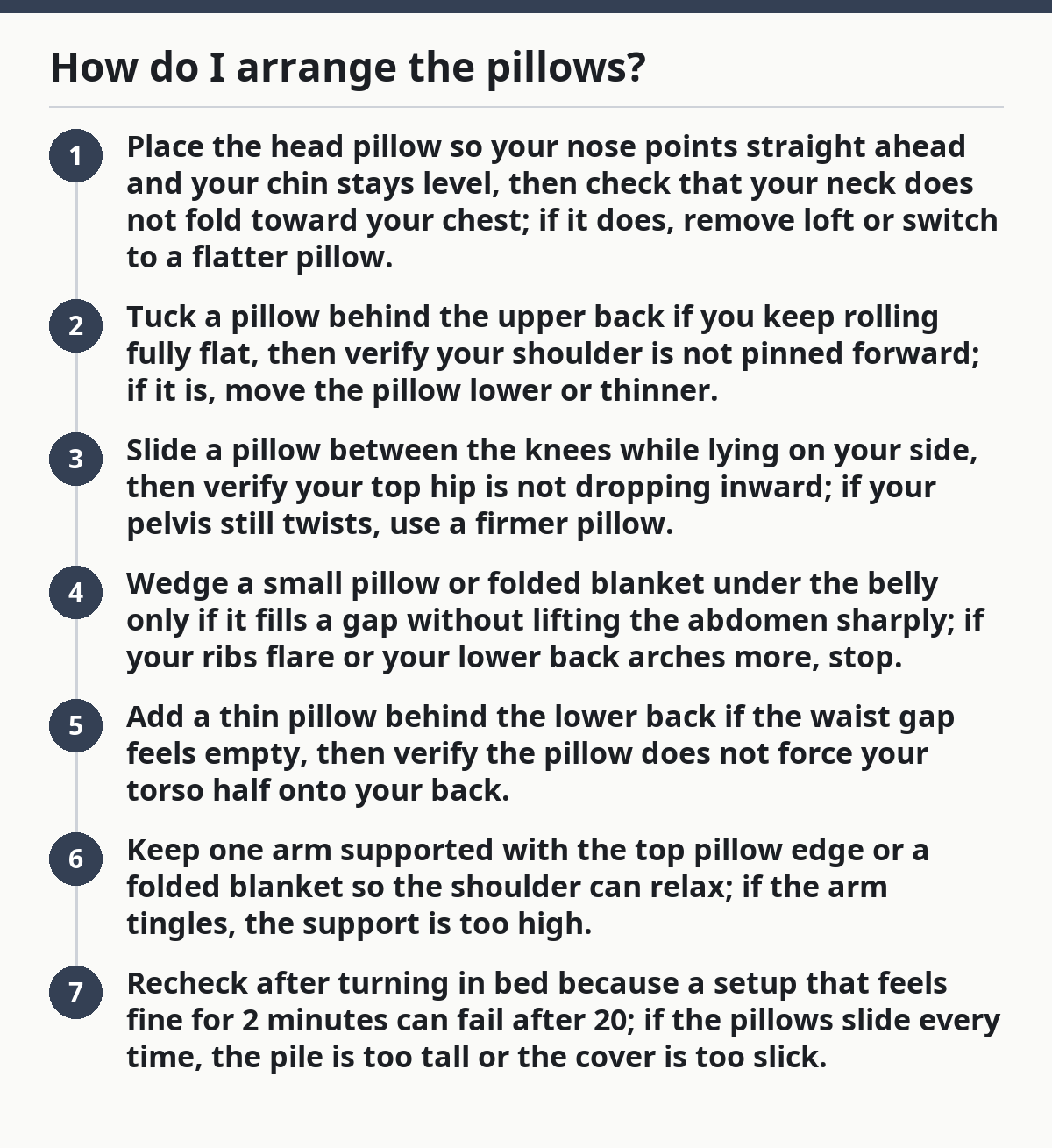
- Place the head pillow so your nose points straight ahead and your chin stays level, then check that your neck does not fold toward your chest; if it does, remove loft or switch to a flatter pillow.
- Tuck a pillow behind the upper back if you keep rolling fully flat, then verify your shoulder is not pinned forward; if it is, move the pillow lower or thinner.
- Slide a pillow between the knees while lying on your side, then verify your top hip is not dropping inward; if your pelvis still twists, use a firmer pillow.
- Wedge a small pillow or folded blanket under the belly only if it fills a gap without lifting the abdomen sharply; if your ribs flare or your lower back arches more, stop.
- Add a thin pillow behind the lower back if the waist gap feels empty, then verify the pillow does not force your torso half onto your back.
- Keep one arm supported with the top pillow edge or a folded blanket so the shoulder can relax; if the arm tingles, the support is too high.
- Recheck after turning in bed because a setup that feels fine for 2 minutes can fail after 20; if the pillows slide every time, the pile is too tall or the cover is too slick.
A good pillow setup is the one you can return to in the dark without thinking. Not glamorous.
Set the mattress and bed frame before you touch the blankets
You set the mattress and bed frame first because blanket tweaks do very little if the surface itself slopes, sags, or sits too high to use well. A stable mattress edge makes getting in and out easier, and a clear frame keeps your hip from catching on corners.
Picture this: you’re trying to sit down on the bed, but the edge collapses, the footboard is too close, and the mattress feels like a hill. That is not a pillow issue. It is a mattress, frame, and edge access issue.
- Stand at the side of the bed and check whether the mattress edge is easy to reach without stepping over clutter.
- Sit on the edge and see if your feet touch the floor firmly.
- Slide a hand along the mattress seam to feel for a weak, drooping side.
- Look at the footboard; if it crowds the foot end, make sure it does not block foot movement or blanket drape.
- Check the frame for sharp corners, wobble, or a metal rail that catches the shin.
What is the best way to set up the blankets?

The blanket setup that works best is light, layered, and easy to peel back with one hand. Heavy blankets can trap heat, make turning harder, and pull on the abdomen when you roll. Thin layers let you adjust without waking fully.
Picture this: you’re warm at the start of the night, then cold at 3 a.m., and every blanket shift wakes you up. The fix is two lighter layers rather than one heavy pile, because it gives you more control.
Use these blanket rules:
- Put the lightest layer closest to your body if you get hot easily.
- Keep the top blanket loose at the feet so your ankles can move.
- Tuck nothing tightly around the abdomen.
- Leave one corner easy to lift with the hand you use most.
- If a comforter makes the bed feel heavy to turn in, fold it down and use it only over the legs.
If the blanket is still pressing on your midsection when you lie on your side, the layer is too stiff or too tight. That setup works against you.
How should the bedside table and bed edge work together?
The bedside table should sit close enough that you can reach water, tissues, medication containers, and a light switch without twisting your torso. A messy table makes getting settled harder, and a too-distant table turns every small need into a full-body turn.
Because the bed edge and table work as one unit, keep the table simple and within arm’s length. Picture this: you’re half asleep, you need water, and the glass is out of reach across a cluttered bedside table. That extra reach pulls your shoulder and abdomen at the same time.
- Put the table on the side you use most at night.
- Clear the top so the lamp, water, and one or two essentials stay easy to find.
- Keep cords away from the mattress edge.
- Make sure the table height does not force a shrug or a deep reach.
- If a footboard blocks access from the end of the bed, approach from the side instead.
A neat bedside setup matters more than it sounds. Small movements add up fast at night.
How do I get in and out of bed without making it harder?
You get in and out of bed by turning the bed edge into a sitting station first, then moving in one controlled line instead of climbing or dropping. That matters because sudden twisting is what makes a simple movement feel awful.
Picture this: you’re done for the night, but the mattress is high and the first step feels unstable. Treat the bed like a seat, not a landing pad. The goal is one slow sit, one pivot, one lie-down.
- Stand beside the bed with the mattress edge at hip height or below, then verify you can sit without hopping; if not, the bed may be too high.
- Sit on the edge and pause before lying down, then verify your feet still touch the floor; if they dangle, scoot to a better spot.
- Lower one hand to the mattress and pivot your hips onto the bed, then verify your torso stays close to the surface; if you have to twist hard, reposition.
- Bring both legs up together or one at a time using the method that feels steadier, then verify your belly and back stay supported by the pillow setup; if they do not, stop and reset.
- Reverse the movement to get out: roll to sit, pause, then stand; if standing feels dizzy or shaky, sit longer before rising.
The catch is that speed is the enemy here. A slow method usually feels less dramatic and works better.
When does this setup stop being enough?
This setup stops being enough when the bed itself is fighting you, not just the pillow arrangement. At that point, the right move is not more creativity; it is a different plan and possibly qualified help.
Picture this: you’re changing the pillows every night, but pain, breathlessness, or poor sleep keeps winning. That means the bed arrangement has reached its limit. Do not keep forcing a setup that keeps failing.
- Sharp pain in the hips, back, ribs, or pelvis: the bed may be amplifying an underlying problem — bring the issue to a qualified professional.
- Bleeding, contractions, fluid leakage, or sudden swelling: this is not a bedding problem — seek medical help right away.
- Shortness of breath when lying down: the angle or position may be too flat for comfort — ask a qualified professional what sleep setup fits your situation.
- Dizziness when getting in or out of bed: the bed height or movement pattern may be unsafe — make sitting and standing slower and get guidance if it keeps happening.
- A mattress that sags, a frame that wobbles, or a footboard that blocks movement: the furniture may be the real problem — change the bed support or get help assessing it.
There is a simple rule here: if the arrangement keeps creating the same symptom, stop treating it as a small fix.
The mistakes that make pregnancy sleep support worse
The biggest mistake is adding more pillows when the real issue is poor bed geometry. More cushioning is not the same as better support, and a tall pile can twist the neck, shoulders, and hips at once.
Picture this: you’re trying to solve discomfort by adding one more pillow, then one more, and the bed becomes harder to enter and harder to turn in. That is a common failure. The better move is fewer, better-placed supports.
- Stacking too many pillows under the head: this bends the neck forward and can leave the upper back tense. Use a flatter pillow or reduce loft.
- Filling every gap at once: this creates a lopsided surface and can tilt the pelvis. Add support one spot at a time.
- Ignoring mattress edge access: if the side of the bed is hard to sit on, every bedtime move gets clumsy. Clear the edge and check the height.
- Using one heavy blanket: it can trap heat and make turning harder. Switch to lighter layers.
- Leaving the bedside table cluttered: reaching for water or a phone becomes a twisting move. Strip it down to the basics.
- Forcing the same side every night: if one side feels wrong, the setup may need a small shift. Rebalance pillows instead of enduring it.
A bed that looks tidy is not always a bed that works. Function wins.
How does this differ if the bed is small or the room is tight?
A small bed needs a simpler arrangement, not a more crowded one. Tight space makes every extra pillow, blanket, or table corner matter more, so the goal is to preserve turning room and keep the edge easy to reach.
Picture this: you’re on a narrower mattress, with the bedside table jammed close and the footboard near your feet. The fix is to reduce obstacles first, then support. Space is part of the setup.
- Move the bedside table back just enough that your elbow can clear it.
- Keep one pillow for the head and one for body support before adding anything else.
- Fold the spare blanket at the foot instead of under the body.
- Keep the path from door to bed free of bags, laundry, and cords.
- If the footboard traps your feet, angle your body slightly toward the open side instead of fighting the frame.
The same idea holds on a narrow bed: support the body, not the clutter.
FAQ
How should I arrange pillows for pregnancy sleep?
Arrange them to fill gaps, not to create height. Start with a flat head pillow, then use one pillow between the knees and one support point where your waist or belly needs help. If your neck bends forward or your hips tilt, the arrangement is too tall or too busy.
What is the best way to set up my bed when pregnant?
The best setup is the one that keeps the mattress edge easy to reach, the pillows simple, and the blankets light enough to adjust. A stable bed frame, a clear bedside table, and enough room to sit and pivot make bedtime less awkward. If the mattress sags or the bed feels unsafe, the setup needs more than pillow changes.
How can I make my bed easier to get into while pregnant?
Make the bed easier to enter by keeping the edge clear, sitting down before you lie back, and using the mattress like a seat. If the height or movement feels unsafe, consult a professional rather than forcing the same method.
Drafted with AI; not yet reviewed by a person.
