
Last updated: November 19, 2026
Quick answer: choose a sleep mask with a soft, adjustable strap, enough room over the eyes, and fabric that does not trap heat. For many people, the right pregnancy sleep mask is one that blocks light in under 1 minute to put on, stays comfortable for a 20- to 90-minute nap, and does not press on the eyelids. If you have eye pain, headaches, or a sleep issue that feels bigger than light sensitivity, speak with a qualified professional about your situation. This guide helps you compare mask types for naps, travel, and night use.
Key Takeaways
- Choose a mask that blocks light without touching your eyes too hard, and favor an adjustable elastic strap if pregnancy makes your face more sensitive.
- The key features are soft contact, low pressure, and a fit that can change as your face and sleep habits change.
- The right shape depends on whether pressure, heat, or light leakage is the main problem.
- Fit it snugly enough to block light, but loose enough that you forget it is there within a few minutes.
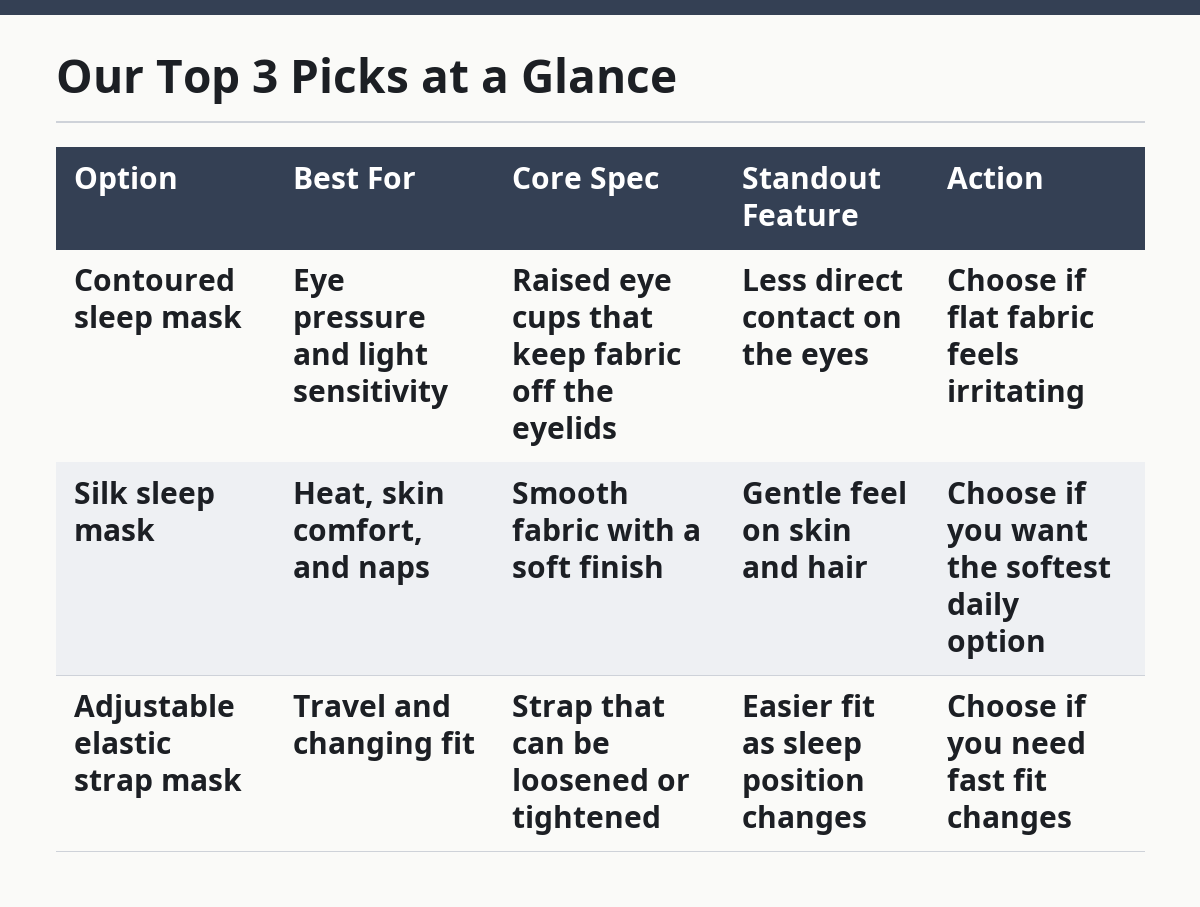
Our Top 3 Picks at a Glance
| Option | Best For | Core Spec | Standout Feature | Action |
|---|---|---|---|---|
| Contoured sleep mask | Eye pressure and light sensitivity | Raised eye cups that keep fabric off the eyelids | Less direct contact on the eyes | Choose if flat fabric feels irritating |
| Silk sleep mask | Heat, skin comfort, and naps | Smooth fabric with a soft finish | Gentle feel on skin and hair | Choose if you want the softest daily option |
| Adjustable elastic strap mask | Travel and changing fit | Strap that can be loosened or tightened | Easier fit as sleep position changes | Choose if you need fast fit changes |
How to choose a pregnancy sleep mask for light sensitivity and naps
Choose a mask that blocks light without pressing on your eyes, and prioritize an adjustable elastic strap if your face feels more sensitive during pregnancy. A good sleep mask should feel like a dim room, not a bandage. That means soft edges, enough space over the lashes, and fabric that stays comfortable for a 20- to 90-minute nap or a full night.
According to the American Academy of Ophthalmology, a well-fitting mask should avoid direct pressure on the eyes. That matters here because pregnancy can make pressure feel sharper, even when the mask itself seems small.
Picture this: you’re lying down for a 30-minute nap and the room still feels too bright, but anything tight around your face makes you notice it even more. The right pregnancy sleep mask solves the light problem without turning into a new annoyance.
Here’s the catch: the “best” mask changes with your face shape, swelling, and sleep position. A flat cotton mask may work at first and then start pressing on the bridge of your nose by the second trimester.
A few real things matter most:
- Light blocking: The mask should seal around the nose and cheeks well enough that a lamp or daylight does not leak in at the edges.
- Pressure: The center should not sit hard on the eyelids or lash line.
- Strap fit: The strap should stay put without tugging hair or sliding up during side sleeping.
- Breathability: Pregnancy can make you run hotter, so a mask that traps heat is a poor fit for naps.
- Ease of cleaning: A mask you can wash without much fuss gets used more often.
The best part is that you do not need a bulky product to get real relief. You need the right shape.
What features matter most in a pregnancy sleep mask?
The right features are soft contact, low pressure, and a fit that can change as your face and sleep habits change. A mask that is perfect on day one can become irritating later if the strap is fixed or the eye cups are shallow.
Picture this: you wake up from a nap with red marks across your nose and a crease on your face. That is usually a fit problem, not a sign that the mask is “working.”
Look for these features first:
-
Contoured eye space
- This means the mask has raised cups or a molded center that sits away from the eyelids.
- Verify that your lashes do not brush the fabric when you blink.
- A problem shows up as eye pressure, smudged mascara, or a feeling that the mask is “on” your eyes instead of over them.
-
Soft edge binding
- Edges should be smooth, not stiff or thick.
- Verify that the seam does not dig into your temples after 10 to 15 minutes.
- If the edge leaves a line on your skin, it may become annoying on longer nights.
-
Adjustable strap
- An adjustable elastic strap helps when swelling changes the fit.
- Verify that you can tighten it enough to stay in place but still slide one finger under it.
- If you have to pull it so tight that it shifts your hairline or gives you a headache, skip that model.
-
Nose bridge shape
- A molded or flexible nose bridge can block light better than a flat strip.
- Verify that light does not leak from the center when you lie on your back or side.
- If the bridge feels rigid, it can press uncomfortably across the nose.
-
Breathable fabric
- A silk sleep mask or similarly smooth fabric often feels cooler than thick foam.
- Verify that your skin does not feel damp after a short nap.
- If the mask feels warm before you even fall asleep, it may be too heavy for pregnancy use.
-
Washable construction
- Masks that can be hand-washed or machine-washed on a gentle cycle are easier to keep in rotation.
- Verify the care tag before buying.
- If the cleaning instructions are fussy enough that you would avoid washing it, move on.
The truth is, one feature can hide a flaw in another. Strong blackout is nice, but not if the mask presses on your eyes.
Which mask shape works best: flat, contoured, or silk?
The right shape depends on whether your bigger problem is pressure, heat, or simple light leakage. Flat masks block light well for some faces, but contoured masks usually win when eye pressure is the complaint.
Picture this: you are trying to fall asleep in the middle of the day, and the mask either sits too close to your lashes or floats just far enough away to let in a stripe of light. Shape decides the result.
- Flat mask: Best if you want the lightest feel and your face tolerates direct contact well.
- Contoured mask: Best if your eyelids feel sensitive or you dislike fabric touching your lashes.
- Silk mask: Best if skin comfort and temperature matter more than maximum structure.
A contoured mask is often the strongest choice for pregnancy because swelling, congestion, and side sleeping can make contact points feel sharper. The drawback is that some contoured models feel bulky or shift if the nose bridge is poorly shaped.
A silk mask is easy on skin and often pleasant for naps. The trade-off is that silk by itself does not guarantee better blackout, and a loose silk mask can let in light around the nose or cheeks.
Flat masks are simple and often compact for travel. The drawback is direct contact, which can feel like too much when your eyes are already sensitive.
Who Should Skip This: skip a flat, unstructured mask if your main problem is eye pressure or lashes touching fabric. A contoured sleep mask is usually the better fit.
How should you fit a sleep mask for naps and nighttime?
Fit it snug enough to block light, but loose enough that you forget it is there within a few minutes. For many people, that means adjusting the strap so it sits steady during a 20- to 40-minute nap and does not slide if you roll onto your side.
Picture this: you are half awake, trying to rest, and every small shift of the strap pulls you back out of sleep. A poor fit can matter more than the mask material.
Use this simple check:
-
Put the mask on in the position you sleep in most.
- If you usually nap on your side, test it that way.
- Verify the mask stays centered when your head turns.
- A problem is movement that exposes light at the nose.
-
Adjust the strap gradually.
- Tighten in small steps, not all at once.
- Verify the mask stays in place without leaving a deep mark after 10 minutes.
- A problem is any pulsing pressure on the temples.
-
Check the nose seal.
- Look for light leaking around the bridge.
- Verify no bright line shows when the room light is on.
- A problem is a gap that looks small but wakes you up later.
-
Blink and relax your face.
- The eye cups should not rub your eyelids.
- Verify that your eyes can open and close without touching the fabric.
- A problem is a scratchy, fluttery feeling over the lashes.
-
Lie still for a few minutes.
- Do not judge fit standing up.
- Verify the mask does not creep up as you settle in.
- A problem is a strap that slowly slides no matter how you adjust it.
-
Recheck after a nap, not only before it.
- Pregnancy fit can change with swelling later in the day.
- Verify the same mask still feels okay after a full rest period.
- A problem is a mask that feels fine at noon and tight by evening.
-
Test it with your usual pillow setup.
- Head position changes how a mask seals.
- Verify the mask still blocks light when your face sinks into the pillow.
- A problem is leakage that only happens in real sleep, not during a quick fit check.
If the strap adjustment keeps failing, choose a model with a wider band or a more flexible closure. That small detail often makes the difference between a useful mask and a drawer item.
When is a sleep mask the wrong choice?
A sleep mask is the wrong tool when pressure, pain, or skin irritation becomes the main problem instead of light. In those cases, the mask is not solving the real issue.
Picture this: you put on a mask to help you rest, and within minutes you notice eye ache, headache, or skin burning. That is a stop sign, not something to push through.
Eye pain or pressure: this can mean the mask is pressing on the eyes or the brow — switch to a contoured mask or stop using it if the discomfort continues.
Headaches that start with the mask: tight straps can irritate the temples and scalp — loosen the fit or choose a wider strap.
Skin irritation or rash: fabric, dye, detergent residue, or friction may be the cause — try a different material and stop if the skin reacts again.
Mask slips every time you side sleep: the shape is wrong for your sleep position — pick a contoured model with a better nose bridge.
Light still gets through after careful fitting: the mask is too shallow or too small for your face — move to a different design rather than tightening more.
You wake more often because the mask feels hot: trapped heat can defeat the point of rest — switch to a lighter, more breathable fabric such as silk.
If your sleep trouble is tied to eye symptoms, migraine patterns, or another health concern, speak with a qualified professional about your situation. A mask can reduce light, but it cannot sort out the cause of pain.
What mistakes do people make with pregnancy sleep masks?
The biggest mistakes are choosing for blackout alone, tightening too much, and ignoring how pregnancy changes fit. Those choices turn a simple sleep aid into a source of discomfort.
Picture this: a mask looks perfect online, but after three nights it leaves a mark, traps heat, and slides off during naps. The problem was not the idea of a mask. The problem was the wrong spec.
Common errors:
- Buying a very firm blackout mask first
- Consequence: strong light blocking, but more pressure on the face.
-
Better alternative: choose a contoured or lightly cushioned mask if pressure is the issue.
-
Choosing a fixed strap
- Consequence: the fit stops working as swelling changes.
-
Better alternative: choose an adjustable elastic strap with a soft, wide band.
-
Ignoring the nose bridge
- Consequence: light leaks in and you keep tightening the strap.
-
Better alternative: pick a model with a shaped or flexible bridge.
-
Picking a warm, thick material for daytime naps
- Consequence: the mask feels sweaty and distracting.
-
Better alternative: use a breathable fabric, especially for short naps.
-
Treating one mask like it should do everything
- Consequence: travel, home naps, and overnight sleep each expose different flaws.
-
Better alternative: keep a main nighttime mask and a lighter travel backup if needed.
-
Skipping the real sleep position test
- Consequence: the mask seems fine in the mirror and fails on the pillow.
- Better alternative: try it lying down in the position you actually use.
A simple mask should reduce friction, not create more of it. If you need to force it into place, it is the wrong one.
How do you pick one for travel, naps, and night use?
Pick one by matching the shape to the use case, not by chasing the most padded option. Travel, naps, and night sleep ask for slightly different things, and a single design rarely wins all three.
Picture this: on a plane or in a bright guest room, you want quick darkness without fuss. At home, you may care more about pressure and heat over a longer stretch.
- For naps: choose a light, breathable mask that is easy to put on and take off.
- For night use: choose the most comfortable option for long wear, usually contoured with a soft strap.
- For travel: choose a mask that packs flat and keeps its shape in a bag.
If your naps are short, a silk sleep mask can be enough because comfort matters more than extreme blackout. If daylight is strong or you are sensitive to even small light leaks, a contoured mask usually earns its place.
Keep the backup logic simple:
- Use a silk sleep mask when softness and cool feel matter most.
- Use a contoured sleep mask when the eyelids or lashes are the sensitive part.
- Use an adjustable elastic strap when fit changes through the day.
The truth is, the best pregnancy sleep mask is the one you can wear without noticing it. If you feel the mask more than the darkness it creates, keep looking. For more fitting guidance, see our sleep position guide and travel sleep checklist.
What does a good choice feel like after a week?
A good choice feels boring in the best way: it goes on quickly, stays put, and stops drawing attention to your face. After a few days, you should notice the light less and the mask more rarely.
That usually means the fit is stable across several uses, not just one good test. If the mask still feels fine after 7 nights, 3 naps, and one travel day, that is a strong sign you picked well.
A good pregnancy sleep mask should fade into the background. It should not leave a sore spot, a hot patch, or a fight with your strap every night.
According to the National Sleep Foundation, sleep quality is often helped by reducing light and keeping the sleep setup comfortable. That is why the right mask is less about fashion and more about fit, heat, and pressure.
Drafted with AI; not yet reviewed by a person.
