
Last updated: November 19, 2026
Quick Answer: Pregnancy night waking may be linked to dehydration, overheating, or anemia; in one PubMed search, 1,022 records matched the 2016–2026 query, so a qualified clinician should still review your own pattern because the same symptom can have different causes in different pregnancies. This guide sorts the clues and shows what each pattern tends to look like.
Key Takeaways
- The pattern matters more than one wake-up.
- Dehydration may wake you with thirst or a dry mouth.
- Overheating can wake you hot, sweaty, or unable to keep blankets on.
- Pregnancy night waking could be linked to anemia when fatigue, dizziness, weakness, or breathlessness dominate.
The search method behind the PubMed figures below: 1,022 PubMed records match this query for 2016–2026; the 100 most relevant were read and every median, range, and share below is computed across those records, using the PubMed search filter described in the brief; source: PubMed (NCBI), computed on 2026-11-09.
What makes pregnancy night waking more than “just bad sleep”?
Pregnancy night waking is often more than a light sleeper’s problem, because thirst, heat, dizziness, and fatigue can cluster at night and point to a body issue, not just a bad mattress. The topic is pregnancy night waking linked to dehydration, overheating, or anemia, and the pattern matters more than the single wake-up.
PubMed records show the field is active: 1,022 PubMed records matched this query for 2016–2026, and the median publication year was 2022 in the 100 most relevant records, PubMed (NCBI). That does not diagnose you; it does tell you this is a current topic with a lot of overlap between sleep and physical symptoms, and a qualified professional can help interpret your own pattern.
Here’s the catch: a night waking pattern can be ordinary one night and meaningful the next. A dry mouth after a salty dinner is one thing. Waking again and again with a pounding heart, feeling overheated, or feeling weak when you stand is a different picture.
- Dehydration clues tend to include thirst, dry mouth, darker urine, and waking with a parched throat.
- Overheating clues often include a flushed face, sticky sheets, and waking hot even when the room is not warm.
- Anemia clues may include unusual tiredness, dizziness, shortness of breath with mild effort, or a shaky, washed-out feeling.
For general pregnancy sleep support, the hub on pregnancy sleep health signals and symptom checks is the better place to start if you want the wider map, not just this one cluster.
Why would dehydration wake you up at night?
Dehydration can wake you up at night in pregnancy because your body notices a fluid gap fast, and thirst can break sleep before you fully understand why you woke. A dry mouth, a scratchy throat, or a strong urge to drink can be the first clue.
The usual pattern is simple. You go to bed a little low on fluids, you sleep through the early part of the night, then you wake feeling dry, restless, or cramped. That does not mean every night waking is dehydration. It means nighttime thirst deserves attention when it repeats.
A few things make this pattern more likely:
- evening vomiting or reflux that makes drinking harder
- a day with poor fluid intake
- warm weather or a hot bedroom
- a lot of sweating
- frequent urination, which is common in pregnancy
One useful check is the story your body tells over 24 hours, not one minute. If you feel thirsty when you wake, your mouth feels sticky, and your urine is often dark yellow, dehydration is more plausible than a random sleep snag. If you wake up thirsty but also flushed and sweaty, overheating may be part of the same picture.
PubMed data for this topic are broad, and the sample read had a median study duration of 7 weeks across the abstract figures that stated one, PubMed (NCBI). That tells you researchers are often looking at changes over weeks, not just one night.
What does overheating look like at 2 a.m.?
Overheating can wake you at 2 a.m. because a hot room, heavy bedding, or pregnancy-related heat intolerance can push your body past its comfort point. The waking is often sudden and comes with a hot face, damp skin, or the urge to throw off blankets fast.
Picture this: you wake up sweaty, your shirt feels wet at the neck, and the room seems too warm even though it felt fine when you fell asleep. That pattern fits overheating signs more than simple insomnia. It can also overlap with dehydration, because sweating without enough fluid intake can make thirst worse.
The common clues are practical:
- your skin feels warm or flushed
- sheets feel damp
- you need to uncover quickly
- sleep gets worse in a closed, stuffy room
- you wake more often after a hot shower, heavy blankets, or a heater running all night
The truth is, overheating is easy to miss because it looks like “poor sleep.” But if the waking improves when the room is cooler, the blanket is lighter, or air moves better, heat was probably part of the problem. A 26°C room and a heavy duvet are very different from a cool, well-ventilated room with light bedding.
What are signs that pregnancy night waking could be anemia?
Pregnancy night waking could be linked to anemia when sleep is interrupted by fatigue patterns, dizziness, weakness, or breathlessness rather than thirst or heat alone. Anemia means the blood does not carry as much oxygen as the body needs, and the tiredness can show up as poor sleep or frequent waking.
The clue is often the daytime story. You feel wiped out by routine tasks, your legs feel heavy, stairs feel harder than usual, or you get dizzy when you stand up too fast. Night waking may be part of the same picture, especially if the sleep issue comes with a washed-out feeling instead of a hot or thirsty one.
Common clues people notice:
- fatigue that feels out of proportion
- lightheadedness or dizziness
- shortness of breath with mild effort
- paleness
- a racing heart
- feeling weak after standing
PubMed’s mix of article types shows this is still an active evidence area: of the 100 most relevant records, 31 were tagged Review, 16 were tagged Systematic Review, and 6 were tagged Meta-Analysis, PubMed (NCBI). That matters because reviews often summarize patterns rather than offering one simple answer.
Anemia is not something to guess from sleep alone. Night waking plus tiredness can come from pregnancy itself, poor sleep, dehydration, or heat. The pattern becomes more suggestive when the tiredness is persistent and the dizziness keeps showing up.
How do I tell dehydration, overheating, and anemia apart?
You tell them apart by the main feeling on waking, the daytime pattern, and the trigger that seems most tied to the wake-up. One clue is rarely enough on its own.
A quick way to sort the pattern is to ask three questions:
- Do you wake thirsty or dry?
- Do you wake hot or sweaty?
- Do you wake weak, dizzy, or unusually tired?
If thirst is the loudest clue, dehydration moves up the list. If heat and sweat dominate, overheating moves up. If fatigue and dizziness dominate, anemia becomes more likely to be part of the picture.
Use this simple comparison, but consult a qualified professional if the pattern keeps repeating or you feel unwell:
| Main clue at night | More likely pattern | What else often shows up |
|---|---|---|
| Dry mouth, strong thirst | Dehydration | Dark urine, cramps, headache |
| Sweating, flushed skin, blanket feels unbearable | Overheating | Restless sleep, frequent uncovering |
| Weakness, dizziness, pounding heart, heavy fatigue | Anemia | Breathlessness, pale skin |
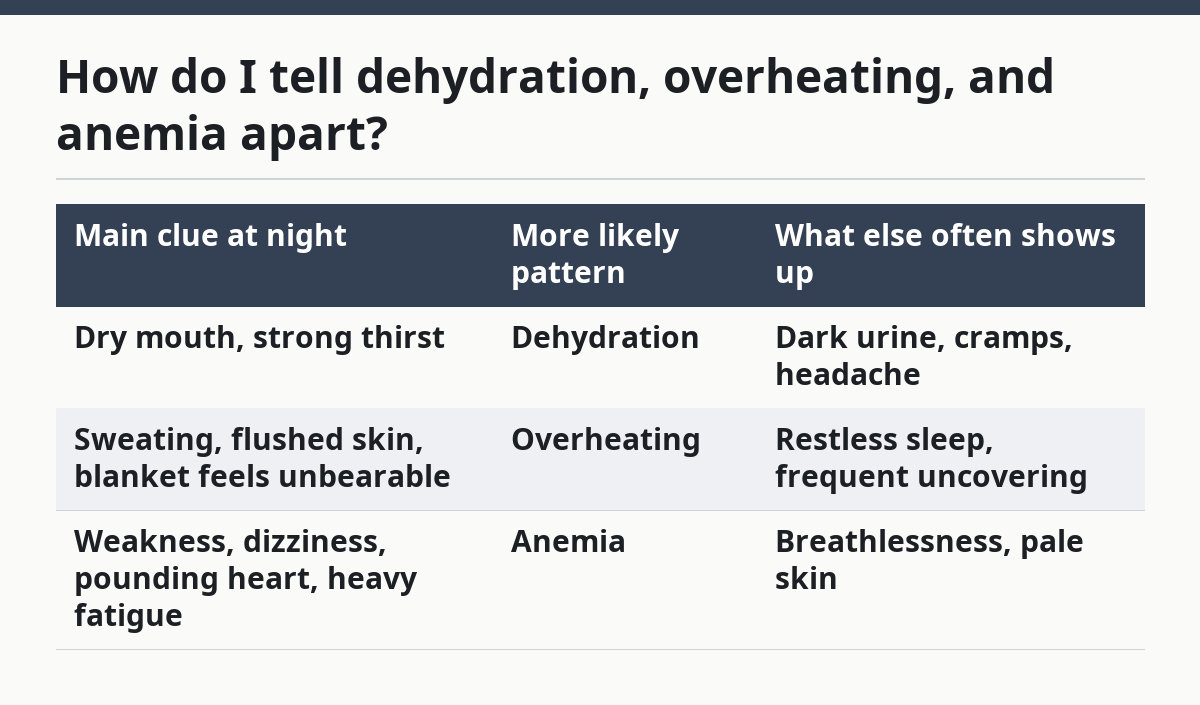
The point is not to self-diagnose from a table; a clinician can help confirm the cause. The point is to stop treating every wake-up as the same thing. A pattern that repeats for 3 nights in a row with the same clue is more useful than a single bad night.
What should you check before you assume it’s sleep trouble?
You should check the room, the day, and the body pattern before you call it “just pregnancy sleep.” Small details often explain the wake-up better than a long list of vague symptoms.
Start with the room:
- Is the bedroom warm or stuffy?
- Are the blankets too heavy?
- Did you go to bed after a hot bath or shower?
- Is there dry air from heating?
Then check the day:
- Did you drink enough fluids?
- Did you vomit, sweat, or spend time in heat?
- Did you feel tired or dizzy before bed?
Then check the pattern:
- Do you wake once or many times?
- Do you wake at the same hour?
- Is thirst, heat, or weakness the strongest symptom?
- Does sitting up, cooling down, or drinking water change anything?
A basic paper log for 3 to 5 nights can help you spot the pattern. Write the wake time, the room temperature if you know it, the main symptom, and whether you felt thirsty, hot, or weak. That kind of record is far more useful than a vague memory after a long night.
When does this pattern need qualified help?
This pattern needs qualified help when the waking is paired with symptoms that point beyond ordinary sleep disruption, because the same symptom can mean different things in pregnancy. I can’t diagnose your cause here, and you should speak to a qualified professional about your own situation.
Waking with chest pain or shortness of breath: This is not a normal “sleep issue” pattern — get urgent medical help, because it can signal a serious problem beyond dehydration, heat, or anemia.
Fainting or near-fainting: This suggests a circulation or blood issue, not just poor sleep — seek prompt assessment.
Severe dizziness that keeps returning: This may point to anemia, dehydration, or another pregnancy issue — arrange medical review soon.
Persistent thirst plus very dark urine: This can mean the body is not keeping up with fluid needs — bring it up with a clinician, especially if vomiting is also present.
Fatigue that is new, heavy, and unrelenting: This can fit anemia but also many other conditions — ask for evaluation rather than assuming it is “normal pregnancy tiredness.”
The best part is that you do not need a perfect explanation to ask for help. You only need a pattern that keeps repeating or a symptom that feels out of line with ordinary sleep loss.
Common mistakes that blur the picture
The most common mistake is treating every wake-up as the same problem, and that hides the clue that would have made the pattern obvious. A second mistake is trying to fix thirst, heat, and anemia with the same response.
- Blaming all waking on pregnancy: That can delay noticing a fluid, heat, or blood issue. The better move is to note the strongest symptom each night.
- Drinking only after you wake: That may help one night but misses the daytime fluid pattern. The better move is to check whether the day was low on fluids in the first place.
- Ignoring room temperature: A bedroom that feels fine at 9 p.m. can feel much warmer at 2 a.m. The better move is to cool the room before sleep starts.
- Assuming fatigue means anemia: Fatigue is common in pregnancy and not specific. The better move is to look for dizziness, breathlessness, or pallor too.
- Using only one night as proof: Sleep is noisy, and one bad night can mislead you. The better move is to watch the pattern over several nights.
- Waiting for the problem to “pass”: Repeated waking with dizziness or marked weakness can deserve review. The better move is to get the pattern checked if it keeps coming back.
The article pool here also skews toward reviews, which is a clue that single-symptom explanations are often too simple. Of the 100 most relevant PubMed records, 4 were Randomized Controlled Trial, 2 were Clinical Trial, and 2 were Observational Study, PubMed (NCBI). The evidence base is not one neat answer; it is a set of overlapping clues.
What this pattern can and can’t tell you
This pattern can tell you that your sleep may be reacting to something physical, but it cannot tell you which cause is real without context. That is the limit of symptom spotting.
A useful rule is this: if the wake-up is mostly about thirst or dry mouth, look first at fluids; if it is mostly about heat and sweat, look first at the room and bedding; if it is mostly about weakness, dizziness, or heavy fatigue, think about anemia as part of the picture. If more than one clue is present, more than one cause may be involved.
What this pattern does not do:
- it does not separate pregnancy-related sleep disruption from every medical cause
- it does not replace blood testing or an exam
- it does not prove that a symptom is harmless because it is common
That is why this page sits under the larger hub on pregnancy sleep health signals and symptom checks. The hub covers the broader sleep picture; this page narrows to three common physical clusters that can wake you at night.
Can dehydration wake you up at night during pregnancy?
Yes, dehydration can wake you up at night during pregnancy, especially when thirst, dry mouth, or a scratchy throat is the main clue. The wake-up often feels urgent because the body is signaling a fluid need. If the pattern repeats, it is worth mentioning to a qualified clinician, especially if vomiting, dark urine, or dizziness comes with it.
Can overheating cause you to wake up while pregnant?
Yes, overheating can cause you to wake up while pregnant, and the wake-up often comes with sweating, a flushed face, or a strong urge to uncover. A hot room, heavy bedding, or poor air flow can make this more likely. If heat seems to drive the waking, the room setup is part of the symptom, not just the sleep setting.
What are signs that pregnancy night waking could be anemia?
Pregnancy night waking could be anemia when it goes with persistent fatigue, dizziness, weakness, shortness of breath, or a racing heart. The sleep issue alone is not enough to tell.
Drafted with AI; not yet reviewed by a person.
