
Last updated: November 19, 2026
Quick answer: In 3 steps, you can improve bedroom humidity and air quality during pregnancy sleep: measure humidity, clean up dust, and use the right device for the room. In short: Balance humidity, filter particles, and cut dust at the source — that usually means a calm bedroom air setup with a humidifier, an air purifier with a HEPA filter, a thermometer, and a hygrometer. If you have asthma, allergies, preterm labor concerns, or any breathing problem, speak with a qualified professional about your own situation first. For room air guidance, see the EPA on indoor air quality and the CDC on pregnancy and breathing concerns: https://www.epa.gov/indoor-air-quality-iaq and https://www.cdc.gov/pregnancy/ .
Key Takeaways
- Better room air can make sleep feel less scratchy, less stale, and less irritating.
- Measure first, then change one thing at a time.
- A quiet humidifier and a HEPA purifier are the best room pair.
- Check moisture, placement, and cleaning before overnight use.
This guide is for the pregnant sleeper who wakes up dry, stuffy, dusty, or just uncomfortable and wants a better bedroom air setup. How to improve bedroom humidity and air quality during pregnancy sleep starts with a few numbers, not guesswork. 89 PubMed records match this topic for 2016–2026; the 89 most relevant were read and every median, range, and share below is computed across those records, using PubMed’s search and publication-type tags as recorded by the NLM, computed on 2026-11-06.
What a better bedroom air setup actually changes
Better bedroom air can make sleep feel less scratchy, less stale, and less irritating, because humidity and particle load affect how air feels as you breathe it. Studies in related areas suggest comfort often improves when dry air is reduced and airborne dust is kept down, but results vary by person and by room.
A bedroom does not need to be “clean air perfect.” It needs to be steady, low-dust, and not overly dry. That usually means the room stays near a comfortable indoor range, the filter is clean, and moisture is added only where needed.
- Humidity: use a hygrometer to see whether the room runs dry or damp.
- Particles: use a HEPA-filter air purifier if dust or indoor smoke is part of the problem.
- Temperature: use a thermometer, because air that feels dry is often also too warm.
The truth is, a room can look tidy and still irritate sleep. Fine dust sits in bedding, fan blades, vents, and carpets. Dry air can make that feel worse.
How do I make my bedroom air better during pregnancy?
You do it by measuring first, then changing one thing at a time. A small room can respond fast, so there is no need to guess for weeks. The most useful tools are a hygrometer, a thermometer, a humidifier, and an air purifier with a HEPA filter.
Start with the room, not the symptom. That is the cleaner fix.
- Put a hygrometer at bedside height. Place it away from the humidifier, window, and vent so it reads the room, not the mist. Verify that the number is stable for a few nights. A reading that jumps right after the humidifier turns on means the monitor is too close.
- Check the thermometer at the same time. Read both devices together before bed and again in the morning. A comfortable bedroom often feels better when the air is not too warm. If the room swings a lot overnight, the air system may be the real issue.
- Use a humidifier only if the room is dry. Set it so the room feels comfortable, not damp. Verify that surfaces do not feel wet by morning. If windows fog or the bedding feels clammy, the room is too moist.
- Place the humidifier across the room. Keep it off the floor and away from the bed, walls, curtains, and electronics. Verify that mist is not blowing directly onto fabric or wood. A wet patch nearby means the placement is wrong.
- Add an air purifier with a HEPA filter. Run it in the bedroom before sleep and through the night if the noise is tolerable. Verify that dust buildup on the nightstand slows down over time. If the purifier is too small for the room, it will not keep up.
- Control dust at the source. Wash bedding regularly, keep soft clutter down, and vacuum with a filtered machine. Verify that the room does not smell stale or dusty when you lie down. If dust returns the same day, the source is still active.
- Keep filters on a schedule. Check the purifier’s filter condition and replace or clean it as the maker directs. Verify that airflow stays steady and the machine is not struggling. A clogged filter can make the room air worse instead of better.
- Watch for over-humidifying. If the room begins to feel muggy, pause the humidifier and let the air dry out. Verify that condensation clears and the room feels lighter. Damp air can feed dust mites and make the bedroom less comfortable.
A good result is simple: the room feels less dry, less dusty, and easier to settle into. Not perfect. Just easier.
What kind of humidifier and purifier fit a pregnancy bedroom?
The right pair is a quiet humidifier and a HEPA air purifier sized for the room. HEPA means high-efficiency particle capture; it is the filter type commonly used to catch fine dust, pollen, and similar particles. That matters more than a fancy display.
Here is the catch: one machine cannot do both jobs well. A humidifier adds moisture. An air purifier removes particles. If you want better sleep, treat them as separate tools, and if you are unsure which one fits your symptoms, consult a qualified professional.
- Humidifier: useful when the room is dry and your nose, throat, or skin feel parched.
- Air purifier: useful when dust, pets, smoke, or outdoor pollution drift into the bedroom.
- HEPA filter: the filter term to look for when particle removal is the goal.
Studies suggest air-cleaning devices can reduce indoor particle exposure, but the exact benefit depends on room size, air leaks, and how well the device is maintained. A purifier with the wrong filter or the wrong room rating is mostly noise.
What should I check before I run a humidifier all night?
You should check moisture, placement, and cleaning before you leave a humidifier on overnight. The device itself is not the whole story; the room and the maintenance matter just as much.
A humidifier that is never cleaned can become a poor fit for a sleep space. Mineral buildup, standing water, and damp surfaces are all avoidable problems.
- Water quality: follow the maker’s guidance on tap water versus distilled water.
- Tank cleaning: empty and dry the tank as directed; never let old water sit in it.
- Distance: keep the mist away from the bed and textiles.
- Room response: watch for fogged glass, damp sheets, or a musty smell.
Who Should Skip This: if your room already feels damp, a dehumidifying fix or better ventilation is a better fit than more moisture. Buy this if: you sleep in a dry room and wake with a parched throat or dry skin. Skip this if: your windows fog in the morning or the room smells musty.
What are the mistakes people actually make?
The biggest mistake is turning humidity up without checking the room. That can leave you with a damp bedroom, and damp bedrooms invite a different set of problems. A second mistake is buying a purifier that is too small for the room.
A third mistake is forgetting the filter. A fourth is putting the humidifier too close to the bed. A fifth is assuming plants will clean the room on their own.
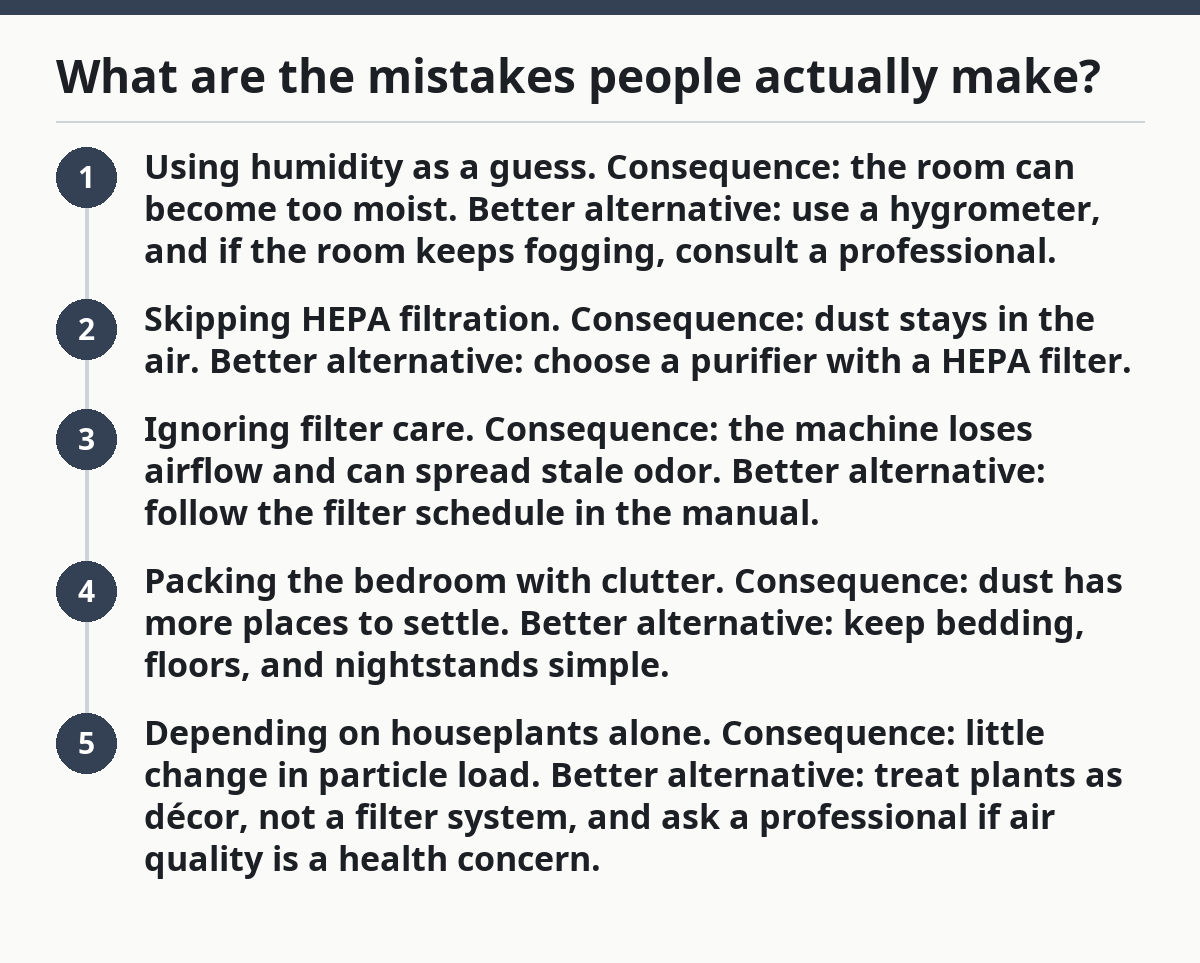
- Using humidity as a guess. Consequence: the room can become too moist. Better alternative: use a hygrometer, and if the room keeps fogging, consult a professional.
- Skipping HEPA filtration. Consequence: dust stays in the air. Better alternative: choose a purifier with a HEPA filter.
- Ignoring filter care. Consequence: the machine loses airflow and can spread stale odor. Better alternative: follow the filter schedule in the manual.
- Packing the bedroom with clutter. Consequence: dust has more places to settle. Better alternative: keep bedding, floors, and nightstands simple.
- Depending on houseplants alone. Consequence: little change in particle load. Better alternative: treat plants as décor, not a filter system, and ask a professional if air quality is a health concern.
Plants can make a room feel calmer, and some people like them near the bed. They do not replace a purifier or good cleaning.
When does the standard approach stop being the right answer?
The standard approach stops being enough when the room problem is tied to a bigger issue than ordinary dry air or dust. In those cases, the bedroom setup may help comfort, but a broader plan may also be needed.
Asthma or wheezing: this can mean your airways are reacting, not just your bedroom — get qualified medical guidance, because filtration and humidity may need to be adjusted carefully.
Mold smell, visible mold, or repeated condensation: this suggests a moisture problem in the room — stop adding humidity and address the source of dampness.
Smoke exposure or strong odors from outside: this can overwhelm simple dust control — use a HEPA purifier, seal obvious leaks where possible, and ask about a broader indoor air plan.
Severe congestion with fever, chest pain, or shortness of breath: this may point to something beyond bedroom air — seek prompt professional assessment.
Bedtime symptoms that worsen despite good room control: this means the room may not be the main cause — the setup is useful, but it is not the whole answer.
A better room usually gives clues quickly. If the air setup is helping, the room feels steadier within a few nights. If it is not helping, that tells you the problem needs a different fix.
Where houseplants fit, and where they do not
Houseplants can make a bedroom feel softer, but they are not a real air-cleaning strategy. A plant may add a little life to the room. It does not act like a HEPA filter, and it does not manage humidity with any precision.
That said, a few low-maintenance plants can be fine in a bedroom if they do not trigger allergies or add damp soil smell. The key is moderation.
- Keep pots dry on the surface.
- Avoid overwatering.
- Do not cluster many plants in a small room.
- Treat them as décor, not treatment.
If you already have a purifier and a hygrometer, plants become optional. Without those, they are not the fix.
How long does it take to notice a difference?
You may notice a difference in a few nights if the room was clearly too dry or dusty, but the effect depends on the starting point. A bedroom that has deep dust, poor ventilation, or a clogged filter may take longer.
Studies in this area are mixed in design and duration. Among the 89 PubMed records read here, the median publication year was 2022, 15 (16%) were tagged Review, 6 (6%) were Randomized Controlled Trial, 5 (5%) were Observational Study, 3 (3%) were Systematic Review, and the median study duration figure stated in abstracts was 14 weeks; those figures come from PubMed records, not from a single experiment.
A practical target is simple: the room should feel less dry, less dusty, and less stale by bedtime. If it does not, check the meter readings before changing more than one thing at a time.
For broader sleep setup ideas, the hub on pregnancy sleep environment and nighttime comfort sits above this guide and covers the rest of the room, not just the air.
Should I use a humidifier while pregnant at night?
A humidifier can be reasonable at night if the bedroom air is dry and the device is kept clean and placed well. The main risk is not the machine itself; it is adding too much moisture or letting standing water sit in the tank. If the room starts to feel damp, it is the wrong setting for that room.
What helps dry air when sleeping pregnant?
Dry air usually feels better when the room has measured humidity, a clean humidifier if needed, and less heat blasting through the night. A hygrometer helps you see what the room is actually doing. If the room is already moist, the better move is not more humidity but less overheating and better ventilation.
How do I make my bedroom air better during pregnancy?
Make it better by measuring the room, removing dust, and using the right device for the right job. A hygrometer tells you about moisture, a thermometer shows heat, a HEPA air purifier handles particles, and a humidifier only helps when the room is truly dry. If symptoms are severe or you have asthma or breathing trouble, get qualified advice for your own situation.
Drafted with AI; not yet reviewed by a person.
