

Last updated: November 29, 2026
Yes — insomnia can feel different in each trimester, and the pattern often shifts as pregnancy changes. Sleep trouble may start in the first 12 weeks, ease for a time in the second trimester, then return with more night waking in the third trimester; because this is a health question, a qualified clinician should weigh in on your own symptoms. ACOG notes that sleep problems are common in pregnancy, and the NIH also emphasizes that sleep loss can affect daytime function. For a broader overview of related sleep topics, see pregnancy sleep problems, insomnia symptoms, and when to seek medical advice.
Key takeaways
- Sleep loss in pregnancy does not usually follow one fixed pattern.
- Early pregnancy sleep problems often start with nausea, a full bladder, and a body that feels “wired and tired.”
- Mid-pregnancy may bring a short lull, but sleep can still break up for different reasons.
- Late pregnancy often brings the most obvious night waking, and Healthline notes insomnia symptoms are especially common in weeks 28 to 40.
- If symptoms happen at least 3 days weekly for at least 3 months, that can fit chronic insomnia and deserves medical attention.
What changes from one trimester to the next?
Insomnia can feel different in each trimester because the cause of the sleep loss changes. In the first trimester, the problem is often sleepiness mixed with broken sleep; in the second trimester, some people sleep more steadily but still wake for specific reasons; in the third trimester, physical discomfort usually makes sleep lighter and more fragmented.
That shift is not just about “being pregnant.” The body is changing fast, and sleep gets pulled apart by different forces at different stages. A review of the evidence is not the same as a diagnosis, but the pattern is clear enough to be useful: the trimester matters.
The search picture reflects that. PubMed records on this topic include a mix of reviews and clinical studies, which suggests the field is still trying to sort out what is common, what is measured well, and what varies by stage.
Why does the first trimester hit so hard?
The first trimester often brings the earliest insomnia, and Healthline says insomnia during pregnancy usually begins within the first 12 weeks. That lines up with the first wave of body changes: nausea, more frequent urination, and shifts in hormones can make sleep both heavier and more fragile.

This stage can feel odd because exhaustion and insomnia may show up together. A person may want to sleep more, then wake up often or lie awake after a short sleep block. That is one reason the first trimester can feel less like “can’t fall asleep” and more like “sleep never feels deep enough.”
This is also where the wrong explanation is common. People may assume the problem is only stress, when the sleep pattern is often tied to pregnancy changes that are real and temporary. That does not make the sleep loss harmless, but it does explain why the pattern can start early, even before the belly changes much. If symptoms feel severe, Mayo Clinic advises discussing them with a clinician.
Why can the second trimester feel different?
The second trimester often changes the shape of insomnia rather than ending it. For some people, the sleep fog lifts a little, but the sleep pattern still shifts in smaller ways: lighter sleep, more vivid dreams, or wake-ups that do not match the first trimester pattern.
This stage can be confusing because it may not feel as dramatic as the first or third trimester. A person may think the sleep problem is gone when it has only changed form. The sleep may be less broken by nausea and more disturbed by timing, schedule drift, or a body that no longer settles the same way after lying down for a few hours.
That is why trimester-specific thinking helps. If the first trimester was about repeated waking and the second trimester is about trouble falling back asleep after one wake-up, that still fits pregnancy-related insomnia. The problem is real even when it looks less dramatic on the surface. The Sleep Foundation also notes that sleep changes can shift across pregnancy stages.
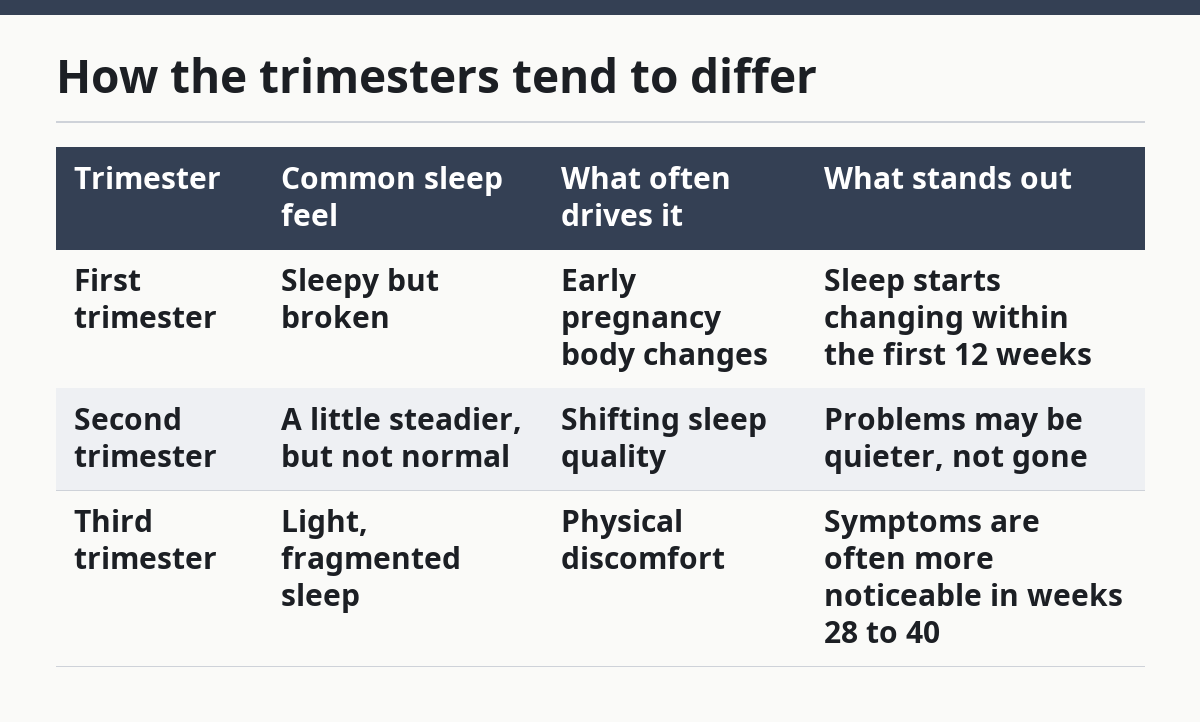
How the trimesters tend to differ
| Trimester | Common sleep feel | What often drives it | What stands out |
|---|---|---|---|
| First trimester | Sleepy but broken | Early pregnancy body changes | Sleep starts changing within the first 12 weeks |
| Second trimester | A little steadier, but not normal | Shifting sleep quality | Problems may be quieter, not gone |
| Third trimester | Light, fragmented sleep | Physical discomfort | Symptoms are often more noticeable in weeks 28 to 40 |
Why is the third trimester often the hardest?
The third trimester often brings the most obvious insomnia symptoms. Healthline says insomnia symptoms are especially common in the third trimester, weeks 28 to 40, and that fits the way sleep can get more fragmented as pregnancy advances.

This stage tends to change sleep in more than one way. The night may include more waking, shorter stretches of sleep, and a stronger sense that the body will not settle. A common mistake is to call that “just normal late pregnancy sleep,” as if nothing can be done or noted. That is too vague. It may be common, but common does not mean the same for everyone.
The key point is that third-trimester insomnia often feels more physical than mental. The body can feel too restless, too full, or too uncomfortable to stay asleep. That does not mean anxiety is absent, only that the stage itself can drive the pattern.
What is typical, and what is more concerning?
Typical trimester sleep change is usually a shift in sleep quality that tracks with pregnancy stage, and it may come and go. More concerning sleep change lasts longer, happens often, or comes with other symptoms that do not fit the usual pattern.

A useful reference point is chronic insomnia. According to Healthline, symptoms happening at least 3 days weekly for at least 3 months may mean chronic insomnia. About 10% of adults have chronic insomnia lasting at least three months, according to Cleveland Clinic, though pregnancy adds a separate set of causes and timing.
If the problem is mostly stage-linked, it may improve as the trimester changes. If it is steady across stages, or it becomes severe, that is a different picture. That is when the question shifts from “Is this trimester normal?” to “Does this need medical review?” ACOG recommends bringing persistent sleep problems to a clinician.
What should you watch for next?
Trimester-specific insomnia is worth watching because the pattern tells a story. If sleep loss starts in the first 12 weeks, eases in the middle, and then returns in weeks 28 to 40, that pattern fits pregnancy-related change better than one flat, unchanging problem. If it stays intense through all three trimesters, the pattern deserves closer attention.

A few details matter more than the label. How often does it happen? Is it trouble falling asleep, staying asleep, or waking too early? Has it lasted near 3 months? Those details help separate a common pregnancy sleep shift from a longer-term sleep disorder.
One useful way to think about it is this: the trimester gives context, but it does not give a final answer. Sleep loss can be expected and still need care, especially if it is piling up night after night. For symptom tracking, sleep diary tips can help you notice the pattern clearly.
When does trimester sleep change need more than watchful waiting?
Trimester sleep change needs more than watchful waiting when the pattern stops fitting a simple stage shift. That matters because pregnancy sleep problems can look ordinary at first and still hide a bigger issue.
Symptoms happening at least 3 days weekly for at least 3 months: this can fit chronic insomnia — speak with a qualified professional about what is driving it and whether it needs assessment.
Sleep is getting worse instead of changing with the trimester: the pattern is no longer behaving like a stage-linked shift — get checked rather than assuming it will pass on its own.
The problem began in the first 12 weeks and never eased: that can mean the sleep issue is persisting across pregnancy — bring it to a clinician’s attention.
Sleep loss is strongest in weeks 28 to 40 and is disrupting daytime function: third-trimester symptoms can be common, but function still matters — ask for professional guidance.
The sleep pattern feels different from anything that has happened before pregnancy: a new pattern can point to more than routine insomnia — get it reviewed.
What mistakes do people make most often?
A common mistake is treating every trimester the same. That can hide the real cause, because the first trimester, second trimester, and third trimester do not usually disturb sleep in the same way. Another mistake is assuming that if insomnia is “common,” it does not deserve attention.
A third mistake is waiting for the whole pregnancy to end before taking the pattern seriously. That can leave someone struggling through many weeks of poor sleep, which is a long time when nights are already short. A fourth mistake is focusing only on how hard it is to fall asleep, while ignoring frequent waking, early waking, and sleep that never feels restorative.
The better alternative is to track the pattern by trimester, not just by mood. Note when it started, what changed, and whether it is still happening after a few weeks. That makes the difference between a vague complaint and a useful description. If the pattern is unclear, pregnancy symptom tracking can help.
FAQ
Does pregnancy insomnia change by trimester?
Yes, it often does. The sleep problem can start early in the first 12 weeks, feel different in the second trimester, and become more obvious again in the third trimester, weeks 28 to 40. The cause shifts as the body changes, so the symptom can feel different even when the name stays the same.
Why is sleep worse in one trimester than another?
Sleep is worse in one trimester than another because pregnancy changes the body in stages. Early pregnancy can bring nausea and frequent waking, mid-pregnancy can bring a different sleep pattern, and late pregnancy often brings more physical discomfort. The sleep trouble is real in each stage, but the trigger can vary, so it is worth discussing with a professional if it is persistent.
When is trimester sleep change not normal?
Trimester sleep change is not normal when it is frequent, long-lasting, or hard to explain by pregnancy stage alone. If symptoms happen at least 3 days weekly for at least 3 months, that may fit chronic insomnia. If the pattern is severe or keeps getting worse, a qualified professional should assess it.
Sources
- Healthline, Do I Have Insomnia? Signs to Look Out For (checked 29 Nov 2026)
- Cleveland Clinic, Insomnia: What It Is, Causes, Symptoms & Treatment (checked 29 Nov 2026)
Drafted with AI; not yet reviewed by a person.
