
Last updated: November 19, 2026
Key Takeaways
- Block light, keep setup simple, and avoid cords or heavy daily hassle.
- Measure first, then match fabric and hanging style to the light you need to stop.
- Fit usually matters more than fabric.
- Use room-darkening shades when curtains alone cannot seal the edges.
Quick Answer: For how to choose pregnancy-friendly blackout curtains for day sleep and early sunrise, start with one window, one rod, and one goal: reduce light leaks enough for sleep.
Pregnancy-friendly blackout curtains for day sleep and early sunrise should block light without adding extra hassle, heavy fumes, or unsafe cord setups. Pick a room-darkening setup with a sturdy curtain rod, a thermal lining if you want more insulation, and a length that covers the window without dragging into dirt. The sections below will help you choose the right fabric, fit, and installation for your room.
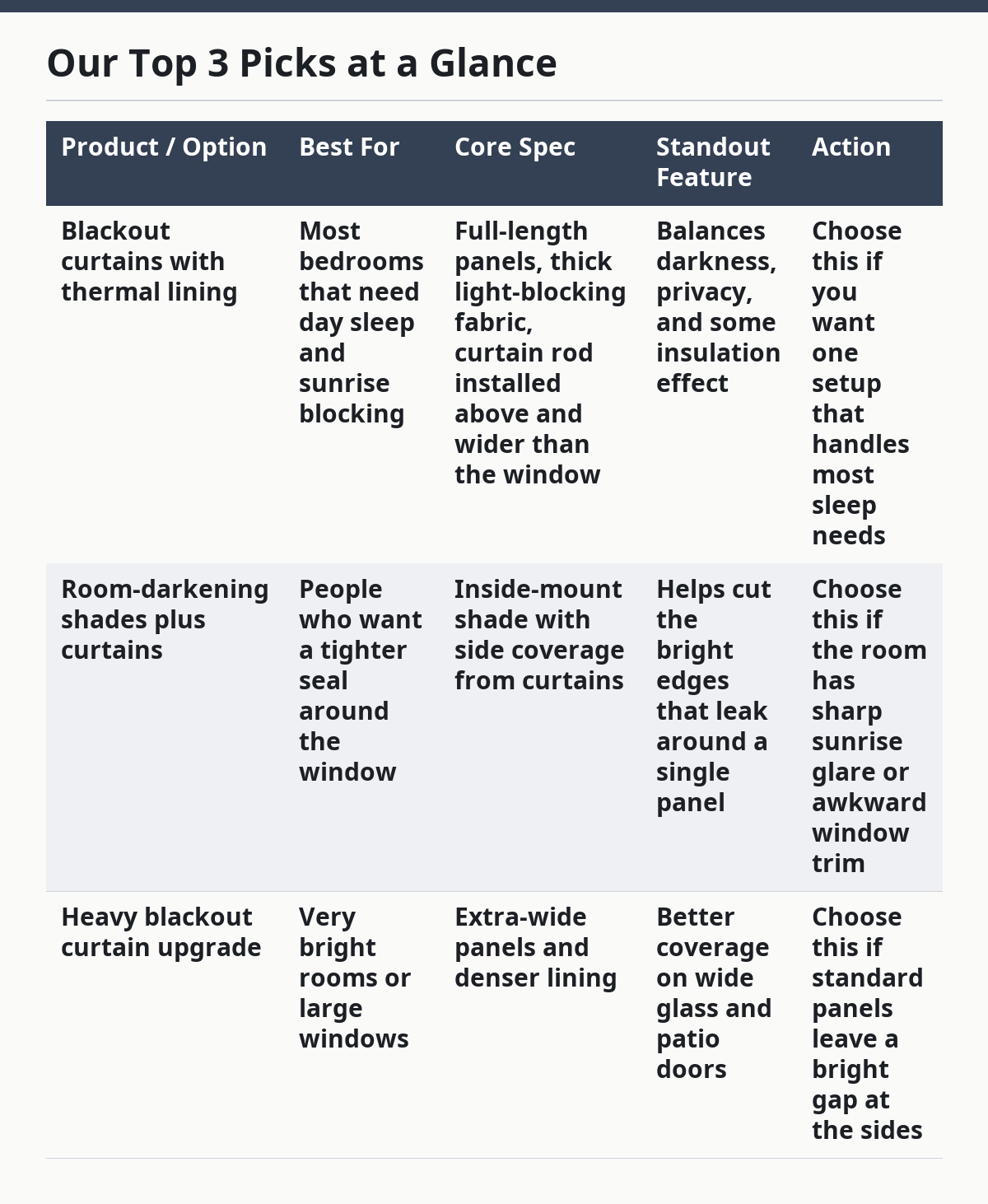
Our Top 3 Picks at a Glance
- #1 Best Overall: Blackout curtains with a thermal lining, full window overlap, and a simple rod-pocket or grommet top for easier hanging.
- #2 Best Budget Pick: Room-darkening shades paired with lighter blackout panels when you need strong light control without a full curtain overhaul.
- #3 Best Heavy-Duty / Upgrade Pick: Extra-wide blackout curtains with insulated backing for bright rooms, early sunrise, or windows that face direct morning light.
| Product / Option | Best For | Core Spec | Standout Feature | Action |
|---|---|---|---|---|
| Blackout curtains with thermal lining | Most bedrooms that need day sleep and sunrise blocking | Full-length panels, thick light-blocking fabric, curtain rod installed above and wider than the window | Balances darkness, privacy, and some insulation effect | Choose this if you want one setup that handles most sleep needs |
| Room-darkening shades plus curtains | People who want a tighter seal around the window | Inside-mount shade with side coverage from curtains | Helps cut the bright edges that leak around a single panel | Choose this if the room has sharp sunrise glare or awkward window trim |
| Heavy blackout curtain upgrade | Very bright rooms or large windows | Extra-wide panels and denser lining | Better coverage on wide glass and patio doors | Choose this if standard panels leave a bright gap at the sides |
Who this is for — and who should do something else
This guide is for you if you need blackout curtains that make daytime sleep feel like night and cut the sting of early sunrise. It assumes you already have a window, a curtain rod or a plan to install one, and the goal of better light control rather than a full bedroom makeover.
Because pregnancy sleep needs vary, speak with a qualified clinician about your own situation if you have breathing trouble at night, dizziness, severe swelling, or any symptom that changes how you tolerate a darkened room. Curtains can change light and privacy; they do not address the cause of a sleep problem.
Picture this: you’re trying to sleep at 2 p.m., and the sun finds the exact edge of the panel. The right setup fixes that by covering the glass, stopping side spill, and staying easy to live with through the whole pregnancy.
- Best fit: a bedroom with strong morning light, streetlight glare, or nap-time light spill.
- Also a fit: renters who need a reversible fix.
- Wrong fit: a room where the window opens poorly and long panels would block access.
- Wrong fit: a setup that already uses a tight room-darkening shade and only needs a tiny tweak.
The main question is not “blackout or not.” It is whether the curtain can seal enough light, hang safely, and stay practical when you’re tired, sore, or moving around less easily.
What should pregnancy-friendly blackout curtains actually do?
Pregnancy-friendly blackout curtains should block light well, hang safely, and avoid adding extra friction to daily use. That means strong coverage, a manageable fabric weight, and hardware that does not turn opening the window into a chore.
The phrase “blackout” gets used loosely. In practice, some panels are true blackout fabric, while others are room-darkening curtains that reduce light but still let some glow through. For early sunrise, that difference matters.
Here’s the catch: the window frame is part of the system. A dense panel alone can still leak light at the top, sides, and bottom if the rod is too narrow or the curtains are too short.
Sleep hygiene matters here too, because darkness is only one part of a sleep-friendly room.
Use this shortlist:
- Blackout fabric or lining: the panel should be built to block most visible light, not just dim the room.
- Thermal lining: this is a backing layer that can help with insulation effect by slowing heat transfer through the window.
- Wide overlap: panels should extend beyond the glass on both sides.
- Full length: floor-length usually seals better than a short panel.
- Easy hardware: a curtain rod that is stable and simple to reach matters more than decorative extras.
If the label says “light filtering” or “semi-sheer,” skip it for this use. Those fabrics are fine for ambiance. They are weak for sunrise blocking.
How do you choose blackout curtains for day sleep step by step?
Choose them by measuring the window, checking the fabric, and matching the hanging style to the amount of light you need to stop. A good choice starts with coverage, not color.
For how to choose pregnancy-friendly blackout curtains for day sleep and early sunrise, start with the window and work outward.
-
Measure the window width and height.
Add extra width beyond the glass so the curtain can overlap the sides. Verify that the rod can sit wider than the window trim. If the panel only covers the glass edge to edge, light leaks are likely. -
Decide how much light you need to stop.
If sunrise wakes you early, go for true blackout or blackout plus a shade. If the room only needs nap-time dimming, room-darkening may be enough. A weak match shows up as a bright halo around the edges. -
Check the fabric weight and lining.
Look for blackout fabric or a thermal lining, not just a dark color. A dark navy panel that is thin can still glow in morning sun. If you can see light through the weave when held up, expect poor performance. -
Pick a hanging style you can live with.
Grommet tops slide easily on a rod, while rod-pocket panels can look neater but often move less smoothly. Verify that you can open and close them one-handed. If the panel snags, you will stop using it the way it was meant to be used. -
Choose the right length.
Aim for full coverage that reaches close to the floor without dragging. A 1/2-inch or 1-inch gap can still let in a sharp line of sunlight. If the hem sweeps the floor, it may collect dust and get in the way. -
Plan the rod placement before buying.
Hang the rod a few inches above the window frame and wider than the frame when possible. That extra space reduces side and top leaks. If the rod sits too low, the curtain will bunch and leave a gap. -
Think through privacy and insulation together.
In a street-facing room, blackout curtains can also protect privacy during daytime naps. A thermal lining may help the room feel less drafty near the glass, though it won’t replace proper heating or cooling. If the panel is only dark but flimsy, it won’t do either job well. -
Check care and cleanup.
Look for a fabric you can dust or wash without a special process. Pregnancy tends to make simple tasks feel bigger. If the curtain needs careful dry cleaning only, that may be one more chore than you want.
The best result is a room that goes dark enough for sleep, the curtain opens without a fight, and the setup does not crowd the window or the floor.
For product safety context, the U.S. Consumer Product Safety Commission recommends cordless window coverings for homes with children; see the CPSC Safe Sleep guidance and the Window Coverings page.
What mistakes do people make with blackout curtains?
People usually miss the fit, not the fabric. The curtain can be “blackout” on paper and still fail if the rod, length, or installation leaves gaps.
For example, a panel can look strong in the package and still leak light at the edges at home.
A few mistakes show up again and again:
- Buying panels that are too narrow.
This leaves bright stripes at the sides. Choose wider panels or use two panels that overlap more fully. - Hanging the rod too close to the window.
This creates top and side leaks. Place the rod higher and wider when the wall space allows it. - Choosing short panels for a sleep room.
Short curtains often leave light under the bottom edge. Floor-length is usually the better sleep choice. - Ignoring the opening style.
A beautiful panel that is hard to slide gets left half-open. Pick a top style that works with your hand strength and daily routine. - Confusing dark fabric with blackout performance.
Dark color alone does not block sun. Look for blackout construction or a lining. - Skipping the privacy check.
Some rooms need daytime privacy as much as darkness. A thin panel may dim the room but still silhouette movement.
The fix is usually boring and effective: better measurement, better overlap, and a more practical hanging style. That is the whole game.
When should you choose room-darkening shades instead?
Room-darkening shades are the better choice when a curtain alone cannot control the window edges. They work well in small rooms, odd-shaped frames, and spaces where the side glow matters as much as the center light.
Picture a room with shallow trim, a bright sunrise, and a narrow wall beside the window. A standard curtain may darken the middle and leave sharp streaks of light. A shade mounted inside the frame can reduce that leak, and curtains can add a second layer if needed.
Use this rule of thumb:
- Choose shades first if the window has limited wall space for wide curtain overlap.
- Choose curtains first if you want easier daily opening and a softer look.
- Use both if sunrise is intense and naps are short.
Room-darkening shades are not the same as blackout shades. They usually reduce light rather than shut it out. If full darkness matters for early sunrise, pair them with blackout curtains instead of treating them as a full substitute. If you are unsure which setup fits your room, a window-treatment specialist or home improvement professional can help you measure the frame and choose the safer option. For general sleep environment advice, see the NHLBI sleep deprivation resource and the NICHD sleep page.
The most useful part is flexibility. A layered setup lets you adjust the room by time of day. Shade down for the brightest hours. Curtains closed for the deepest sleep.
What if the window is awkward, wide, or hard to reach?
Awkward windows need a more exact fit, not a fancier fabric. Wide glass, patio doors, and windows near the ceiling all change how the curtain should hang.
If the window is wide, look for extra-wide panels or a two-panel setup that overlaps well in the middle. If the ceiling is high, a longer panel can help the room feel darker because it reduces light from above. If the window is hard to reach, avoid hardware that needs frequent fiddling.
Specific situations that call for a different approach:
- Patio door or extra-wide glass: one standard panel may leave a large gap — use wider panels or layered coverage.
- Very little wall space beside the window: side leakage may stay visible — a room-darkening shade plus curtain is usually better.
- Window opens often for airflow: long panels can get in the way — choose a style that stacks neatly.
- Dry-clean-only fabric: care may become annoying — pick a washable or easy-wipe option instead.
- Rod installed too low for full drop: the panel may bunch and leak light — move the rod higher if you can.
What matters here is not perfection. It is whether the setup fits the room without becoming a daily nuisance.
Curtains, shades, and bedroom privacy solutions all work better when the hardware matches the room.
How do you know the result is good enough?
The result is good enough when the room looks dim at the edges, the panel stays easy to use, and sunrise no longer lands directly on your sleep space. You do not need perfect blackout to get a useful improvement.
Check these three things after installation:
- Side spill: stand at the bed and look for bright vertical slivers. If you see them, widen the rod position or add overlap.
- Top spill: check for a bright band above the curtain. If it shows, raise the rod.
- Bottom spill: check for light under the hem. If it shows, lengthen the panel or adjust the hanging height.
A strong setup should also feel calm to use. You should be able to close it in seconds, open it without strain, and keep the room private during the day.
For the broader sleep-space context, this article fits into the site’s bed setup, sleep space, and comfort controls hub, where the other pieces handle the rest of the room.
Which blackout curtain features matter most for pregnancy?
The most useful features are full coverage, easy operation, and fabric that does more than look dark. A thermal lining can add insulation effect, and a curtain rod placed well can matter as much as the curtain itself.
A simple ranking helps:
- Must-have: blackout or room-darkening performance that matches your light problem.
- Should-have: enough width and length to block side and bottom leaks.
- Nice-to-have: thermal lining for extra comfort near drafty windows.
- Optional: decorative texture, unless it gets in the way of cleaning or hanging.
This is where many shoppers overbuy the wrong thing. They focus on color, pattern, or thread count and miss the real issue: light sneaks in at the edges. That is what wakes a sleeper at 5:30 a.m.
For standards and material guidance, the U.S. Department of Energy’s window coverings page explains how coverings can affect heat gain and loss.
The Verdict
Choose blackout curtains that fit the window with overlap, hang from a stable rod, and use a real blackout build or thermal lining rather than a dark color alone. For pregnancy day sleep and early sunrise, coverage beats decoration every time.
Drafted with AI; not yet reviewed by a person.
