

Last updated: November 19, 2026
Key Takeaways
- Travel sleep gear for pregnancy should cover support, warmth, light control, and charging in one small kit.
- Pack one compact sleep setup for the room, bed, and bedside needs.
- For car travel, use stable support and keep the seat area organized for safe stops.
- The key items handle light, temperature, and device power, which are the main sleep disruptors.
Pregnancy travel sleep gear checklist is the small set of items that makes a hotel bed, car seat, or unfamiliar couch less miserable for sleep. Pack support, darkness, temperature control, and a way to keep essentials within arm’s reach. In short, for the pregnancy travel sleep gear checklist, bring a travel pillow, blanket, eye mask, extension cord, small night light, and portable charger, then match the setup to the place you’re sleeping.
Before you pack, speak with a qualified health professional about your own pregnancy, travel plans, and any symptoms that make sleep harder, and use the travel advice below as a planning aid. The checklist below settles what belongs in the bag, what can stay home, and where the limits are.
Our Top 3 Picks at a Glance
#1 Best Overall: A travel pillow that supports your neck, belly, or knees without taking over the whole suitcase.
#2 Best Budget Pick: A compact eye mask and a thin blanket that solve the easiest hotel problems fast.
#3 Best Heavy-Duty / Upgrade Pick: A bedside kit with extension cord, portable charger, and small night light for rooms that are awkwardly laid out.
What belongs in pregnancy travel sleep gear?
Pregnancy travel sleep gear is the stuff that helps you sleep in a place you don’t control, and the basics are simple: support, warmth, light control, and power. A sensible kit usually includes a travel pillow, blanket, eye mask, extension cord, small night light, and portable charger, plus any item you already rely on at home.
The reason this matters is practical. Travel rooms often have hard pillows, cold air, bright alarm clocks, and outlets that are too far from the bed. The right kit reduces friction before bedtime, which is the point.
Here’s the catch: not every item needs to be bulky or special-made for pregnancy. For example:
- Travel pillow: Best for side-sleep support in cars and hotels.
- Blanket: Useful when hotel bedding feels thin or too warm.
- Eye mask: Helps when curtains leak light.
- Extension cord: Useful when the outlet is behind furniture or across the room.
- Small night light: Helps you avoid turning on overhead lights.
- Portable charger: Keeps your phone and any needed device close by overnight.
A quick note on evidence: PubMed shows 16,996 human-study records matching this wider subject for 2016–2026; the 100 most relevant records were read, and the medians and shares below are computed from those records, not from this exact checklist, on 2026-11-06. The search used pregnancy[Title/Abstract] AND support[Title/Abstract] AND humans[MeSH Terms] in PubMed, with results sorted by relevance, because the narrower topic had too little published on it.
What should I pack for a hotel stay?
You should pack a small sleep kit that solves the room, the bed, and the bedside in one go. The smartest hotel kit is usually five items: one support item, one comfort layer, one darkness item, one power item, and one light source.
Picture this: you walk into a hotel room at night, and the bed is fine but the pillow is too flat, the curtains leak light, and the nearest outlet is behind a desk. That is why the bag matters more than the room.
- Bring a travel pillow that fits the way you sleep. If you like side sleeping, a long body pillow style or firm wedge is usually easier to use than a tiny decorative pillow. Verify that it stays in place when you roll. If it slips or forces your shoulder forward, it’s the wrong shape.
- Pack a thin blanket or shawl even if the hotel provides bedding. A blanket helps when the room is cold, the air conditioner is loud, or the duvet feels too heavy. Check that it folds small enough to fit in carry-on or a tote. If it traps too much heat, leave it at home.
- Add an eye mask for room darkening. Hotel blackout curtains are not always enough, so an eye mask can be the lighter fix. Verify that it blocks light without pressing on your eyelids. If the band digs in, it will make sleep worse.
- Pack an extension cord if you need the phone, lamp, or charger near the bed. Choose one with enough length to reach from the outlet to bedside level without stretching. Verify that the cord lies flat and does not create a trip hazard. If the room has no clear path for it, skip the setup.
- Bring a portable charger so you do not end up sleeping with your phone in a random corner of the room. Keep it charged before you leave. If it cannot hold power through the evening, it’s not dependable for travel.
- Add a small night light for dim bathroom or bedside use. A plug-in or battery light is better than turning on a ceiling fixture at 2 a.m. Verify that it gives enough light to see the room edges but does not shine in your face.
- Use bedside organization such as a pouch, zip bag, or small tote for glasses, water, lip balm, and charger cable. If those items scatter across the room, you spend more time hunting than resting.
The best part is simple: most of this is low drama. One compact bag can cover the main hotel problems without turning your suitcase into a closet.
How do I sleep better in a car while pregnant?
You sleep better in a car by packing support that keeps you stable and by organizing the seat area so you can change position safely when the car is stopped. A car is different from a hotel because space is tight, movement is limited, and hard edges matter more.
Picture this: you are riding in the back seat for hours, and every turn pulls you against the seatbelt while your neck drifts to one side. That is the moment when travel gear earns its place.
- Use a compact travel pillow rather than a large bed pillow. In a car, bulky gear can push your head forward and make the seat feel cramped. Verify that your head can rest without tilting your chin down. If it blocks your shoulder or belt placement, it does not fit the seat.
- Pack a small blanket that folds easily. It can help if the car is cold or if you need a layer over your lap. Check that it does not bunch up under you or under the belt path. If it does, remove it.
- Keep the eye mask in reach for rest stops, not while the car is moving if it would interfere with your awareness. A mask is mainly for when the vehicle is parked or when you are trying to rest after a long day. If it makes you feel disoriented, don’t use it in the car.
- Store the portable charger where you can reach it without digging under bags. Long drives drain phones fast, and a dead phone is a nuisance if you need to call ahead or check directions. Verify that cables do not cross the floor in a way that catches on your feet.
- Use the extension cord only for lodging, not the moving car. In a vehicle, cords and loose items create clutter and can become unsafe. The better tool for a car is a charged power bank, not a wall cord.
- Keep bedside organization in a seat pocket or small pouch so your water, tissues, and charger do not slide around. If you need to twist repeatedly to reach things, the setup is wrong.
- Plan for temperature swings. Cars can feel hot, then cold, then hot again. A blanket you can fold and unfold fast works better than a heavy layer you have to fight with.
On the flip side, a car is not the place to build a giant sleep nest. Too many pillows make it harder to get in and out of the seat, and that defeats the point.
Which gear matters most for light, temperature, and power?
The most useful items are the ones that control the three things that wake people up: light, temperature, and device power. If you only have room for a few extras, start there.
The truth is, hotel sleep problems are often mechanical, not mysterious. Light leaks through curtains. Air conditioning makes the room chilly. A phone dies just as you settle in. Those are annoying, but they are predictable.
- For light: pack an eye mask and a small night light. The mask blocks ambient glow, and the light helps with midnight room movement without blasting the room awake.
- For temperature: pack a blanket that can be used alone, under a hotel duvet, or across your lap in the car. A light layer is easier to adjust than a heavy comforter.
- For power: pack a portable charger and, if the room layout is bad, an extension cord for the bedside table. Verify that you can charge the phone without stretching a cord across a walkway.
A small note on room darkening: if you already know a room has thin curtains, do not rely on a “maybe.” Bring the mask. If you are sensitive to light, that one item can save the whole night.
What mistakes do people make with pregnancy sleep gear?
The biggest mistake is packing comfort items that are too big for the space they will be used in. A giant pillow can work at home and fail in a car. A heavy blanket can feel cozy in a hotel and unbearable on a warm night.
Picture this: you packed everything “just in case,” then spent half the trip moving it around the room. That is a packing problem, not a sleep problem.
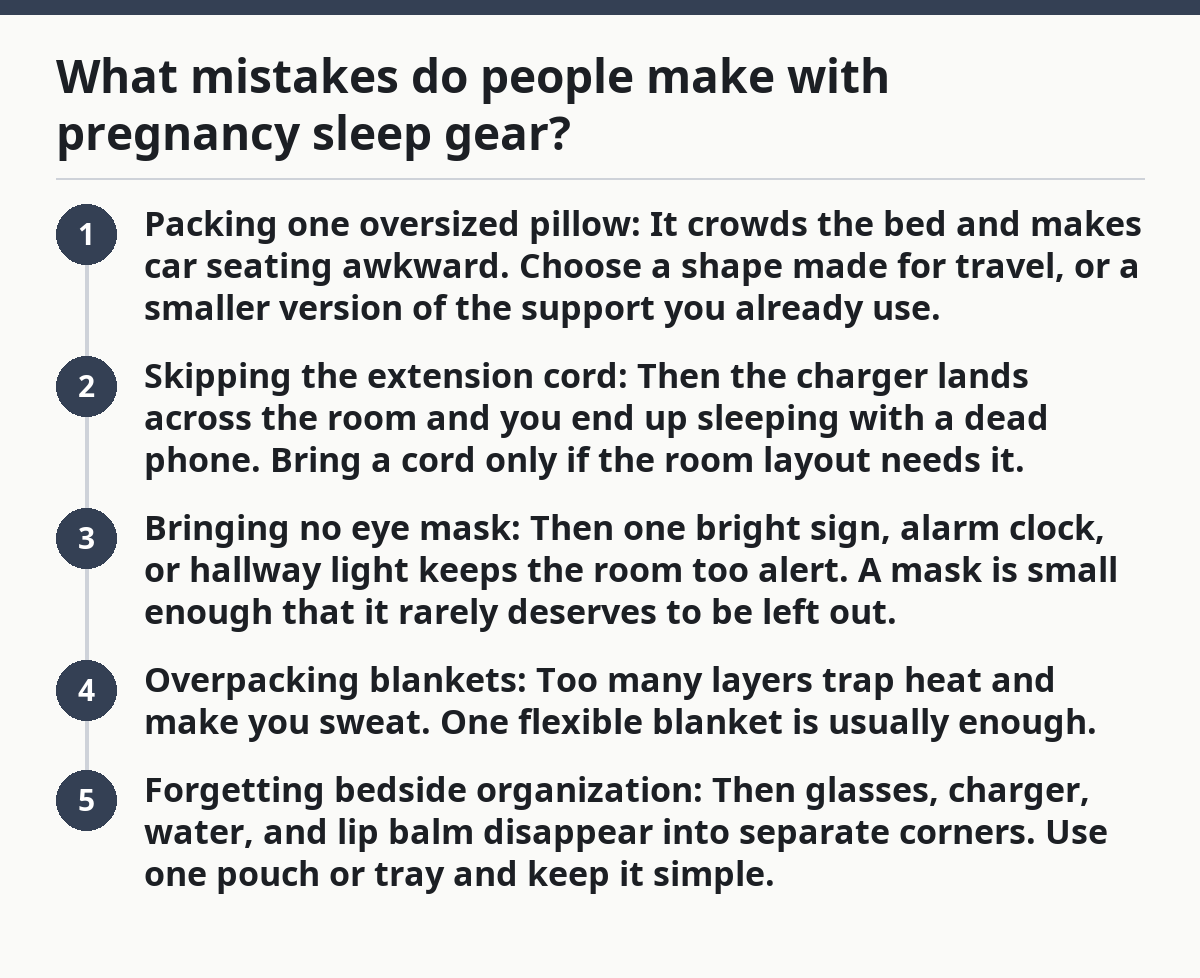
- Packing one oversized pillow: It crowds the bed and makes car seating awkward. Choose a shape made for travel, or a smaller version of the support you already use.
- Skipping the extension cord: Then the charger lands across the room and you end up sleeping with a dead phone. Bring a cord only if the room layout needs it.
- Bringing no eye mask: Then one bright sign, alarm clock, or hallway light keeps the room too alert. A mask is small enough that it rarely deserves to be left out.
- Overpacking blankets: Too many layers trap heat and make you sweat. One flexible blanket is usually enough.
- Forgetting bedside organization: Then glasses, charger, water, and lip balm disappear into separate corners. Use one pouch or tray and keep it simple.
The correct alternative is to pack for the room you expect, not the room you hope to get.
When should you change the plan?
You should change the plan when the setup starts to add strain instead of removing it. Travel gear is meant to help sleep, not to force a bad fit.
Picture this: the pillow is propping you into a twist, the cord is crossing the floor, and the night light is brighter than the hallway. That is not a sleep setup. That is clutter.
The pillow pushes your body out of alignment: That means the shape is wrong for your bed or seat — switch to a flatter or smaller support item.
The extension cord crosses a walking path: That creates a trip hazard — move the bedside setup or skip the cord.
The blanket makes you too hot: That can leave you restless and sweaty — swap it for a lighter layer.
The eye mask presses on your face or feels irritating: That can wake you up more than light does — use a softer mask or skip it.
The portable charger will not last through the evening: That means it is not dependable for travel — recharge it fully or bring a different one.
The room layout is too cramped for extra gear: That means less is better — keep only the items that solve a real problem.
This is also where the hub on pregnancy pillows and support gear fits best: use it if you need help choosing support shapes before you pack. The present checklist is about travel, not home-bed shopping.
What are the edge cases?
The standard checklist needs trimming or swapping when your trip setup is unusual. A red-eye flight, a long road trip, a shared room, or a very warm hotel changes what earns space in the bag.
If you are sleeping in a car for part of the trip, prioritize compact items. If you are in a hotel with limited outlets, prioritize the extension cord and portable charger. If you are staying with family, prioritize the eye mask and bedside pouch, because you may have less control over the room.
A few practical exceptions:
- Very short trips: keep the kit light. One pillow item, one light-blocking item, and one charging item may be enough.
- Warm climates: downshift the blanket and lean on a thin layer instead.
- Shared rooms: the small night light matters more, because overhead lights disturb other people.
- Late arrival times: bedside organization matters more, because you’ll want to find essentials fast without turning the room upside down.
If your symptoms, sleep problems, or travel limits are changing quickly, that is the point to discuss the trip setup with a qualified professional. The gear can only do so much.
How much research sits behind this topic?
The background literature is larger than the checklist itself, which is why the advice here stays practical rather than overly specific. PubMed shows 30 of the 100 most relevant records were tagged Review, 7 were tagged Systematic Review, 3 were tagged Meta-Analysis, 1 was tagged Clinical Trial, 1 was tagged Observational Study, and 1 was tagged Randomized Controlled Trial, all from the PubMed sample read on 2026-11-06.
That mix matters because it tells you what this page can and cannot claim. The evidence base is broad, but the most usable travel advice still comes down to common sleep supports rather than a single magic item. The median study duration in the abstract text was 15 weeks, with a range of 4–52 weeks across 16 figures stated in the sample, which supports the idea that sleep-related questions in pregnancy are usually studied over time, not in quick fixes.
So the gear list should stay simple. It should solve the room, the bed, and the bedtime routine without pretending to be a treatment. If you are unsure what is safe for your pregnancy, consult a qualified professional before you travel.
Drafted with AI; not yet reviewed by a person.
