
Last updated: November 19, 2026
Quick Answer: choose a waterproof mattress protector with a quiet waterproof membrane, deep-pocket corners, and a washable top that stays put under a fitted sheet.
This page helps you sort out how to choose a pregnancy mattress protector for leaks, spills, and easier cleanup by comparing protection, breathability, noise, fit, and cleanup. It also includes a quick comparison so you can spot the wrong fit fast.
Pick the protector that matches your mattress depth first, then check that the waterproof layer is backed by a fabric top that won’t trap heat or crinkle loudly. A good protector should wash easily, stay flat under a fitted sheet, and cover the full sleep surface without leaving the corners exposed. For more pregnancy sleep product guidance, this page sits under the hub on pregnancy sleep products and bedding fit.
1 Best Overall
A fitted waterproof protector with deep-pocket corners and a breathable top.
2 Best Budget Pick
A basic waterproof mattress protector with a simple wipe-clean barrier and fewer extra features.
3 Best Heavy-Duty / Upgrade Pick
A bed-encasing style protector with more complete coverage for spills and bed bug protection.
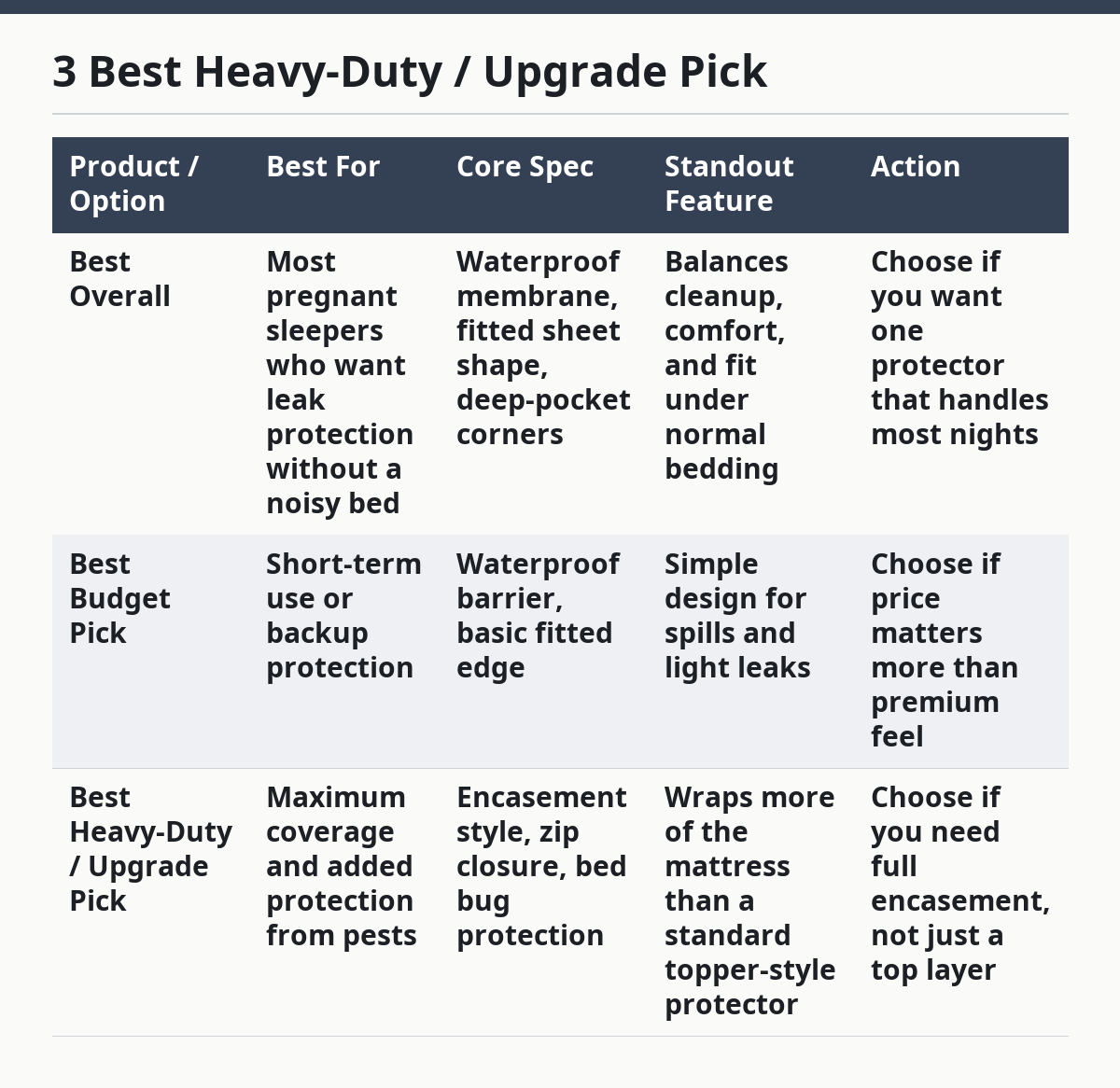
| Product / Option | Best For | Core Spec | Standout Feature | Action |
|---|---|---|---|---|
| Best Overall | Most pregnant sleepers who want leak protection without a noisy bed | Waterproof membrane, fitted sheet shape, deep-pocket corners | Balances cleanup, comfort, and fit under normal bedding | Choose if you want one protector that handles most nights |
| Best Budget Pick | Short-term use or backup protection | Waterproof barrier, basic fitted edge | Simple design for spills and light leaks | Choose if price matters more than premium feel |
| Best Heavy-Duty / Upgrade Pick | Maximum coverage and added protection from pests | Encasement style, zip closure, bed bug protection | Wraps more of the mattress than a standard topper-style protector | Choose if you need full encasement, not just a top layer |
What a pregnancy mattress protector needs to do
Picture this: you’re halfway through pregnancy, your sleep is already broken, and a leak, spill, or sweaty sheet means another 2 a.m. laundry load. A pregnancy mattress protector should stop liquid from reaching the mattress, stay comfortable enough to sleep on, and come off fast when cleanup time arrives.
The mechanism is simple. The waterproof membrane blocks fluid from soaking into the mattress foam or springs, while the outer fabric helps the bed feel less plastic-like. If the fit is poor, liquid can pool at the corners or slip under the edges.
- Look for a protector that covers the full top and wraps securely under the mattress, and consult a sleep or bedding professional if your mattress has unusual depth or a pain condition.
- Avoid loose quilted pads that shift around under a fitted sheet.
- If the bed is already hard to manage, a protector that is easy to wash matters more than a fancy finish.
The best option is not always the thickest one. You need a barrier that matches your mattress and your cleanup habits.
How to choose a pregnancy mattress protector
Picture this: you’re standing in the bedroom with a tape measure in one hand and a fitted sheet in the other, trying to guess what will actually fit. The right choice starts with mattress depth, then moves to waterproofing, breathability, and washability.
A good protector should act like a shield, not a second mattress. It needs to sit flat, avoid bunching, and survive repeated washing without peeling apart at the seams.
- Measure the mattress depth. Check the mattress from top to bottom in inches, then compare that to the protector’s pocket depth. Verify that the corners fully cover the mattress edge. A problem shows up when the protector rides up, pops off, or leaves the sides exposed.
- Choose a fitted-sheet style or encasement style. A fitted-sheet protector is easier to remove for laundry; an encasement wraps more of the mattress. Verify that the style matches how much coverage you need. A problem is a loose topper-style pad that slides out from under the fitted sheet.
- Check the waterproof layer. The barrier should be described as a waterproof membrane or waterproof backing. Verify that liquid protection extends across the sleep surface, not just the center. A problem is a protector that absorbs spills but still lets moisture reach the mattress seams.
- Assess breathability. Look for a fabric top that is meant to be worn under a sheet without feeling clammy. Verify that the surface is not just vinyl or thick plastic. A problem is trapped heat, which can make already disrupted pregnancy sleep feel worse.
- Listen for noise claims. Some waterproof layers crinkle when you move. Verify that the product is described as quiet, soft, or low-noise. A problem is a loud rustling sound every time you turn over in bed.
- Check washability. Make sure the protector can go through normal machine washing, and confirm whether it can be tumble dried on low. Verify that the care label is simple enough for repeated cleanup. A problem is a protector that needs special care you will avoid after the third spill.
- Decide whether you need bed bug protection. If you want full enclosure, look for a zippered encasement rather than a standard fitted protector. Verify that the closure fully seals the mattress. A problem is buying a surface protector and expecting it to block pests it was never made to stop.
- Pick the easiest removal path. Choose corners, zippers, or stretch that you can manage with a large belly and less sleep. Verify that you can remove it without fighting the mattress. A problem is a product that works in theory but becomes a wrestling match on wash day.
The truth is, many generic mattress protectors are built for guest rooms, not pregnancy. A product can look fine in the package and still fail the real test: staying put on a deep mattress, drying fast, and not sounding like a raincoat. Sleep Foundation and the NIH both note that fit, comfort, and moisture control matter for usable sleep gear, and that practical details often decide whether you keep using a product.
What should I check before I buy one?
Picture this: you are comparing two protectors online and both say “waterproof,” but only one tells you the pocket depth and care instructions. That missing detail matters, because the mattress protector only works if it fits your bed and fits your routine.
Start with the label. A protector should name its waterproof barrier, its mattress depth range, and its cleaning method. If the listing hides those basics, the product usually hides other limits too.
- Fabric top: cotton or a soft blended surface is usually easier to sleep on than a hard plastic feel.
- Membrane type: a thin waterproof membrane is usually quieter than a thick vinyl-style backing.
- Corner shape: deep-pocket corners help on taller mattresses and pillow-top beds.
- Closure style: encasements use zippers; fitted protectors use elastic edges.
- Cleaning instructions: simple machine-wash care beats special handling.
- Protection goal: spills and leaks need surface waterproofing; bed bug protection needs full encasement.
Also check the fitted sheet you already use. A protector adds thickness, and some fitted sheets feel tight once the protector is on. If your sheet already struggles to stay in place, a deeper-pocket protector may save you from constant corner resets.
Which mattress protector is wrong for pregnancy use?
Picture this: you want something cheap and quick, but the wrong protector can make sleep hotter, noisier, and harder to clean. On this topic, “close enough” is often the wrong answer.
Skip thin, slippery protectors if you sleep hot or wake often. They can feel loud and plasticky — choose a softer top layer or you may end up avoiding the bed itself.
Skip loose pads with no deep-pocket corners if your mattress is tall. They tend to shift under a fitted sheet, which leaves gaps at the edge. A better fit is a protector with firmer elastic and a stated pocket depth.
Skip encasements if you need fast cleanup after frequent laundry. They give more coverage, but zippers and full removal take longer. A fitted-sheet style is easier if leaks are common and you want faster changes.
Skip products with vague care labels. If the washing directions are unclear, the protector may be a pain to keep clean. That becomes a problem fast when spills happen often.
Skip bed bug encasements if you only want spill protection and want a lighter feel. A full encasement is more coverage than many sleepers need. The better fit is a standard waterproof protector unless you also need pest protection.
How do leaks, spills, and cleanup change the decision?
Picture this: you are not shopping for “nice bedding.” You are shopping for faster cleanup at 3 a.m., fewer mattress stains, and less stress after a spill. That changes what matters more than the marketing copy does.
If leaks are your main worry, the barrier has to cover the whole sleep surface and stay sealed at the edges. If spills are the bigger issue, washability matters even more, because you may need to strip and relayer the bed quickly. If cleanup is the real problem, choose a protector that comes off without tugging and goes back on without a corner fight.
A few specific trade-offs help here:
- More coverage usually means more hassle during laundry.
- More breathability sometimes means less heavy-duty waterproofing, depending on construction.
- Quieter fabric may cost you a little firmness in the feel of the top layer.
- Full bed bug protection is a bigger commitment than most pregnancy spill protection needs.
The right pick is the one that matches the mess you are actually trying to manage.
What are the most common mistakes?
Picture this: you buy a protector, wash it once, and then discover it bunches, traps heat, or fails to fit over the mattress and pad together. Most bad outcomes come from a few repeat errors, not from bad luck.
Buying by price alone. The result is often a noisy, thin protector that fails early. The fix is to check depth, membrane type, and cleaning method before price.
Ignoring mattress height. The result is corner pop-off and exposed edges. The fix is to measure the mattress, then buy for the actual depth.
Assuming all waterproof layers feel the same. The result is a bed that sounds crinkly or sleeps hot. The fix is to look for a soft top layer and low-noise construction.
Choosing a protector that is hard to wash. The result is skipped laundering and sticky buildup after spills. The fix is to choose a product that fits your normal wash routine.
Buying an encasement when you only need surface protection. The result is extra work without extra value. The fix is to match the product to the problem: spills, leaks, or bed bug protection.
When does the standard approach not fit?
Picture this: the mattress is unusually deep, the leak problem is frequent, or the bed already has layers that change how things fit. Standard advice needs adjustment when the bed itself is not standard.
Very deep mattress: A normal fitted protector may not stay on — choose one with deeper pocket corners and confirm the stated depth before buying.
Bed bug concern: A standard waterproof protector is not enough — use a zippered encasement made for full mattress coverage.
Frequent laundry need: An encasement may be too slow to remove — a fitted-sheet style protector is easier to strip and relayer.
Heat sensitivity: A thick laminated surface may feel too warm — look for a thinner, quieter build with a softer top fabric.
Multiple layers on the mattress: If you already use a topper, the protector has to fit over both layers — check the combined depth, not just the mattress alone.
The truth is, the “best” protector on paper can still be the wrong one for a deep pillow-top bed or a setup that changes every night.
What good looks like after you buy it
Picture this: the protector is on the mattress, the fitted sheet goes over it cleanly, and you can’t hear much when you shift positions. That is the goal — not perfection, just a bed that is easier to manage.
A good result looks like this:
- The protector lies flat with no corner lift.
- The fitted sheet still fits without strain.
- The surface does not make loud crinkling sounds.
- The waterproof layer stays hidden under normal bedding.
- Cleanup takes minutes, not a full bedding overhaul.
A final check helps. After the first wash, see whether the protector still fits the same way. If the elastic loosens, the corners wrinkle, or the surface feels louder than before, that is a sign to look for a different build next time.
For broader choices across pregnancy sleep gear, this guide sits inside the hub on pregnancy sleep products and bedding fit. That is where the rest of the bedding decisions belong.
What the PubMed record shows about this topic
There are 20 PubMed records matching this query for 2016–2026, and the 20 most relevant were read; the median publication year is 2022 across those records, the range is 2017–2026, and 5 (25%) are tagged “Review” according to PubMed (NCBI), computed on 2026-11-09.
Drafted with AI; not yet reviewed by a person.
