
Last updated: November 19, 2026
Key Takeaways
- A pregnancy bedside lamp should give safe night visibility without making you feel fully awake.
- Controls should be easy to use in the dark, with little finger work.
- Choose a dimmable warm bulb so the light stays soft and low.
- Skip clear bulbs, clear shades, and lamps that send light straight into the room.
A pregnancy bedside lamp should let you see the bed, the floor, and the bathroom path without blasting your eyes awake. How to choose a pregnancy bedside lamp for nighttime visibility without waking yourself up starts with a dimmable, warm LED lamp with touch or motion control and a low-glare shade. The steps below will help you sort out what matters and what to skip. A quick answer: for most nightstands, a dimmable warm LED lamp is the simplest setup.
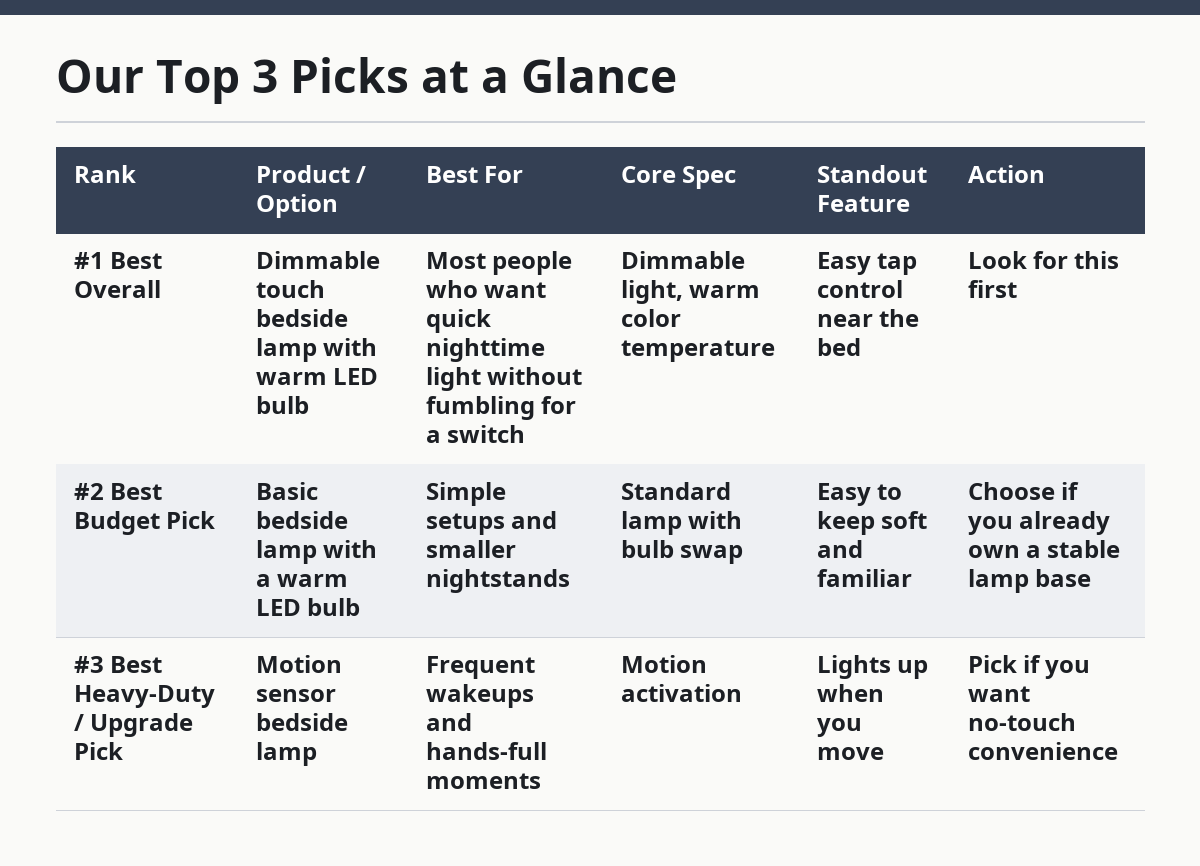
Our Top 3 Picks at a Glance
| Rank | Product / Option | Best For | Core Spec | Standout Feature | Action |
|---|---|---|---|---|---|
| #1 Best Overall | Dimmable touch bedside lamp with warm LED bulb | Most people who want quick nighttime light without fumbling for a switch | Dimmable light, warm color temperature | Easy tap control near the bed | Look for this first |
| #2 Best Budget Pick | Basic bedside lamp with a warm LED bulb | Simple setups and smaller nightstands | Standard lamp with bulb swap | Easy to keep soft and familiar | Choose if you already own a stable lamp base |
| #3 Best Heavy-Duty / Upgrade Pick | Motion sensor bedside lamp | Frequent wakeups and hands-full moments | Motion activation | Lights up when you move | Pick if you want no-touch convenience |
What should a pregnancy bedside lamp do?
A good pregnancy bedside lamp should give you enough nighttime visibility to move safely, but stay soft enough that you do not feel fully awake. That usually means a warm LED bulb, a dimmer, and a control you can reach without sitting up all the way. In one review of light and sleep, lower evening light exposure was linked with less sleep disruption, which is why softer light matters.
Picture this: you’re half asleep, your hips hurt, and you need to find the water glass or the bathroom door without turning on the ceiling light. You want a lamp that answers fast, at the lowest useful brightness, with no harsh glare.
The catch is simple. A lamp that is bright and “helpful” at noon can feel brutal at 2 a.m. The right setup usually sits in the middle: enough light to see edges and obstacles, not enough to flood the room. For sleep-related concerns during pregnancy, it’s smart to speak with a qualified professional about your own situation.
A bedside lamp is the right tool if you need:
- A clear path from bed to door
- A way to check the time without a phone screen
- Light for a quick diaper change, water sip, or bathroom trip
- Less dependence on overhead lighting
It is the wrong tool if your real problem is a room that stays too bright, a noisy sleep setup, or severe insomnia. Those are separate fixes, and this page does not try to solve them. If the problem is broader bedroom comfort, a room-lighting guide can help you compare options before you buy.
Which lamp controls actually matter at 2 a.m.?
The best controls are usually the ones you can use without fine motor work. Touch controls, motion activation, and a simple inline switch each solve a different problem, and the wrong one can wake you up more than the light itself.
Picture this: you’re lying on your side, one hand is tucked under a blanket, and you need light in under a second. A tiny twist knob on the cord is not much help there. A touch lamp or motion sensor is often easier to use in the dark.
Here’s the catch: the control matters as much as the bulb. A lamp with the perfect shade but a stiff switch forces too much movement. For many people, a touch lamp on the nightstand edge or a motion sensor lamp aimed at the floor path is the better fit.
Use this quick filter:
- Touch lamp: best if you want one tap and no hunting for a switch
- Motion sensor: best if you wake often and want the light to come on without contact
- Inline switch: fine if the lamp is easy to reach and stays in one place
- Pull chain: usually awkward at night and not ideal when you are sleepy
A common mistake is buying a lamp with a fancy base and no easy control. The result is more movement, more alertness, and more fumbling. If you want a simple upgrade path, a bedside light guide can help you compare control styles.
How do I choose the right brightness and color?
Choose a dimmable bulb with a warm color temperature so you can keep the light low and soft. The goal is not maximum brightness. The goal is enough visibility to move safely without waking your brain into daytime mode. The CDC and AASM both advise limiting bright light before sleep, which is why lower and warmer is a practical starting point.
Picture this: you flip on the lamp for a bathroom trip, and the whole room flashes bright white. Your eyes snap open. That is the opposite of what you want. A warm bulb and dimmer let you keep the scene legible without making the room feel like noon.
A warm LED bulb is usually a better fit than a cool white one. Warm light is easier on the eyes at night, and LED bulbs are common in bedside lamps because they stay cooler than many older bulb types. If the lamp has a shade, check how much light leaks upward and outward. A shade that throws light across the ceiling can feel brighter than the bulb rating suggests.
Use this sequence when shopping:
- Pick a lamp that accepts a standard bulb size you can replace later, such as an E26 base in many homes.
- Choose a warm LED bulb rather than a cool white bulb; verify the package says warm white or a similar low-glare description.
- Look for dimmable compatibility if you want to lower the light instead of using full power every time.
- Check the shade shape; a deeper shade or opaque sidewall usually reduces glare better than clear glass.
- Place the lamp so the bulb is not directly in your line of sight from bed.
- Turn it on at night and verify you can see the floor without seeing a bright hot spot.
- If the light still feels harsh, swap to a warmer bulb or a lower-lumen option rather than using a brighter lamp farther away.
What indicates a problem? You feel squinting, glare on the ceiling, or a light that wakes you up more than the bathroom trip does. That lamp is too aggressive for nighttime use.
What should I skip when the goal is not waking up more?
Skip bright clear bulbs, clear glass shades, and lamps that point light straight into the room. Those designs can look stylish in daylight and still be terrible at 3 a.m.
Picture this: you bought a pretty lamp because it matched the nursery dresser, but it throws a sharp beam across the mirror and lights the whole room. That kind of lamp can make nighttime wakeups longer, not shorter.
The rule is plain: if the lamp looks like decor first and a tool second, check its night use carefully. A bedside lamp for pregnancy should reduce effort. It should not add one more decision when you are tired.
A few features look useful but often miss the mark:
- Clear glass shades can create glare and visible bulb hotspots
- Tall open bases can be easy to knock or catch on cords
- Overbright bulbs can overdo a small bedroom
- Tiny touch zones can be hard to find half asleep
- Motion sensors pointed too broadly may turn on too often
If you already own a lamp, the easiest upgrade is often a bulb swap, not a full replacement. A warm dimmable LED bulb can change the feel of a lamp more than people expect. For shoppers comparing styles, a nursery lighting guide or a sleep-space page can narrow the field.
When should you choose motion activation instead of a normal lamp?
Choose motion activation when your hands are usually full, your wakeups are frequent, or you want light before you reach for a switch. It is best for the path to the bathroom, not for all-day lighting.
Picture this: you stand up slowly, need one hand for balance, and do not want to search for a cord switch in the dark. Motion activation can help because the light comes on as you move. That can feel easier than tapping a base when you are groggy.
Motion sensors are not perfect. They can turn on from pets, blankets shifting, or movement in the room. They can also shut off too soon if the sensor angle is wrong. That is why placement matters.
Use motion activation when:
- The lamp sits near the bed exit or hallway edge
- You want light for a short walk, not reading
- You can aim the sensor away from pets or other motion sources
- You prefer hands-free use over manual control
Skip it when:
- The room has lots of false triggers
- You want light only at a very low level while settling back down
- You need a lamp for reading, not just moving around
A motion sensor works best as a helper, not the only light in the room. If it keeps firing at the wrong times, it becomes a nuisance fast. If you want a deeper comparison, a motion-light guide can show when hands-free control is worth it.
What are the most common mistakes?
The most common mistakes are choosing style over output, using the wrong bulb, and placing the lamp where it throws glare into your face. Each one can make sleep harder even if the lamp itself is “nice.”
Picture this: you set up the lamp, but the first night tells you it is either too bright, too hard to reach, or too dim to help. That is not a lamp failure. It is a fit problem.
Here are the mistakes that cause the most trouble:
- Buying a lamp with no dimmer — You get only one brightness, which is often too much at night. The better alternative is a dimmable lamp or dimmable bulb.
- Using a cool white bulb — Cool light feels harsher and can wake you more. The better alternative is a warm LED bulb.
- Placing the lamp too high — Light lands in your eyes instead of on the floor or bedside surface. The better alternative is a lower lamp or a shade that hides the bulb.
- Choosing a hard-to-find switch — You end up sitting up and searching. The better alternative is a touch lamp or motion sensor.
- Ignoring glare — A naked bulb or clear shade can feel sharp even at low brightness. The better alternative is a shade that softens the beam.
A warm bulb around 2700K to 3000K is a common target, and a lower-lumen lamp can help in a small bedroom. The truth is, the best bedside lamp for pregnancy is often not the prettiest one. It is the one that stays quiet, low, and easy at 2 a.m.
What should I do before I buy?
Check the bulb type, the control style, the shade, and where the lamp will sit before you buy anything. Those four details tell you more than a product photo ever will.
Picture this: you’re comparing lamps online and trying to guess which one will be gentle at night. The listing gives you style shots, but the details that matter are the ones hidden in the specs and the shape of the shade.
Use this short checklist:
- Confirm the lamp takes a bulb you can replace later, not a fixed light that cannot be changed
- Look for dimmable support if you want to lower brightness
- Pick a warm LED bulb or a lamp designed for warm light
- Make sure the switch is reachable from bed
- Check whether the base will stay stable on your nightstand
- See whether the shade hides the bulb from direct view
- Decide if you want touch, motion, or a plain switch before you shop
If you already know you wake often, a touch lamp near the mattress edge may be the simplest fit. If you tend to get up with both hands busy, motion activation may be the better match.
For related setup ideas, the hub on bed setup, sleep space, and comfort controls can help you think about the lamp as part of the larger bedside layout.
When does the standard bedside lamp setup not work?
The standard setup does not work when your room layout, wake pattern, or sensitivity to light makes even a soft lamp feel wrong. That is when you adjust the tool, not just the bulb.
Picture this: your nightstand is too low, your outlet is awkward, and every lamp you try still sends light into your eyes. At that point, the usual advice needs a tweak.
The lamp sits too far from bed: You have to reach awkwardly, which adds movement and wakefulness — move it closer or choose a touch lamp with a larger base.
The room has a partner or baby nearby: Light spread matters more, because a beam can disturb someone else — use a lower-output lamp and a tighter shade.
You wake several times a night: Repeated on-off cycles matter more than reading light — motion activation or a very low dim setting may fit better.
You need both hands for balance: A switch-based lamp may be annoying — pick motion activation or a touch lamp with easy access.
The bulb still feels harsh after dimming: The color temperature may be the real issue — switch to a warmer bulb rather than just reducing brightness.
These are not rare edge cases. They are the moments when a buyer realizes the lamp itself is fine, but the match is wrong.
What a good result looks like
A good result is simple: you can see where you are going, you do not feel blasted awake, and the lamp is easy to use without thinking. That usually means a warm LED bulb, low glare, and one control you can reach in the dark.
Picture this: you wake up, tap or trigger the lamp, and the room lights just enough for a safe trip. You can see the floor, the doorway, and the bedside surface. Then you turn it off and fall back asleep without much reset time.
That is the standard worth aiming for. Not a bright room. Not a decorative statement. Just a bedside lamp that keeps nighttime tasks calm, quick, and clear.
Drafted with AI; not yet reviewed by a person.
