

Last updated: November 20, 2026
Quick answer: if pregnancy circulation symptoms at night are mild, both-sided, and improve with movement, they are often not urgent; if one leg is clearly more swollen, painful, warm, or you have chest symptoms, get prompt medical assessment. Pregnancy circulation symptoms at night often reflect pressure on veins and slower blood return after hours of lying down, yet a blood clot can look similar enough that a qualified professional should assess your own situation when the pattern is new, one-sided, or painful.
Key takeaways
- Heavy, tingly legs at night are common enough to be discussed in pregnancy care, but the pattern matters more than the label.
- One swollen leg is more concerning than two puffy ankles, especially if the calf hurts or feels warm.
- Overnight changes can make symptoms feel worse because fluid shifts and vein pressure change when you lie down.
- A blood clot can start with mild symptoms, so “wait and see” is a bad plan when swelling is sudden or one-sided.
- Research on this topic is active: PubMed and trial registries show a mix of reviews, smaller studies, and ongoing work rather than one settled answer. That matters because the evidence is still mixed, and most studies are reviews rather than large trials.
What counts as a circulation symptom at night?
Pregnancy circulation symptoms at night are leg feelings that change with blood flow, position, or swelling while you are in bed. That usually includes heaviness, tingling, aching, visible veins, ankle puffiness, or one leg that feels fuller than the other.
The pattern is the clue. If the feeling eases after you change position, raise your legs, or walk for a short time, that points more toward pressure and fluid shift than an emergency. If the symptom is new, clearly one-sided, or comes with calf pain, that is a different pattern and deserves prompt assessment by a qualified professional. For background on swelling and clot warning signs, see the NHS pregnancy varicose veins guidance and ACOG’s patient information.
The evidence base is broad but not deep. PubMed turns up a substantial body of literature on pregnancy leg symptoms and vein problems, but the current research base leans more toward reviews, summaries, and smaller studies than large intervention trials.
A practical source for background on pregnancy vein problems is the NHS page on varicose veins in pregnancy, and the American College of Obstetricians and Gynecologists also has patient guidance on leg swelling and clot warning signs. Those are useful starting points, but they do not replace an individual assessment when symptoms are one-sided or sudden.
Why do legs feel heavy or tingly at night?
Legs often feel heavier or tingly at night because pregnancy changes how blood and fluid move through the lower body. The growing uterus can slow venous return, which is the flow of blood back toward the heart, and that can make legs feel full after a day upright.
Night makes the problem more noticeable. When the body finally lies still, you stop “pumping” blood with calf muscle movement, and fluid that settled during the day can feel more obvious in the ankles and calves. Tingling can also show up when pressure on nerves or soft tissue rises, though that sensation is not specific to one cause.
A simple way to think about it is this: both legs behaving the same way is more often a circulation or fluid issue; one leg acting differently is more concerning. If the left and right sides do not match, that mismatch matters more than the exact feeling.
The research pattern supports caution without overclaiming. Current PubMed and trial-registry results suggest a mix of reviews, observational work, and a smaller number of trials rather than a large, definitive treatment literature. The median publication year in the PubMed sample is recent, so the topic is still current, not settled.
What should I do tonight if the symptoms are mild?
Mild symptoms at night are usually managed by watching the pattern closely and checking whether they stay bilateral, brief, and position-related. The goal is not to self-diagnose; it is to notice whether the sensation behaves like ordinary pregnancy discomfort or starts to look like something else. If you are unsure, contact a qualified professional or maternity service for advice.
- Change position for 10 to 15 minutes. Roll onto the left side or another comfortable side and note whether heaviness drops off; if symptoms stay exactly the same, that is less reassuring.
- Compare both legs in the same light. Look for one ankle, calf, or foot that is visibly larger; if one side is clearly fuller, treat that as a warning sign and seek advice from a qualified professional.
- Feel the calf, not just the ankle. Check for tenderness, warmth, or a firm cord-like area; calf pain is more concerning than vague tiredness.
- Walk a short distance in the room. A few minutes of movement can ease simple pooling; if walking makes pain worse or you feel short of breath, stop and get help.
- Raise the legs on pillows. Keep them raised long enough to see whether swelling softens; if the swelling remains one-sided after elevation, do not brush it off.
- Check whether shoes or socks fit differently on each side. A sudden change in fit on one side can be a clue that swelling is real rather than imagined.
- Write down the time and pattern. Note whether symptoms began suddenly, after standing, or after a long day; new onset in under 24 hours is more concerning than a familiar pattern.
- Look for other warning signs. If the leg is red, hot, very painful, or paired with chest symptoms, the concern rises because a blood clot can travel.
Each step is about pattern, not perfection. The point is to spot a change over 15 minutes to a few hours, because that is often where the difference between routine discomfort and a problem begins.
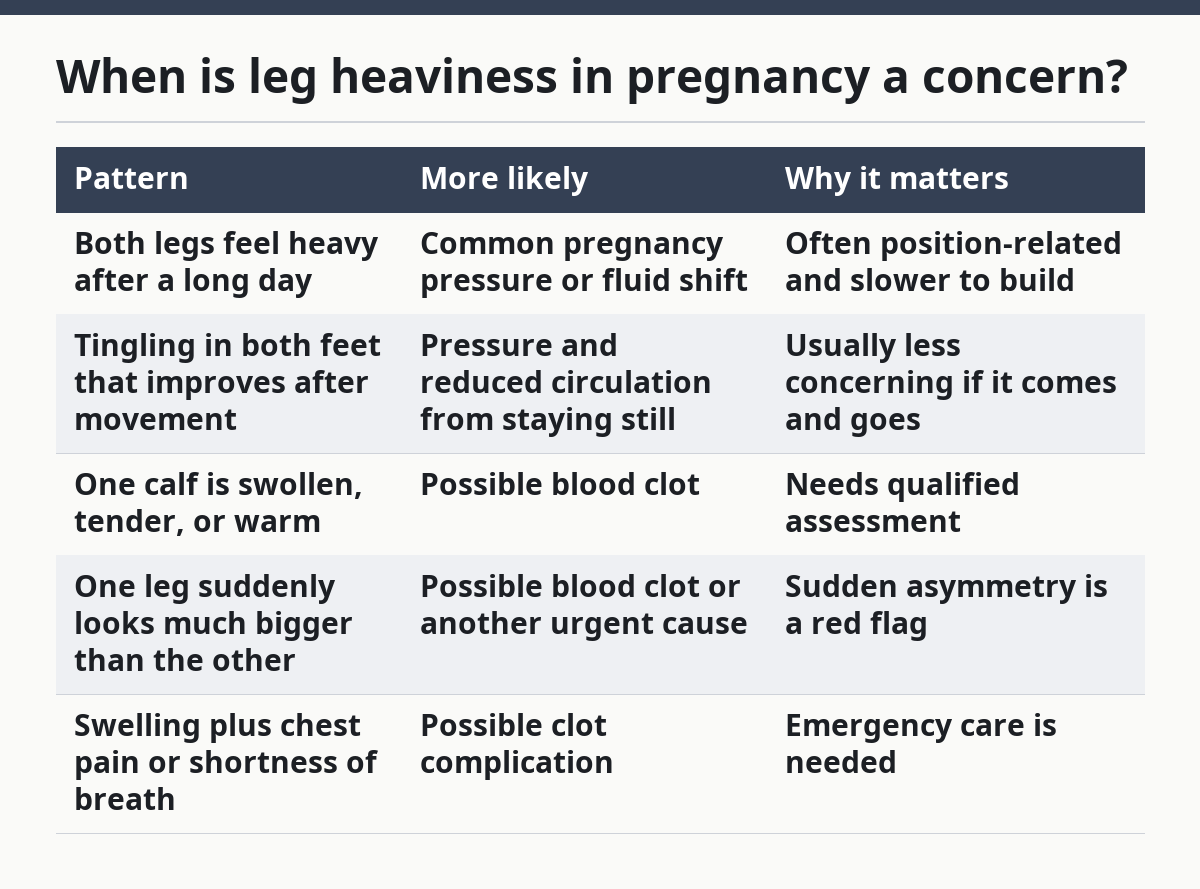
When is leg heaviness in pregnancy a concern?
Leg heaviness in pregnancy is a concern when it becomes one-sided, sudden, painful, or paired with a visible change in size. Heavy legs alone can be ordinary, but heaviness plus calf pain, warmth, or swelling on only one side points to a different category.
Here is a simple comparison of patterns:
| Pattern | More likely | Why it matters |
|---|---|---|
| Both legs feel heavy after a long day | Common pregnancy pressure or fluid shift | Often position-related and slower to build |
| Tingling in both feet that improves after movement | Pressure and reduced circulation from staying still | Usually less concerning if it comes and goes |
| One calf is swollen, tender, or warm | Possible blood clot | Needs qualified assessment |
| One leg suddenly looks much bigger than the other | Possible blood clot or another urgent cause | Sudden asymmetry is a red flag |
| Swelling plus chest pain or shortness of breath | Possible clot complication | Emergency care is needed |
A clot is called a deep vein thrombosis, or DVT, when it forms in a deep leg vein. That term matters because DVT is different from routine ankle puffiness, even though symptoms can overlap.
If the concern is mild and both sides look the same, that is less alarming than a one-sided change. Still, “less alarming” is not “no need to ask,” especially if the symptom is new to you or you have a history of vein problems.
Can one swollen leg in pregnancy be serious?
Yes, one swollen leg in pregnancy can be serious because it can be a sign of a blood clot. One-sided swelling is not proof of a clot, but it is one of the patterns that needs faster attention than ordinary swelling in both legs.
The main risk is that a clot in the leg can stay local or move into the lungs. That is why calf pain, warmth, redness, or a leg that feels distinctly different from the other side matters more than the word “swelling” by itself.
This is where a simple “normal versus not normal” rule breaks down. A person with two swollen ankles after a day on their feet may be dealing with common pregnancy pressure, while a person with one painful calf and a tight sock on only one side may need same-day medical input. If you are not sure which pattern you have, contact a professional rather than trying to decide alone.
ClinicalTrials.gov reflects how active the question still is: trials are registered, but the numbers are modest and the evidence base is not huge for a problem that can affect safety at night. The median planned enrolment is 81 participants, which is not a huge evidence base for a problem that can affect safety at night.
What are the blood clot warning signs?
Blood clot warning signs are one-sided leg swelling, calf pain, warmth, redness, and a feeling that one leg is suddenly different from the other. Shortness of breath or chest pain makes the situation more urgent because it can mean the clot has moved.
The danger is not that every swollen leg is a clot. The danger is that a clot can start with symptoms that feel easy to explain away as “just pregnancy,” especially at night when a person is tired and already uncomfortable. If the pattern changes quickly, seek medical advice promptly. For more detail, see the NHS blood clot symptoms page and Mayo Clinic’s DVT overview.
When should I stop watching it and get help?
You should stop self-monitoring and get qualified help when the symptom is one-sided, sudden, painful, or paired with chest symptoms. Those patterns matter more than how late it is or whether you were already planning to sleep.
- One leg is clearly more swollen than the other: This can fit a clot pattern — seek prompt medical assessment.
- The calf is painful, warm, or tender to touch: This raises concern for DVT — do not wait until morning if the change is new.
- Swelling appeared suddenly over hours, not days: A fast change is more concerning than slow puffiness — contact a qualified professional.
- You also have chest pain, shortness of breath, or a fast heartbeat: This can signal a clot complication — get urgent help now.
- The leg looks red or feels hot compared with the other side: This is not typical “just tired legs” swelling — ask for medical advice promptly.
This is also the point where “it might be nothing” is the wrong standard. The cost of being wrong is too high, and the check is usually straightforward enough that waiting buys very little.
What people get wrong about nighttime circulation symptoms
The most common mistake is assuming that two days of heaviness means the same thing as one sudden swollen calf. Those are different patterns, and they do not carry the same risk.
Another mistake is focusing on the ankle and ignoring the calf. A shoe that feels tight can happen for routine fluid shifts, but a calf that is tender, warm, or visibly larger points somewhere else.
People also dismiss tingling because it sounds vague. Tingling is vague, but it can still be useful when it appears with pressure, position, or asymmetry; the context gives it meaning. If tingling is only on one side and does not ease with movement, that is not a detail to ignore.
A final mistake is waiting for pain to become severe before acting. Blood clots do not have to announce themselves loudly at the start, so a mild symptom with the wrong pattern is more important than a strong symptom with the right pattern.
How does this fit with sleep support and circulation?
This symptom guide fits the broader pregnancy sleep support and circulation topic because night is when circulation discomfort often becomes easiest to notice. If a reader wants the bigger picture of sleep position, circulation, and comfort, the hub page on pregnancy sleep support and circulation is the right place to start.
The useful boundary is simple: comfort measures are for patterns that are bilateral, mild, and familiar; medical assessment is for patterns that are one-sided, sudden, or painful. That boundary is more important than any single remedy or sleep trick. If you want related guidance, see also pregnancy leg cramps at night, swelling in pregnancy, and when to call your midwife.
For context, the current literature skews toward summaries and smaller studies rather than large treatment trials. PubMed and trial-registry results point to a field that is still being refined, which is why cautious, pattern-based advice is more reliable than broad reassurance.
What circulation symptoms are normal in pregnancy at night?
Mild heaviness, light tingling, and some ankle puffiness can be part of normal pregnancy changes at night. They are more reassuring when they affect both legs, improve with movement, and do not come with calf pain or sudden swelling.
When is leg heaviness in pregnancy a concern?
Leg heaviness is a concern when it starts suddenly, affects one side more than the other, or comes with pain, warmth, or redness. Those features make a simple comfort issue less likely and a clot more important to rule out.
Can one swollen leg in pregnancy be serious?
Yes, one swollen leg in pregnancy can be serious because it can point to a blood clot. It is not proof on its own, but sudden one-sided swelling, especially with calf pain or chest symptoms, needs prompt medical assessment.
Drafted with AI; not yet reviewed by a person.
