

Last updated: November 19, 2026
Quick Answer: A pregnancy wedge pillow cover fits only if you match the foam wedge shape, the cover closure, and the stated dimensions before you buy. This guide shows exactly what to check, what to skip, and how to avoid a cover that bunches, zips short, or leaves the foam exposed.
Key Takeaways
- A cover can change how a wedge feels, but it will not fix every sleep problem.
- A cover fits when its dimensions and closure style match the wedge you already own.
- Measure the longest edge, shortest edge, and thickest point first.
- A full-length zipper is usually easiest to check; short zippers, envelope closures, and ties are fussier.
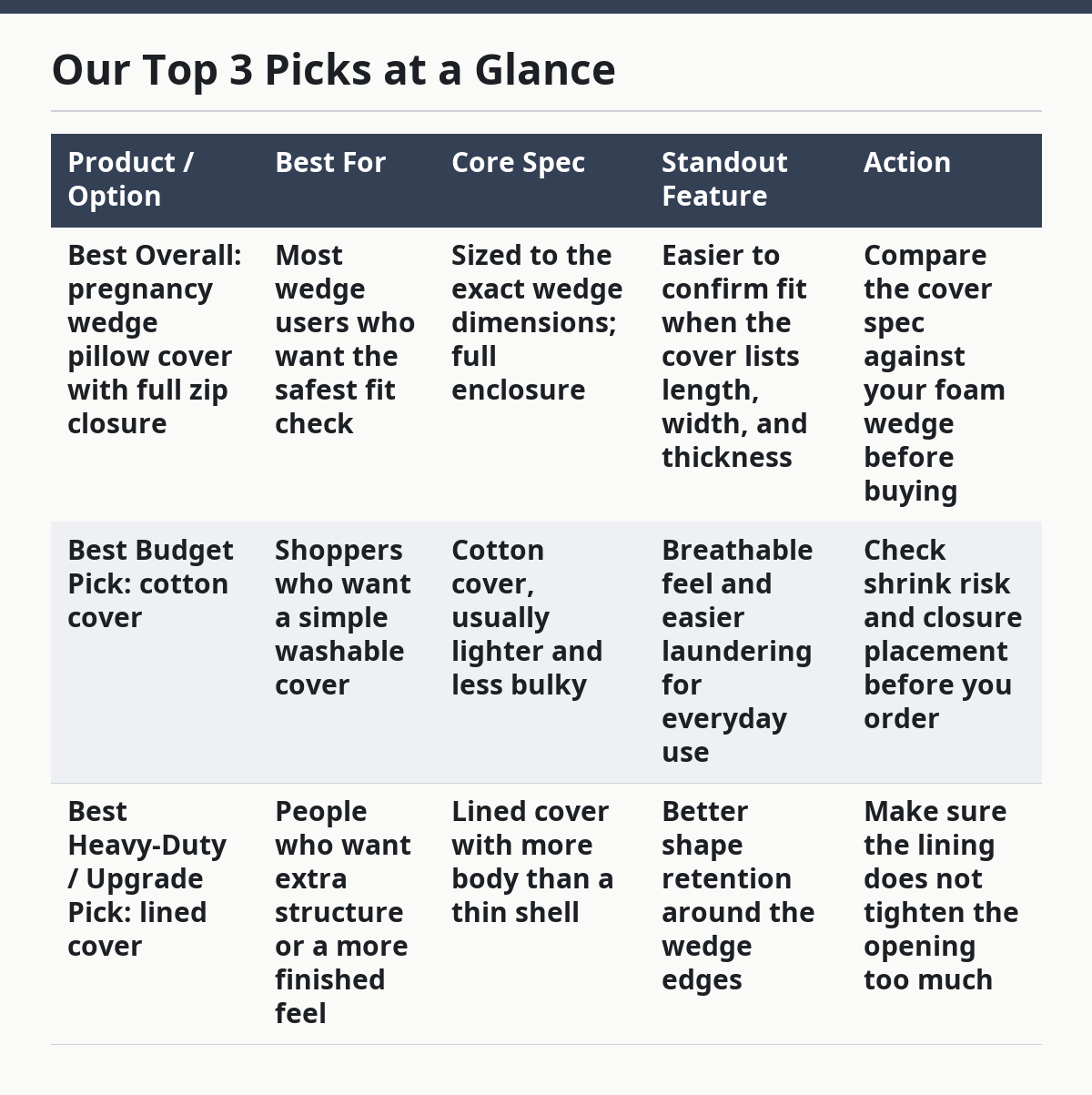
Our Top 3 Picks at a Glance

| Product / Option | Best For | Core Spec | Standout Feature | Action |
|---|---|---|---|---|
| Best Overall: pregnancy wedge pillow cover with full zip closure | Most wedge users who want the safest fit check | Sized to the exact wedge dimensions; full enclosure | Easier to confirm fit when the cover lists length, width, and thickness | Compare the cover spec against your foam wedge before buying |
| Best Budget Pick: cotton cover | Shoppers who want a simple washable cover | Cotton cover, usually lighter and less bulky | Breathable feel and easier laundering for everyday use | Check shrink risk and closure placement before you order |
| Best Heavy-Duty / Upgrade Pick: lined cover | People who want extra structure or a more finished feel | Lined cover with more body than a thin shell | Better shape retention around the wedge edges | Make sure the lining does not tighten the opening too much |
| Product / Option | Best For | Core Spec | Standout Feature | Action |
|---|---|---|---|---|
| Full zip pregnancy wedge pillow cover | Exact-fit buyers | Matched to wedge dimensions | Closes along the full edge, so the foam is easier to fully enclose | Buy if your wedge has a standard triangular shape and listed measurements |
| Cotton cover | Hot sleepers and frequent washing | Washable cover in cotton | Simple care and softer hand feel | Buy if you want a lighter cover and do not need extra structure |
| Lined cover | People who want more structure | Cover with inner lining | Helps the cover hold its shape on a firmer foam wedge | Buy if your wedge is dense or the cover tends to sag on softer fabrics |
Talk to a qualified clinician about your own pregnancy comfort and sleep setup if pain, numbness, reflux, or pelvic issues are part of the picture. A cover can change how a wedge feels, but it does not solve every sleep problem.
What this pregnancy wedge pillow cover guide covers, and what it assumes
This applies if you already have a foam wedge or you are about to buy a pregnancy wedge pillow cover for one. It assumes you know the wedge’s basic dimensions or can measure them with a tape measure before checkout.
Picture this: you have the wedge on your bed, and the cover looks right online but may still miss the corners by an inch. That small mismatch can make the foam shift, wrinkle, or stick out at the seam, and that is what this guide helps you prevent.
A broader pregnancy support literature search on PubMed found 16,996 records for 2016–2026, and the 100 most relevant were read; those figures were computed from PubMed records on 2026-11-06 using the query pregnancy[Title/Abstract] AND support[Title/Abstract] AND humans[MeSH Terms], with the search widened because the full subject had too little published on the exact question. In that sample, many records were reviews, and the median publication year was 2022 with a median study duration of 15 weeks in abstract text. That broader research base is useful context, but the pregnancy wedge pillow cover question is narrower and more practical. See also the pregnancy pillows hub and the sleep support guide if you are comparing shapes.
- Many of the 100 records were tagged Review in NLM publication type.
- Several were tagged Systematic Review.
- A smaller share were tagged Meta-Analysis.
- A few were tagged Clinical Trial or Observational Study.
- The median publication year in that sample was 2022.
- The median study duration in abstract text was 15 weeks.
On the flip side, this page does not compare wedges with body pillows. That topic sits on the hub for pregnancy pillows and support gear, which is the right next stop if you are still deciding on shape. For broader fit questions, see the pillow cover sizing guide and the washable covers page.
How do I know if a pregnancy wedge pillow cover will fit?
A cover fits when its length, width, thickness, and closure style match the wedge you already own. The tricky part is that wedge pillows are not all cut the same, so a cover that sounds “universal” can still be too snug at the thick end.
Picture this: you are looking at a listing that says “fits most wedges,” but your foam has a steep slope and a rounded nose. That is where fit fails most often—at the shape, not the fabric.
- Measure the wedge at three points. Use a tape measure to record the long side length, the short side length, and the thickest point in inches or centimeters. Verify that the cover’s stated dimensions cover all three numbers. If the listing gives only one side, that is a red flag.
- Check the shape, not just the size. A triangular wedge, a rounded wedge, and a cut-corner wedge do not all sit the same inside a lined cover or a thin shell. Verify that the cover is described for the same shape as your foam wedge. If the product photos show a flatter insert than yours, expect slack or strain.
- Look at the closure type. A full zip closure usually gives the clearest fit check because it runs farther along the edge. Verify the zipper starts and ends where the wedge can slide in without forcing the seam. If the opening is short, the foam may compress the fabric and stress the zipper.
- Check seam placement. If the seams sit right at the thick corner, the cover can twist when you lean on it. Verify that the seam lines follow the wedge edge, not cut across the face. If the listing hides seam lines, assume less predictable fit.
- Read the care label before buying. A washable cover is only useful if the fabric can survive regular laundering. Verify whether the care instructions mention machine wash or line dry. If the cover needs delicate handling and you plan frequent washing, it is the wrong match.
- Compare the opening size to the foam shape. The opening needs to pass over the widest part of the wedge without wrestling. Verify that the zipper opening looks long enough for the foam’s height and taper. If you have to fold or squeeze the foam hard to insert it, the fit is off.
- Check whether the cover is intended for travel use. Travel wedges are often smaller and less bulky, so a regular-size cover can bag out. Verify whether the product says travel, standard, or oversized. If the wedge will ride in a tote or suitcase, a loose cover can snag or wrinkle badly.
The best part? These checks work before you buy, so you can rule out the wrong cover in minutes. For practical shopping, compare the listing with a triangle wedge pillow cover page or replacement covers if you already know the foam size.
Which measurements matter most on a wedge cover?
The most useful measurements are the longest edge, the shortest edge, and the thickness at the high end. Those three numbers tell you more than a vague “fits wedge pillows” claim ever will.
Picture this: the cover claims a match, but your wedge is tall enough that the zipper meets resistance halfway up the slope. That means the cover may fit the base and still fail at the peak, which is why thickness matters as much as length.
A good rule is to compare the cover’s measurements against the foam wedge itself, not the old cover if one came with it. Covers stretch a little, but they do not change the shape of the insert.
- Length: match the longest side first.
- Width: check the narrow end and the broad end, because wedges taper.
- Thickness: match the tallest point, especially if the wedge has a steep rise.
- Gusset or depth: if listed, this tells you how much room the cover has for loft and edge shape.
Here’s the catch: two covers can share the same length and still fit differently because one uses a lined cover and the other uses a thin cotton shell. Lining adds body, but it can also reduce give.
The truth is, fit problems usually start with missing dimensions. If the seller gives only one number, you do not really have a size guide yet—you have a guess. Check the same dimensions on the pillow size chart before ordering.
What closure type should I look for?
A full-length zipper is usually the easiest closure to inspect for fit, while a short zipper, envelope closure, or tie-style opening can be fussier. The right closure depends on how often you will remove the cover and how tight the wedge is.
Picture this: you are halfway through changing the cover and the foam catches at the corner because the opening is too short. That is annoying on a throw pillow; on a wedge pillow, it can make the fabric wear out faster at the seam.
A zipper should be smooth, not sharp, and it should sit far enough from the foam edge that the material does not pinch. A hidden zipper can feel nicer against skin, but it is still only as good as the opening length behind it.
- Full zip: best when you want the cleanest insert-and-remove process.
- Short zip: fine only if the wedge is small or flexible.
- Envelope style: simpler, but may leave slack at the pointed end.
- Lined opening: sturdier, but can feel tighter on thick foam.
A closure is not just a convenience feature. It changes how the cover sits on the wedge after washing, and it can decide whether the cover stays smooth or shifts every night. For more detail on closure types, see the zippered covers guide and the closure comparison page.
If you plan to wash the cover often, a zipper that runs wider is usually the safer bet. If you plan to travel with the wedge, a bulky closure can take up extra room in a bag.
How to check fit before you buy, step by step
A fit check works best when you treat the wedge like a shaped insert, not a pillow case. Measure first, compare second, and only then decide whether the cover is worth buying.
Picture this: you have the listing open on one screen and your wedge on the bed. That is the right time to check the numbers, because a guessed fit can still look fine online and fail at home.
- Lay the wedge flat. Put it on a table or bed with the thick side up. Verify that the wedge lies in its normal shape, not compressed. If the foam is bent, your measurements will be wrong.
- Measure the longest edge. Use a tape measure from one end to the other along the base. Verify the number against the cover’s listed length. If the cover is shorter, stop there.
- Measure the narrow edge and thick point. Record the short side and the tallest point. Verify those numbers against the product listing, including any depth or gusset. If the seller does not list depth, that is a fit risk.
- Check the cover opening. Look for the zipper start and end, or the envelope overlap. Verify that the opening looks longer than the wedge’s thickest section. If the opening looks tight in the photo, it probably will be tight in hand.
- Match the shape language. Look for words like triangular, tapered, angled, or contoured. Verify that the shape matches your foam wedge. If the listing says “standard pillow” anywhere, skip it.
- Check the fabric type. Cotton cover, blended knit, or lined cover all behave differently. Verify whether the fabric has stretch or only structure. If the fabric has almost no give, you need a more exact size match.
- Confirm cleaning steps. Find the care note before checkout. Verify whether it can be machine washed, line dried, or spot cleaned. If the care steps are missing, you may be buying a cover that is hard to keep fresh.
- Look for travel fit clues. If you will pack the wedge, make sure the cover will not balloon or snag in transit. Verify that it folds flat and does not have bulky trim. If it looks thick enough to hold its shape like a cushion, it may be awkward for travel.
When should you skip a cover and choose a different one?
You should skip the cover when the shape, closure, or care instructions do not match your wedge. A nearly right cover is still the wrong purchase if it bunches, strains the zipper, or blocks easy washing.
Picture this: the cover fits the length but not the slope, so the foam puckers at the thick end and the seam rides against your skin. That is not a small flaw; it means the cover is built for a different wedge profile.
The listing gives only one dimension: that usually means the seller is not giving enough information for a confident fit — choose a cover with full length, width, and thickness details.
The closure is shorter than the wedge’s thick point: the foam may be hard to insert and remove — pick a full zip closure instead.
The foam shape is rounded but the cover is cut for a sharp triangle: the edges can wrinkle and twist — choose a cover made for a contoured or tapered wedge.
The care label is too restrictive for your routine: if the cover cannot handle regular washing, it will become inconvenient fast — look for a washable cover with clear laundering steps.
The opening looks narrow in the product photos: that often means a tight fit around the top edge — choose a wider opening or a lined cover with more structure.
On the flip side, if your wedge is a standard triangle and the seller lists exact dimensions plus closure type, you are much closer to a safe buy.
What mistakes do people make with wedge covers?
The biggest mistake is buying a cover by image alone. A photo can show color and texture, but it cannot tell you whether the wedge cover will fit a 24-inch base, a 10-inch height, or a tapered nose.
Picture this: the cover looks clean and simple online, but it has a short zipper and no depth listed. That combination often leads to a return, because the foam fits the cover’s look but not the cover’s opening.
Common mistakes include:
- Buying without measuring the wedge first.
- Ignoring the thick end of the foam.
- Assuming all triangular wedges share one size.
- Overlooking shrinkage after washing.
- Forgetting to check whether the opening is long enough.
- Skipping the care label until after the first wash.
A safer process is to measure, compare, and then buy. If you do that, the cover is much more likely to sit flat, wash well, and stay useful.
For readers who want a cleaner shopping path, the cover fit checklist and the wedge pillow care guide can help before checkout.
Is a wedge cover worth it for pregnancy comfort?
A cover can make a wedge feel cleaner, softer, and easier to wash, but it does not change the wedge’s support profile. If the foam angle or height is wrong, the cover will not fix that.
Picture this: you slide into bed expecting a small comfort upgrade, but the wedge still pushes your hips, ribs, or back in the wrong way. In that case, the cover is only a finishing layer, not the solution.
That is why the real value of a cover is fit and maintenance. A good pregnancy wedge pillow cover protects the foam, helps with hygiene, and keeps the wedge usable for longer.
If you already like the support, a well-fitting cover is worth it. If you are still unsure about the wedge itself, it may be better to sort out shape and firmness first, then buy the cover.
Drafted with AI; not yet reviewed by a person.
