

Last updated: November 20, 2026
Quick answer: for most people, the best starting point for how to sleep with swollen legs and feet during pregnancy without making pressure worse is left-side sleeping with the calves and ankles slightly raised. That usually means using pillows to support the whole leg, not stacking the knees high or twisting the hips. If swelling is sudden, one-sided, painful, or paired with headache, vision changes, or shortness of breath, speak to a qualified professional promptly.
Who this applies to
This applies to pregnancy leg swelling, swollen feet, and swollen legs that feel worse at night but do not come with emergency warning signs. It assumes you already have a bed, pillows, and enough room to change position, and that the main problem is comfort and pressure, not a known circulation disorder that needs its own plan. If you are unsure whether your swelling is “just pregnancy swelling,” get qualified advice rather than trying to solve it only with sleep position.
That caution matters because the research base on how to sleep with swollen legs and feet during pregnancy without making pressure worse is broad but mixed. ClinicalTrials.gov listed 12 registered trials for this term, with 4 recruiting and 3 completed at the time of the read. PubMed also shows a continuing flow of studies on pregnancy swelling, sleep position, and lower-limb comfort, which is why practical guidance has to stay flexible.
Key takeaways
- Left-side sleeping is a common starting point for pressure relief because it avoids lying flat on the back for long stretches.
- Raise the lower legs gently, not sharply, so the hips do not twist and the knees do not take the full load.
- Compression socks can help some people during the day, but bedtime use depends on how tight they feel and whether they add pressure at the ankle or calf.
- A pillow under the calves or from thigh to ankle is often better than a single high stack under the feet.
- If swelling is sudden, one-sided, painful, or comes with headache, vision changes, or breathing trouble, get qualified help promptly.
What sleeping position helps swollen legs in pregnancy?
Left-side sleeping with support under the lower legs usually helps swollen legs in pregnancy without adding new hip or back pressure. The aim is to reduce strain on the large vessels in the pelvis and keep the legs from hanging straight down, which can make swelling feel heavier by morning.
A good starting position is side-lying with a pillow behind the back, one between the knees if the hips feel strained, and one long pillow or folded blanket under the calves so the ankles sit a little higher than the knees. A small lift of 5 to 15 cm is often enough to feel the difference; a steep angle often bends the hips and increases low-back pressure.
Here is the practical trade-off: the more you raise the legs, the more likely the pelvis is to rotate. A reader who wakes with hip pain should lower the support and spread it out under the whole lower leg instead of loading the heel alone. That is why a standard “feet way up” pose can backfire.
How should you set up pillows without creating more pressure?
Use pillows to support the whole leg, not just the feet, and stop if your hips or lower back start to feel pinched. The setup that works best is the one that keeps the ankle, calf, knee, and hip in one line while you stay relaxed for at least part of the night.
- Lie on your left side first. Start with your left shoulder and hip facing the mattress. Verify that your belly feels supported and your spine is not twisted. If your upper hip rolls backward, the position is too loose and will stress the back.
- Place one pillow between the knees. Use a pillow that fills the space from thigh to ankle, not just the knees. Check that the top knee does not drop forward. If the inner thighs rub together or the pelvis tips, the pillow is too thin.
- Support the calves, not the toes. Put a folded blanket or pillow under the lower legs so the calves rest on it and the ankles sit slightly higher. Verify that the heel is not digging into the mattress. If the heel burns or tingles, the support is too hard or too low.
- Keep the ankles neutral. Let the feet point forward, not sharply up or down. Check that the ankles are not bent for long periods. If the arch cramps or the toes go numb, the angle is too extreme.
- Use a back cushion if you roll. Place a pillow behind your back to stop a full roll onto the spine. Verify that you can still breathe easily and turn a little. If the cushion forces the ribs forward, it is too bulky.
- Adjust the height before sleep, not after pain starts. Make the setup before you are fully drowsy. Check that the lower legs feel lighter within a few minutes. If pressure builds in the hips within 10 to 15 minutes, reduce the lift.
- Leave room for a simple exit. Keep the blanket loose at the feet so you can move without tugging the calves. Verify that you can turn to sit up without dragging the swollen feet against the mattress. If rising feels stiff or jerky, the layers are too tight.
The main point is not to build a tower of pillows. It is to spread support across 30 to 45 cm of the lower body so the legs rest, the hips stay level, and the mattress does not press hard into one swollen spot. That is often more comfortable than one high wedge.
Should you wear compression socks to bed?
Compression socks are sometimes used for daytime swelling, but bedtime use needs caution because a tight band can create more pressure if the sock rolls or cuts in at the top. The night question is not “compression or no compression forever,” but whether the garment feels even, nonbinding, and comfortable when you are lying down.
Here is the simple comparison:
| Option | Possible comfort effect | Main downside |
|---|---|---|
| No compression at bedtime | No added band at the calf or ankle | Swelling may feel heavier by morning |
| Light, even compression | May feel steadier if the sock fits smoothly | Can bunch, roll, or feel tight when lying down |
| Tight or creased sock | Not a good bedtime choice | Can add pressure at the calf, ankle, or knee |
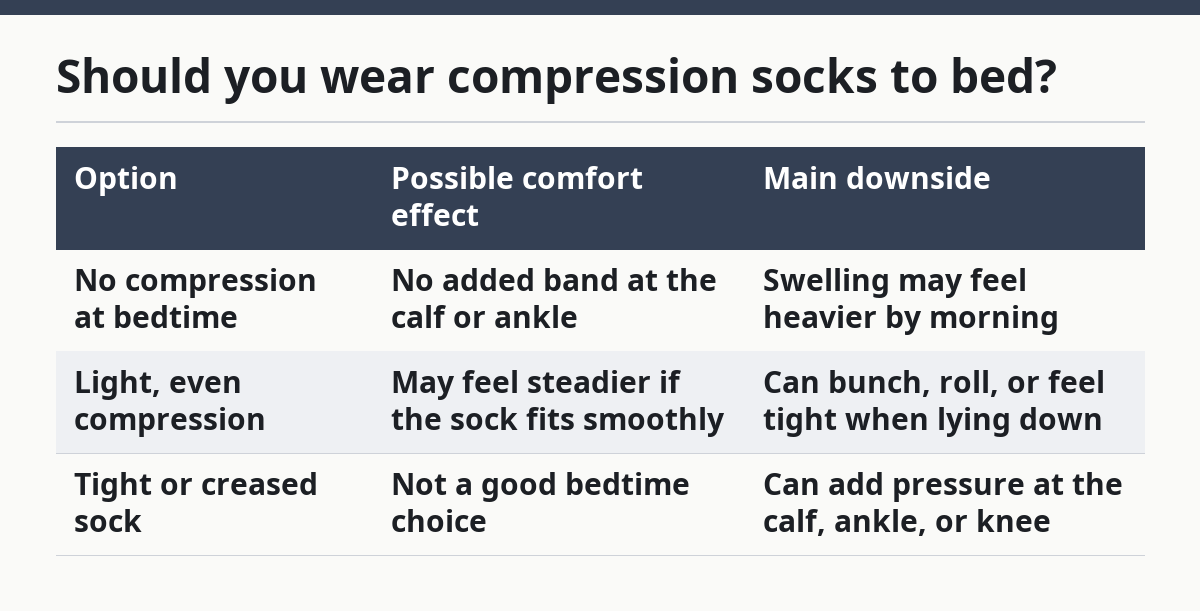
If a sock leaves a deep mark, rolls at the top, or makes the foot feel colder or more cramped, it is working against comfort. A loose bedtime sock is not the answer; steady, even pressure is the version that makes sense here. If you already wear compression socks during the day, removing them before sleep may be the simpler option.
What mistakes make swelling feel worse?
The most common mistake is raising only the feet while the knees stay bent sharply, which puts new pressure on the hips and low back. Another is lying flat on the back for long stretches; that can feel restful for a few minutes, but it often makes pressure and discomfort build.
A third mistake is placing a hard pillow under the heel instead of the whole lower leg. That shifts body weight onto one small point and can leave the heel sore by morning. A fourth is tucking the blanket tight around the ankles, which can trap heat and make the feet feel more swollen.
A fifth mistake is sleeping with the knees pressed together and no pillow between them. That twists the pelvis and can make side sleeping feel worse than it should. A sixth is assuming more height is always better. In practice, a moderate lift that keeps the spine neutral is usually more tolerable than a dramatic angle that stresses the hips.
When should the standard setup change?
The standard side-lying setup should change if the swelling is one-sided, painful, sudden, or paired with other symptoms that do not fit ordinary pregnancy discomfort. That is the point where sleep position is no longer the main issue.
One leg is much more swollen than the other: that pattern does not fit simple bedtime puffiness — get qualified help promptly.
Swelling comes with headache, vision changes, or upper belly pain: those symptoms change the risk picture — seek urgent medical advice.
Shortness of breath or chest discomfort appears at night: that is not a pillow problem — get emergency help now.
The leg is red, warm, or tender in one spot: that can signal something beyond normal swelling — do not try to sleep it off.
The swelling suddenly worsens over hours instead of gradually: that shift deserves assessment — contact a qualified professional soon.
If the usual setup fails but the swelling is ordinary and bilateral, the next move is not more pillow height. Lower the angle, spread the support under the calves, and focus on a neutral spine. The goal is less pressure, not maximum elevation.
How does this fit into pregnancy sleep support and circulation?
This piece is one part of pregnancy sleep support and circulation, and it focuses on the night-time positioning piece only. For many readers, the winning combination is a left-side start, calf support, and a sock choice that does not squeeze at bedtime.
That combination is worth trying because the evidence base is active but still uneven. ClinicalTrials.gov also showed 8 of 12 trials with phase listed as N/A, 2 at Phase 2, and 1 at Early Phase 1, which is a sign that the field is still sorting out what matters most. In other words, how to sleep with swollen legs and feet during pregnancy without making pressure worse is still being studied, and the practical answer is usually to use the least compressive setup that still feels supportive.
For a reader trying to sleep tonight, that means the sensible target is comfort and pressure control, not perfection. If the setup keeps the legs supported, the hips quiet, and the back from aching, it is doing the job.
What if side sleeping hurts my hips?
Side sleeping can hurt the hips if the pillow is too thin, too thick, or placed only under the knees. The fix is usually to widen the support under the whole leg and add a pillow between the knees so the top hip does not collapse forward.
If the hip still aches after 10 to 15 minutes, lower the leg height and try a flatter setup. The hip should feel buffered, not forced open. A hard mattress can make this worse, but that belongs to the bed setup, not this page’s main question.
FAQ
What sleeping position helps swollen legs in pregnancy?
Left-side sleeping with the lower legs gently raised is the usual starting point. The position should keep the hips level and avoid sharp bends at the knee or ankle. If the hip hurts, lower the support and use a pillow between the knees.
Should you raise your legs while sleeping pregnant?
A mild elevation can help, but only if it does not twist the pelvis or press hard on one spot. The best support lifts the calves and ankles together, rather than propping only the feet. If the back or hips ache more, the angle is too steep.
When is swelling in pregnancy a concern at night?
Swelling is a concern at night if it is sudden, one-sided, painful, or comes with headache, vision changes, chest discomfort, shortness of breath, or upper belly pain. Those signs need prompt qualified medical attention. Ordinary pregnancy swelling is usually gradual and on both sides.
Drafted with AI; not yet reviewed by a person.
