

Last updated: November 20, 2026
Quick answer: compression socks and pregnancy sleep can be a reasonable match for some pregnant people, but the best result depends on whether swelling, heavy legs, or leg cramps are actually what is keeping you awake. Speak with a qualified clinician about your own situation, especially if swelling is new, one-sided, painful, or comes with other symptoms.
Key takeaways
- Compression socks are most useful at night when swollen ankles or tired legs are the main sleep problem.
- They are not automatically a bedtime item; some people feel better wearing them in the evening and taking them off before sleep.
- Fit matters as much as the sock itself. A sock that bunches, slides, or pinches can make sleep worse.
- The research base is real but mixed: a PubMed search found 321 records on this topic from 2016–2026, and the 100 most relevant included systematic reviews and randomized controlled trials, read on 2026-11-20.
- If bedtime discomfort increases after putting them on, the sock is the wrong tool for that night.
What do compression socks do in pregnancy?
Compression socks help by applying graduated pressure to the lower leg, which can reduce fluid pooling and make swollen feet and ankles feel lighter. That is why they are commonly discussed for pregnancy swelling, leg heaviness, and circulation support, but that same pressure can feel annoying when you are trying to fall asleep.
The evidence base is broad enough to take seriously, but not neat enough to promise a sleep fix. A PubMed search for pregnancy, sleep, support, and humans found 321 records published from 2016–2026, and the 100 most relevant were read on 2026-11-20. That sample included reviews, systematic reviews, randomized controlled trials, observational studies, meta-analyses, and one clinical trial, which suggests the topic is studied but not settled into one universal bedtime rule.
The practical question is not “Do they work?” in the abstract. It is “Do they help this person sleep tonight without making the feet hotter, tighter, or more irritated?” That trade-off is the whole story.
For a broader overview of pregnancy comfort and sleep, see pregnancy sleep support and swelling in pregnancy.
Who tends to sleep better with them?
Compression socks tend to help sleep most when swelling or leg heaviness is the thing disturbing bedtime. If ankles puff up by evening, the feet feel tight in sheets, or the calves feel heavy after a long day, the socks may make the transition to bed more comfortable.
That does not mean they are right for every pregnant sleeper. Someone whose main problem is heat, skin sensitivity, itching, or a dislike of any firm pressure may feel worse with socks on. The same goes for someone whose legs are already sore from friction, and for anyone whose bedtime routine is built around loose clothing and cool skin.
This is also where the search question gets subtle. Compression socks are not a sleep aid in the same way a pillow is a sleep aid. They are a support tool for lower-leg symptoms that may indirectly help sleep. If the symptom is not present, the socks have less reason to be there.
A useful clue is timing. If the legs feel worst in late afternoon or early evening, a compression sock can fit into the wind-down window. If the discomfort appears only after getting into bed, the issue may be bedding, room temperature, or something else, and the sock may just add one more layer to manage.
Should you sleep in compression socks while pregnant?
Compression socks can be worn to bed by some pregnant people, but they do not have to be worn overnight to be useful. Many people find them more comfortable in the day or evening and prefer to remove them before sleep if they feel tight, warm, or distracting.
The decision is usually about comfort, not heroics. A sock that feels fine at 7 p.m. can feel oppressive at 11 p.m. when body heat rises and the skin wants less contact. If the sock leaves deep marks, bunches behind the knee, or makes the toes feel cold, sleep quality is likely to suffer rather than improve.
For that reason, compression socks and pregnancy sleep often work best when the wear time is flexible. Some people use them for a few evening hours, then take them off before bed. Others tolerate them overnight. Either approach can be reasonable if the legs feel better and the rest of the body stays comfortable.
Here is a practical way to think about the choice.
| Option | What it may help | What can make bedtime worse |
|---|---|---|
| Wear them in the evening, then remove them before sleep | Evening swelling, leg heaviness, transition into bed | Less time in socks, but often more comfort |
| Wear them through the night | Ongoing swelling and heaviness | Heat, pressure, skin irritation, bunching |
| Skip them at bedtime | Hot rooms, irritated skin, pressure sensitivity | Legs may feel heavier or puffier by morning |
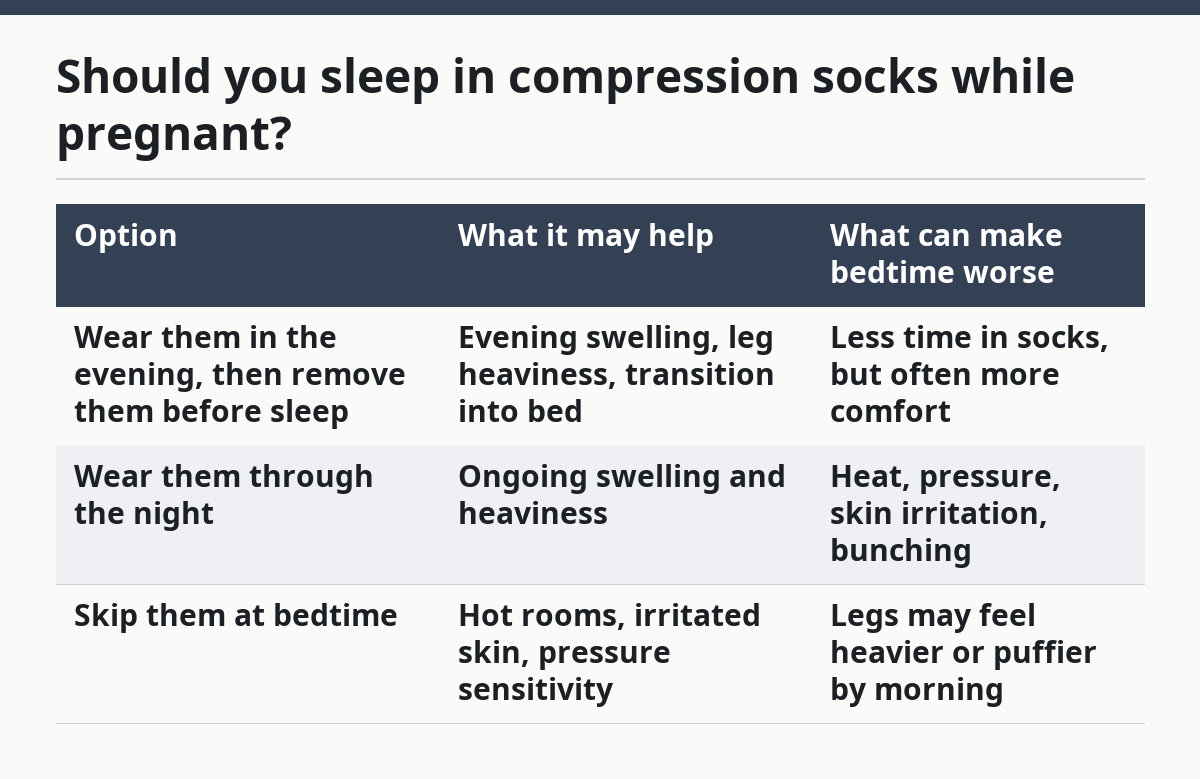
That table is not a prescription. It is a comfort check. If the socks reduce swelling but make sleep lighter or more restless, the nightly trade-off may not be worth it.
How do you keep them from feeling awful at bedtime?
Compression socks feel better at bedtime when the fit, fabric, and timing are right. A few small details usually decide whether they help or annoy.
- Put them on when the legs are clean and dry. Moist skin can make the sock feel sticky, and that can create rubbing.
- Smooth the fabric from ankle to calf so it does not fold or bunch. A fold acts like a tight band.
- Check the top edge before lying down. It should sit flat, not roll or dig in.
- Make sure the toes still feel normal. Cold, numb, or tingling toes are a bad sign.
- Walk a few steps and sit for a minute before bed. If the sock slides down right away, the fit may be wrong.
- Pair them with a regular bedtime routine that already helps the legs relax, such as quiet sitting or elevating the feet for a short time before sleep.
- Re-check after lights out. If the socks are now hotter or tighter than they felt at first, remove them rather than forcing the issue.
The goal is not to “tolerate” compression at all costs. The goal is to see whether the legs feel better without the rest of the body paying for it.
For fitting tips and swelling basics, see pregnancy edema guidance and how to choose compression socks.
When are they the wrong bedtime choice?
Compression socks are the wrong bedtime choice when the pressure, skin contact, or timing makes symptoms worse instead of better. That can happen even if they seemed reasonable in the afternoon.
New one-sided swelling: This can be more than routine pregnancy puffiness — speak with a qualified clinician promptly rather than trying to solve it with socks alone.
Painful swelling with warmth or redness: This is not the usual “heavy legs” picture — stop using the socks and get medical advice the same day.
Toe numbness, coldness, or color change: The sock may be too tight or may be affecting circulation — remove it and do not keep wearing it overnight.
Deep marks, pinching, or skin irritation: The fit or material is not working — switch out of that pair, because pressure points can make sleep worse.
Bedtime heat and sweating: Compression can add another warm layer — if sleep is already disrupted by heat, remove the socks before bed.
Leg cramps that start after the socks go on: The sock may be too tight, bunched, or not the right style — do not assume more pressure will solve it.
These situations matter because the wrong sock can create a second problem while trying to solve the first. Sleep only improves when the legs and the skin both settle down.
If swelling changes suddenly, use pregnancy symptom guidance or seek clinical advice rather than guessing.
What are the most common mistakes?
The biggest mistake is treating compression as a one-size-fits-all fix. In pregnancy, that usually leads to discomfort, not relief. If the fit is uncertain or the symptoms are unusual, ask a qualified clinician or an experienced fitting professional before using compression overnight.
One error is keeping socks on after they start to roll or bunch. The consequence is a tight band effect that can make the calves and ankles feel worse. The better option is to smooth them out or remove them.
Another mistake is choosing bedtime use just because the socks were useful during the day. Daytime comfort does not guarantee nighttime comfort, since heat and restlessness change after lights out. If the socks feel fine at dinner but irritating at 11 p.m., the timing is the issue.
A third error is ignoring skin comfort. Dry, itchy, or sensitive skin can react badly to a snug layer, especially if the room is warm. A lighter bedtime routine may be a better fit than forcing compression through the night.
A fourth mistake is assuming more pressure is better. If the sock feels very hard to pull on, leaves heavy marks, or makes the feet feel trapped, that is not a virtue. The correct alternative is a better-fitting pair or a different schedule, not extra endurance.
A fifth mistake is using socks to push through a symptom that deserves attention. Swelling that is new, uneven, or painful is not just a bedtime nuisance. Compression may be part of the picture, but it should not be the whole response.
When do compression socks make the most sense in pregnancy?
Compression socks make the most sense when swelling and leg heaviness are predictable and mild enough that comfort is the main issue. They are especially useful when the feet feel fuller by evening and the legs feel tired after sitting or standing for long stretches.
The research picture supports cautious use rather than dramatic claims. ClinicalTrials.gov lists 12 registered trials matching this subject; 4 of 12 are recruiting, 3 of 12 are completed, 3 of 12 are enrolling by invitation, and 1 of 12 is terminated, with a median planned enrollment of 81 participants across 12 trials read on 2026-11-20. That suggests active interest, but also a field still sorting out who benefits most and under what conditions.
A separate clue is the shape of the published literature. In the PubMed sample, the median publication year was 2023, and the median study duration mentioned in abstracts was 20 weeks. That points to a topic studied over meaningful stretches of pregnancy, not a quick overnight fix.
For bedtime, the best use is often targeted use rather than automatic overnight wear. If the legs need support before sleep but not all night, the socks can be part of the evening routine and then come off. If the feet are calm and the socks add heat or pressure, bedtime without them may be the better call.
Related reading on compression garments in pregnancy and leg swelling remedies can help if the issue is broader than sock choice alone.
What should you watch for the first night?
The first night should tell you whether the socks are helping the legs more than they are bothering the rest of the body. The signs to watch are simple: less ankle puffiness, less leg heaviness, no toe tingling, no rolling at the top edge, and no extra heat that keeps you awake.
If the socks feel fine for 10 to 20 minutes and then become irritating, that is still useful information. It means the problem is not just initial comfort but overnight tolerance. In that case, a shorter wear window may fit better than sleeping in them.
If they make the legs feel calm but the feet feel trapped, the trade-off is poor. Comfort at bedtime has to include the whole lower leg, not just the swelling. A pair that helps circulation on paper but makes sleep lighter in practice is not doing the job for that person.
Should you sleep in compression socks while pregnant?
Sometimes, but not always. If swelling or heavy legs are the main reason sleep feels difficult, sleeping in them may be reasonable for some people, while others will do better taking them off before bed. If they cause heat, pinching, or numbness, they are not a good overnight choice.
Can compression socks help swollen feet at night?
They can help some people feel less swollen, but they are not a guaranteed sleep fix. The pressure may reduce fluid pooling in the lower legs, which can make feet feel lighter by evening. If the sock is too tight or uncomfortable, though, it can trade swelling for worse bedtime comfort.
When should you wear compression socks in pregnancy?
They are most often worn when leg swelling, heaviness, or standing-related discomfort builds through the day. Some people use them during waking hours and take them off before sleep, while others tolerate them overnight. If symptoms change suddenly or the swelling is one-sided, get qualified medical advice rather than relying on socks alone.
Drafted with AI; not yet reviewed by a person.
