

Last updated: November 20, 2026
Quick answer: use 4 steps tonight—sleep on the side that keeps the more open nostril uppermost, raise your head slightly, use saline close to bedtime, and add moisture if the air is dry. How to sleep with pregnancy congestion when one nostril keeps blocking at night often comes down to changing the conditions that make the nose swell after you lie down. If the blockage is one-sided, painful, bleeding, or paired with fever or shortness of breath, speak to a qualified professional about your own situation.
Key takeaways
- The goal is not to force both nostrils open at once; it is to reduce swelling enough to breathe, rest, and avoid mouth dryness.
- Side sleeping, head elevation, saline rinse timing, and room humidity each help in a different way.
- A method that helps one person can fail for another if the room is dry, the spray is mistimed, or the sleeping position is fighting gravity.
- One-sided blockage is common enough to troubleshoot, but it is not something to ignore if it is severe, persistent, or comes with other symptoms.
What is going on in pregnancy nasal congestion?

Pregnancy nasal congestion is swelling inside the nose that makes one or both nostrils feel blocked, and it often gets worse at night when you lie flat. The nose has a normal cycle where each side can swell and shrink at different times, so one nostril may seem blocked even when the other is more open.
That pattern becomes more noticeable in pregnancy because extra fluid in the tissues and position changes during sleep can magnify it. In the PubMed sample used here, 156 matching records appeared for this topic from 2016 to 2026, and the 100 most relevant were read; the search method was pregnancy[Title/Abstract] AND sleep[Title/Abstract] AND breathing[Title/Abstract] AND humans[MeSH Terms], with PubMed as the database, publication date window 2016–2026, sorted by relevance, on 2026-11-20.
The sleep literature in that sample is mostly review-heavy: 32 of the 100 most relevant records were tagged Review by the NLM, 9 were Meta-Analysis, 9 were Systematic Review, 6 were Observational Study, and 1 was Randomized Controlled Trial. That is a clue that much of the practical advice comes from synthesis and symptom reports, not from a large bank of direct trials on exact sleeping fixes.
How do I sleep when one nostril keeps blocking?
You sleep best by changing the conditions that make the blocked side swell: the angle of your head, the side of your body, the moisture in the air, and the timing of saline. The point is to make breathing easier before the nose fully clogs, not after you are already awake and mouth-breathing.
- Raise the head of the bed or upper body before you lie down. Use bed elevation or an extra support so the upper body is clearly lifted rather than flat; even a modest angle can help drainage and reduce pressure. Verify that your neck stays neutral and you are not sliding down after 10 to 15 minutes. A problem sign is a chin-tucked posture or lower-back strain, which usually means the angle is too steep or the support is too soft.
- Sleep on the side that leaves the more open nostril uppermost. If the left nostril is more blocked, try the right side first, then reverse if the pattern flips. Check after 5 to 10 minutes whether the upper nostril feels freer, since congestion can shift with position. A problem sign is worsening pressure in the ear or face on the lower side, which means the position is not comfortable enough to keep.
- Use saline rinse close to bedtime, not hours earlier. A saline rinse can clear mucus and loosen thick secretions, so it works best when the nose is likely to stay clear long enough to fall asleep. Verify that the rinse feels gentle and that liquid drains out rather than lingering in the nose. A problem sign is burning, ear fullness, or forceful sniffing, which suggests the rinse was too aggressive or rushed.
- Add moisture if the room air is dry. A humidifier can reduce the dryness that makes swollen tissue feel tighter and mouth breathing feel rougher. Check the room for a dry, scratchy feeling in the mouth or nose on waking; that often points to dry air as part of the problem. A problem sign is visible dampness on nearby surfaces, which means the room may be too humid and needs adjustment.
- Keep electronic devices off at least 30 minutes before bed. The CDC advises turning off electronic devices at least 30 minutes before bedtime, which can help settle the body into sleep instead of keeping it alert. Verify that the last 30 minutes are low-light and quiet, because a tense, alert body tends to make breathing feel harder. A problem sign is scrolling in bed, which can delay sleep even if the nose is already open.
- Use a nasal spray only as directed by a qualified professional or product label. “Nasal spray” covers more than one product, and the right choice depends on the ingredient, not just the word on the box. Verify the exact name on the label before use and make sure the spray is intended for your situation. A problem sign is rebound congestion, stinging, or confusion about which spray you are using. Consult a qualified professional or pharmacist if you are unsure which spray is appropriate, and check the NHS guidance on nasal congestion and medicines in pregnancy before using any product.
- Reduce mouth breathing before sleep starts. If the nose is partly open, slow nasal breathing and a calm pace may keep the mouth from drying out fast. Check whether your lips are dry or your throat is scratchy on waking; that often means mouth breathing took over during sleep. A problem sign is waking repeatedly gasping, which needs a broader look at sleep breathing, not just congestion.
The median study duration figure in the PubMed sample is 26 weeks, with a range of 1 to 52 weeks across 38 figures stated in abstract text. That matters because pregnancy congestion is often not a one-night issue; some people need a routine they can repeat through the week, not a single trick.
Which position helps most?
Side sleeping with the less blocked side down often helps most, because it changes how blood and fluid pool in the nose. The upper nostril may have a better chance to open, although the effect can change during the night, so the best position is the one that keeps breathing easiest without causing hip, back, or shoulder pain.
| Option | What it changes | What it can help most | Main drawback |
|---|---|---|---|
| Side sleeping | Shifts pressure and swelling | One-sided blockage that changes with position | Can cause hip or shoulder discomfort |
| Head elevation | Lowers the flat-on-back effect | Nighttime stuffiness and postnasal drip | Too much elevation can strain the neck |
| Saline rinse | Clears mucus and loosens debris | Thick mucus and dry, crusty blockage | Needs timing and gentle use |
| Humidifier | Adds moisture to dry air | Dry nose, dry mouth, scratchy throat | Too much humidity can feel heavy |
| Nasal spray | Depends on the ingredient | Varies by product and advice | Wrong product or wrong use can backfire |
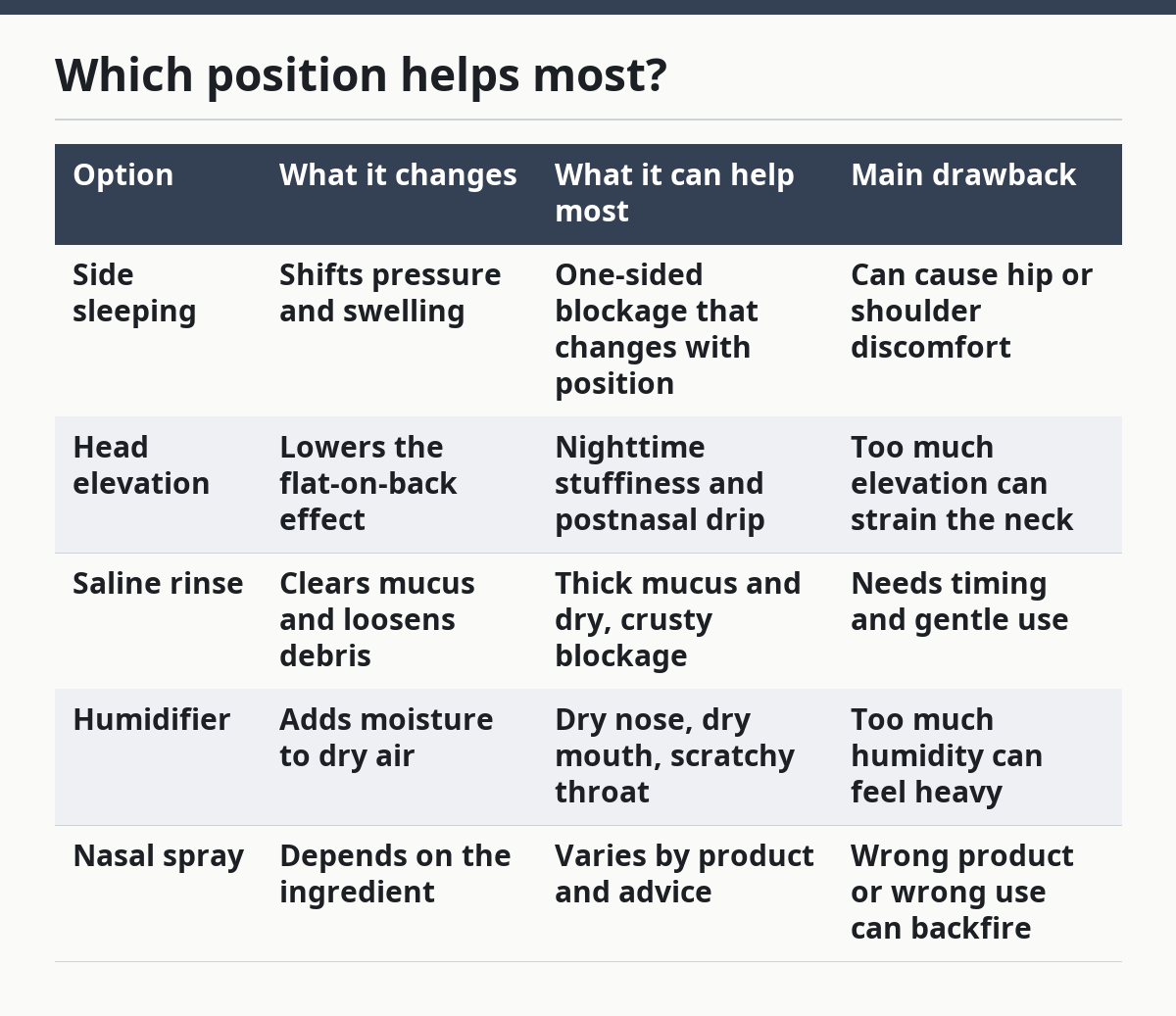
The table is not a ranking. It is a reminder that the best fix often depends on what is driving the blockage that night: dryness, swelling, mucus, or position.
What should I check before bedtime?
You should check whether the problem is mainly dry air, thick mucus, or pure swelling, because each one responds better to a different adjustment. A person waking with a dry mouth may need a different routine than a person whose nose feels stuffed but moist.
Start with the room. If the air feels dry, a humidifier can be the first change to make, because dryness can turn mild swelling into a hard-to-ignore blockage. If the nose feels crusty or clogged with mucus, a saline rinse close to bedtime may help more than extra pillows alone.
Then check position. If the blockage gets worse after lying flat for 5 to 10 minutes, head elevation is worth trying before you assume the congestion is fixed or permanent. If the blockage flips sides when you turn over, that is a clue that sleep position is part of the problem, not the whole story.
When should I stop trying to self-fix it?
You should stop treating this as simple sleep discomfort and get qualified help if the blockage comes with warning signs or does not behave like ordinary pregnancy congestion. The point is not to overreact; it is to avoid missing a different problem that just happens to show up at night. If you are unsure, consult a qualified professional.
One nostril stays blocked day and night for several days: this can mean the problem is not just positional swelling — get checked.
There is fever, facial pain, or thick colored discharge: this can point to infection rather than simple congestion — speak to a qualified professional.
Nosebleeds are frequent or heavy: this can mean the lining is too irritated or there is another cause — get medical advice.
You wake up short of breath or with chest symptoms: this is not routine congestion — seek prompt evaluation.
The blockage comes with severe headache, swelling, or vision changes: this is not a sleep-position issue — get urgent help.
Home steps make no difference after repeated nights: this suggests the routine is not matching the cause — ask for personalized guidance.
A common mistake is to keep forcing the same position for a week because it helped once. That can waste sleep and hide a problem that needs a different approach.
What mistakes make it worse?
The most common mistake is lying flat and expecting the nose to clear on its own. Flat sleep can increase the sense of blockage, especially when the lower nostril swells more from pressure and fluid shift.
Another mistake is using too much force with saline. A rinse should be gentle; if it feels harsh, burns, or leaves the ears feeling full, the technique is too aggressive or the timing is wrong.
A third mistake is adding more and more pillows until the neck bends forward. That can make breathing feel worse by creating neck strain and by preventing the body from settling.
A fourth mistake is treating every spray the same. “Nasal spray” is a category, not one product, so the label matters; the wrong spray or the wrong use pattern can disappoint or irritate. Consult a qualified professional or pharmacist if you are unsure which spray is appropriate, and check the NHS guidance before using any spray in pregnancy.
A fifth mistake is ignoring the mouth. Dry lips, a rough throat, and waking parched can mean mouth breathing is taking over, which makes sleep lighter and comfort worse.
How can I breathe better at night when pregnant?
You breathe better at night by lowering the work your nose has to do before you fall asleep. That usually means a mix of side sleeping, head elevation, saline close to bedtime, and keeping the room from feeling dry.
If the nose is partly open, try a short breathing reset before sleep. A simple nose-unblocking maneuver described by Wyndly is to press the tongue to the roof of the mouth while pressing a finger between the eyebrows for 20 seconds. This is not a cure, and it will not help every person, but it may give brief relief when one nostril is suddenly stubborn. If you are unsure whether it is safe for your situation, consult a qualified professional.
The broader sleep setup still matters more than any single trick. The CDC also advises turning off electronic devices at least 30 minutes before bedtime, which can help the body settle instead of staying alert and tense. A calmer body makes it easier to breathe through a partly blocked nose.
If the problem is mostly mouth dryness, the answer is not to breathe harder. It is to reduce the things that push you into mouth breathing in the first place: flat sleeping, dry air, and late-night screen time.
What does a good night look like?
A good night is not always a fully open nose; it is a nose that stays open enough to let you fall asleep and stay asleep. For many people, that means fewer awakenings, less dry mouth, and less frustration when lying on one side.
A good result usually shows up as one of three things. The blockage shifts to the upper nostril and feels less intense. The mouth stays less dry by morning. Or sleep comes faster because the nose no longer becomes the thing you are fighting for 45 minutes at bedtime.
If none of those changes happen, the routine needs revision. Try the pieces in a different order, watch which one helps most, and involve a qualified professional if the pattern is severe, one-sided in a fixed way, or paired with other symptoms.
Sources
- CDC, About Sleep | Sleep | CDC
- Wyndly, Blocked Nose at Night: Causes and Treatment (2026) | Wyndly
- NHS, Nasal congestion and blocked nose in pregnancy
- PubMed (NCBI), records matching pregnancy, sleep, breathing, and humans, 2016–2026, computed on 2026-11-20
Why does one nostril block more at night in pregnancy?
One nostril can block more at night because lying down changes how fluid pools and how the nasal lining swells. The nose also has a normal side-to-side cycle, so the blockage can seem uneven even when the cause is general pregnancy nasal congestion. If one side stays blocked all day, that is less typical and deserves attention.
What sleeping position helps blocked nose during pregnancy?
Side sleeping usually helps more than flat back sleeping, and the side that leaves the more open nostril uppermost often feels better. Head elevation can help too, because it reduces the flat position that tends to worsen nighttime stuffiness. The best position is the one that eases breathing without causing back, hip, or shoulder pain.
How can I breathe better at night when pregnant?
Use a short routine: raise the head, sleep on the side that feels easier, use a saline rinse close to bedtime, and keep the room from feeling dry. Turn off electronic devices at least 30 minutes before sleep, since a calmer body settles more easily. If shortness of breath or fixed one-sided blockage shows up, speak to a qualified professional.
Drafted with AI; not yet reviewed by a person.
