

Last updated: November 19, 2026
Key Takeaways
- Pregnancy sleep symptoms often come from normal body changes rather than one single cause.
- Common pregnancy sleep changes include trouble falling asleep, waking often, lighter sleep, snoring, heartburn-related waking, vivid dreams, and nighttime urination.
- Some sleep changes are predictable; others deserve review when they come with extra symptoms or feel unusually strong.
- Sleep changes in pregnancy shift by trimester because the body changes by trimester.
Pregnancy sleep symptoms and health signals can be normal, but some changes deserve medical attention. If sleep is suddenly getting worse, breathing changes, leg pain, itching, headaches, or swelling are showing up with it, speak with a qualified clinician about your own situation. Quick answer: sleep changes are common in pregnancy, but new or severe symptoms alongside them should be checked promptly.
What pregnancy sleep symptoms usually mean

Pregnancy sleep symptoms usually reflect normal body changes, not a single problem. A growing uterus, hormone shifts, reflux, nasal congestion, frequent urination, vivid dreams, and uncomfortable legs can all affect sleep, especially in later pregnancy. For an overview of normal and concerning patterns, see the pregnancy sleep tips guide and the pregnancy red flags page.
The tricky part is that the same symptom can be routine in one person and a warning sign in another. For example, waking up to urinate several times is common in pregnancy, but waking with a pounding headache, blurred vision, or sudden swelling is not something to wave off.
This topic has real depth behind it. PubMed contains a large body of pregnancy sleep research, and the overall literature is broad enough to include both reviews and primary studies. The computed date for this set is 2026-10-29, using PubMed (NCBI). The median publication year in the 100-record sample reviewed for this article is 2021, which tells me the question is current, not settled.
The evidence is mostly review-heavy: a substantial share of the relevant PubMed records are review articles, with smaller numbers of systematic reviews, meta-analyses, observational studies, and randomized trials. That matters because the field leans toward synthesis and association, not large intervention trials with simple answers.
Which sleep changes are common in pregnancy?
Common sleep changes in pregnancy include trouble falling asleep, waking often, lighter sleep, snoring, heartburn-related waking, vivid dreams, and a need to pee during the night. Many of these are reported more often as pregnancy advances, though the pattern varies by trimester and by person. If you want a practical starting point, the sleep in pregnancy page breaks down the most common patterns.
A few of the most common mechanisms are mechanical and hormonal rather than mysterious. Progesterone can change breathing patterns and sleepiness, the uterus can press on the bladder, and reflux can wake a person after lying flat. Nasal congestion is also common in pregnancy and can make snoring more likely.
The published literature is broad but uneven. Abstracts often describe studies that follow participants across weeks rather than days, which fits the fact that symptoms shift across gestation. It also means a one-night bad sleep stretch is usually less informative than a pattern that keeps repeating.
That spread tells you something useful: sleep in pregnancy is often studied over months, not days, because symptoms shift across gestation. It also means a one-night bad sleep stretch is usually less informative than a pattern that keeps repeating.
Which sleep symptoms are normal, and which are health signals?
Normal sleep symptoms tend to be annoying but predictable; health signals are symptoms that show up with other changes or feel out of proportion. A headache, swelling, shortness of breath, chest pain, bleeding, fever, severe itch, leg swelling on one side, or reduced fetal movement alongside sleep trouble needs prompt medical review.
A simple way to sort the two is by clustering. If the sleep problem comes with reflux after a late meal, or peeing more often after fluid intake, that points toward a common pregnancy pattern. If it comes with neurologic symptoms, high blood pressure concerns, or a sudden change in how you feel, that is different.
The body gives better clues than the clock. Waking every hour because the bladder is full is one thing; waking because breathing feels blocked, or because you are gasping, is another. Sleep apnea can become more noticeable in pregnancy, especially when snoring is loud or there are pauses in breathing, but only a professional can sort that out. For more on the overlap between sleep and breathing symptoms, the pregnancy breathing changes article is a useful companion.
A full section on warning signs belongs here because generic “pregnancy sleep tips” articles often ignore the real danger: not every sleep symptom is about sleep. The safest judgment is that persistent sleep disruption alone is common, but sleep disruption plus headache, swelling, vision changes, or pain is not a shrug-and-wait situation.
Why do pregnancy sleep symptoms change by trimester?
Pregnancy sleep symptoms change by trimester because the body changes by trimester. Early pregnancy often brings fatigue, nausea, and frequent urination; mid-pregnancy can briefly improve sleep for some people; late pregnancy often brings reflux, back pain, restless legs, breathlessness, and more nighttime waking.
The pattern is not linear. A person may sleep terribly in the first trimester, better in the second, and then worse again near term. Others do the opposite. The point is not to fit a rigid script but to notice what is changing now, and whether the change is mild or paired with a signal that needs review.
Clinical trial registration suggests the field is still trying to pin down what matters most. There are 16 trials registered on ClinicalTrials.gov for this term; 6 of the 16 read are completed, 4 are unknown, 3 are recruiting, and 2 are enrolling by invitation, as registered. Thirteen of the 16 include Phase N/a, and 1 includes Phase 3, with a median planned enrolment of 108 participants across a range of 26–1,600, all from ClinicalTrials.gov and computed on 2026-10-29.
That trial landscape is a clue: many questions remain open, and a lot of the practical guidance still rests on symptom patterns, not hard intervention evidence. It is another reason to avoid overpromising fixes.
What the literature can and cannot tell you
The literature can tell you that sleep changes in pregnancy are common and worth paying attention to; it cannot tell you that every sleep symptom has the same meaning. That distinction matters because the evidence base is heavy on reviews and light on direct trials.
Here is what the publication mix suggests. PubMed records on this topic include many Reviews, Systematic Reviews, and Meta-Analyses, while far fewer records are primary observational or randomized studies. That means the conversation is still largely built from synthesis, not from large head-to-head testing.
This also explains why claims in the area should stay cautious. The research literature includes associations between poor sleep and outcomes such as mood strain, daytime fatigue, and some pregnancy complications, but the direction of causation is not always clear from the abstract level alone. Sleep can be a marker of a problem, a contributor to a problem, or both.
There is also a practical limitation in the evidence that a generic article often skips. Many studies measure sleep with different tools, time windows, and outcome definitions, which makes direct comparison messy. The result is a field that is useful for pattern recognition, but not for turning every symptom into a certainty.
For readers who want the source base behind this kind of overview, PubMed and ClinicalTrials.gov are the main public starting points.
What to do first if sleep is getting worse
The first thing to do is separate comfort problems from health signals and bring the signal list to a qualified clinician. If sleep is worse for several nights in a row, or the symptom pattern is changing quickly, that deserves a conversation rather than guesswork.
For plain sleep disruption, the practical focus is on pattern awareness: what time the waking starts, what symptom wakes you, and whether anything else is happening alongside it. A few examples matter more than a generic “sleep hygiene” list: reflux after lying flat, snoring with pauses, itchy palms or soles, one-sided leg swelling, or headaches that are new or severe. If you are tracking symptoms, a short notes app entry or a simple paper log is often enough; see also the symptom checker for a structured way to record changes.
The article does not need to prescribe a fix to be useful. It needs to help you notice which cluster you are in. That is often the difference between “normal pregnancy discomfort” and “this should be reviewed.”
A second reason to keep the symptom record is that many pregnancy sleep issues are intermittent. A single good night does not erase a week of symptoms, and a single bad night does not define the pregnancy. Patterns over 3 to 7 days are usually more informative than isolated nights, though the exact threshold varies by person and clinician.
What gets missed in generic advice about pregnancy sleep
Generic advice usually misses three things: the timing, the clustering, and the red flags. Timing matters because a symptom in week 10 can mean something different from the same symptom in week 34. Clustering matters because sleep trouble plus headache is not the same as sleep trouble alone. Red flags matter because some sleep-related complaints overlap with blood pressure problems, breathing disorders, anemia, mood symptoms, or liver-related itching.
A second miss is overconfidence. Advice pages often act as if all insomnia in pregnancy is solved by pillows and routine. That can be helpful, but it is not enough when the issue is snoring with daytime sleepiness, severe reflux with vomiting, or itch that is keeping someone awake and waking them from sleep.
The last miss is who the advice is not for. It is not for someone with a sudden change in symptoms, chest pain, fainting, severe shortness of breath, vaginal bleeding, or reduced fetal movement. It is also not for someone who is already worried that the sleep change feels unlike their usual pregnancy pattern. That person should not be talked out of calling.
The evidence base supports that caution. Because the current PubMed sample is review-heavy and the ClinicalTrials.gov set is small, the safest guidance is symptom-driven, not formula-driven.
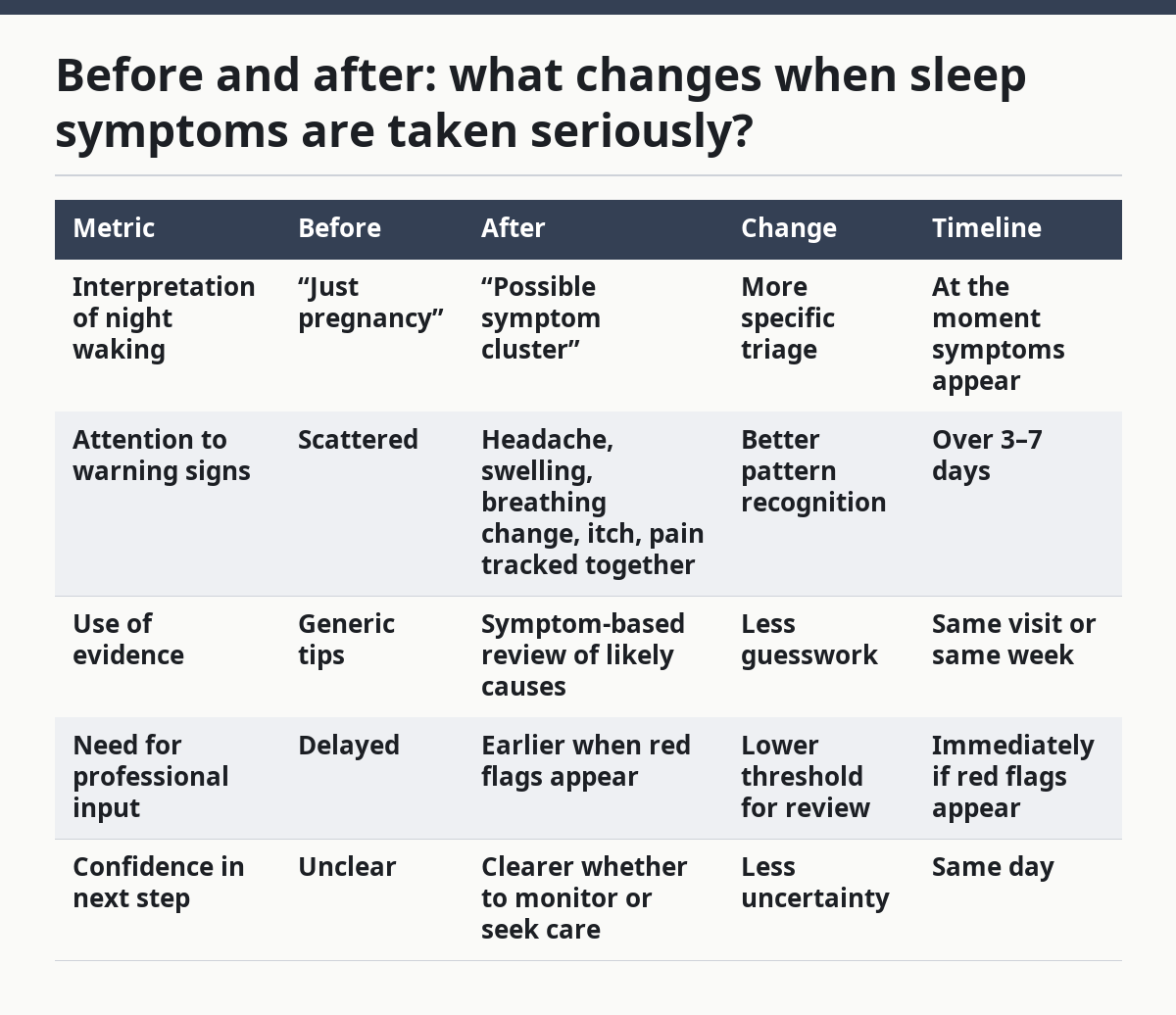
Before and after: what changes when sleep symptoms are taken seriously?
Taking pregnancy sleep symptoms seriously changes what gets noticed, what gets tracked, and what gets escalated. The value is not that sleep becomes perfect; it is that warning signs are less likely to be missed and common causes are less likely to be dismissed.
| Metric | Before | After | Change | Timeline |
|---|---|---|---|---|
| Interpretation of night waking | “Just pregnancy” | “Possible symptom cluster” | More specific triage | At the moment symptoms appear |
| Attention to warning signs | Scattered | Headache, swelling, breathing change, itch, pain tracked together | Better pattern recognition | Over 3–7 days |
| Use of evidence | Generic tips | Symptom-based review of likely causes | Less guesswork | Same visit or same week |
| Need for professional input | Delayed | Earlier when red flags appear | Lower threshold for review | Immediately if red flags appear |
| Confidence in next step | Unclear | Clearer whether to monitor or seek care | Less uncertainty | Same day |
That shift may sound modest, but in pregnancy modest shifts matter. Sleep disruption can be common and still worth evaluating, because the downside of ignoring a signal is larger than the downside of asking.
When should I call a doctor about sleep in pregnancy?
I should call a doctor about sleep in pregnancy when the sleep problem comes with a new or severe symptom, or when the pattern is persistent and unlike usual pregnancy discomfort. Headache, blurred vision, swelling, breathing trouble, chest pain, fever, severe itch, one-sided leg swelling, bleeding, or reduced fetal movement all justify prompt professional advice.
A good rule is to stop treating it as a sleep issue alone once the body starts giving multi-system clues. A sleep change plus pain is different from a sleep change plus nausea, and both are different from isolated insomnia. The details matter more than the label, and if you are unsure, it is safer to consult a professional than to wait.
If the concern is mainly insomnia, snoring, or frequent waking, that still deserves mention at prenatal care, especially if it is lasting more than a few nights. The research literature shows sleep complaints are common in pregnancy, but common does not mean harmless in every case.
The best use of a guide like this is not self-diagnosis. It is knowing when a sleep symptom is just a symptom, and when it is a message.
FAQ
Is waking up a lot at night normal in pregnancy?
Yes, waking up often can be normal in pregnancy, especially when the bladder is full, reflux is active, or discomfort makes it hard to stay asleep. The key question is whether it is happening alone or with other symptoms like headache, swelling, shortness of breath, itching, or pain.
Can pregnancy sleep problems be a sign of something serious?
Yes, they can be. Sleep changes that come with severe headache, vision changes, swelling, breathing difficulty, chest pain, fever, severe itch, bleeding, or reduced fetal movement should be reviewed promptly by a qualified clinician.
Does snoring always mean sleep apnea in pregnancy?
No, snoring does not always mean sleep apnea. Snoring can happen because of nasal congestion or body changes in pregnancy, but loud snoring with pauses in breathing, gasping, or major daytime sleepiness deserves medical attention.
Why does my sleep get worse in late pregnancy?
Late pregnancy sleep often gets worse because reflux, back pain, pressure on the bladder, breathlessness, and restless legs can all become more noticeable. That pattern is common, but it still deserves mention if the change is sudden or paired with other health signals.
Should I mention sleep symptoms at prenatal visits?
Yes, sleep symptoms belong in prenatal conversations, especially if they are persistent or changing. A brief report of when the waking starts, what wakes you, and whether there are other symptoms can help a clinician decide whether the pattern looks routine or needs follow-up.
Drafted with AI; not yet reviewed by a person.
