
Last updated: November 29, 2026
Quick answer: in many cases, pregnancy sleep problems after a good stretch are caused by a new pregnancy change, not by anything you did wrong, and a qualified professional should review sudden or severe changes. This article about pregnancy sleep problems after a good stretch looks at what changed, because hormones, fetal growth, reflux, night waking, and a sleep schedule that no longer fits the night can all play a role. If the change is sudden, severe, or comes with other symptoms, speak to a qualified professional. See Cleveland Clinic and the NHS for general guidance.
Key takeaways
- A good stretch of sleep can fall apart when a new trimester change adds a new trigger.
- The most common culprits are body changes that affect comfort, breathing, reflux, and how often you wake.
- A setback does not always mean something is wrong, but a sudden shift should be checked.
- Re-check the basics first: sleep position, bedtime timing, naps, and any new symptom that showed up with the sleep change.
- If sleep loss comes with warning signs, the problem is bigger than routine pregnancy discomfort.
What changed?
A pregnancy sleep setback usually means a new variable showed up, even if sleep had been steady for weeks. If you are dealing with pregnancy sleep problems after a good stretch, the first question is what changed around the same time. Hormones and increased fetal weight can keep you up at night, according to Cleveland Clinic, and later in pregnancy extra weight can make you feel tired, according to the NHS. Toward the end of pregnancy, the growing fetus is usually blamed for insomnia, also according to Cleveland Clinic.
The timing matters. About 1 in 4 women have insomnia in early pregnancy, the first trimester, according to Cleveland Clinic, and up to 80% report insomnia symptoms by the end of the third trimester, also according to Cleveland Clinic. That spread tells you this is not one single problem. It is a moving target, and the “good stretch” may have ended because the body moved into a new phase.
The main pattern is simple: what helped at 12 weeks may stop working at 28 weeks. By about 17 weeks of pregnancy, most women have gained at least 10 pounds, according to Cleveland Clinic, so even a small change in body load can alter comfort, breathing, or how long you stay asleep. The goal is not to guess one perfect cause. It is to check the new variables in order.
Which changes are most likely?
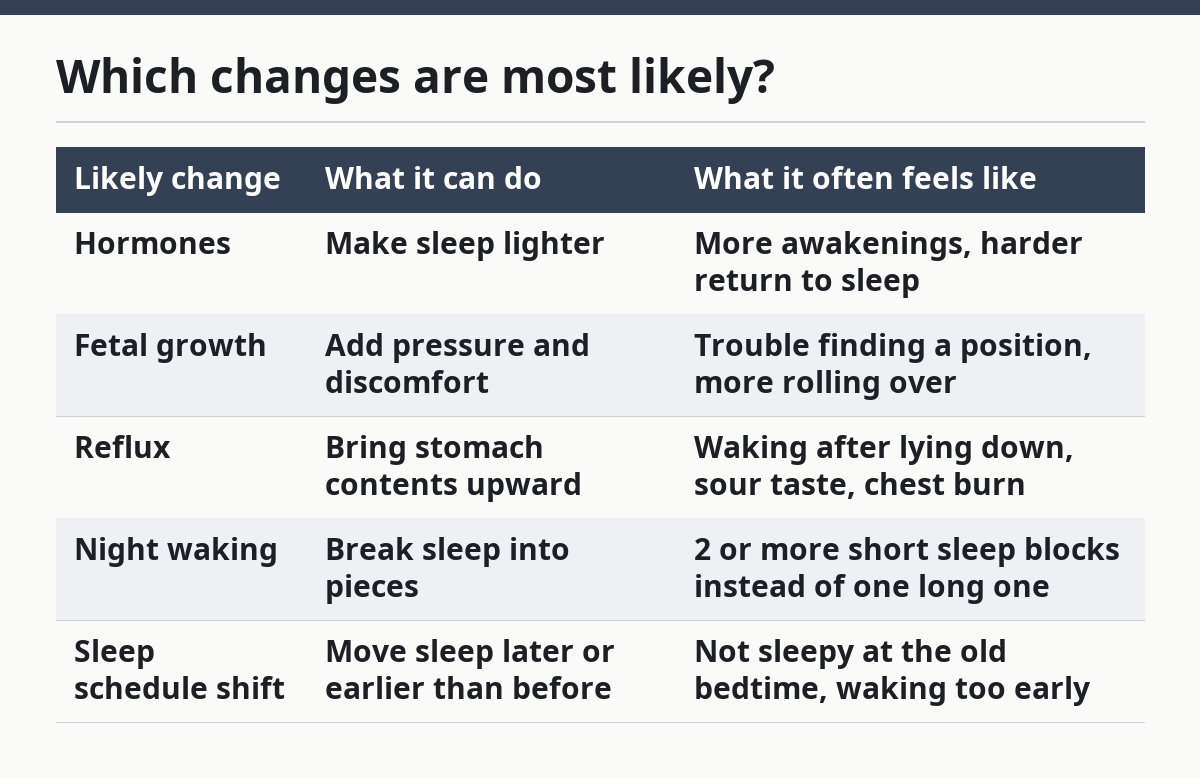
The most likely changes are the ones that alter comfort, airway, stomach pressure, or wake-ups. Pregnancy hormones can raise arousal at night, fetal growth can shift pressure in the abdomen, reflux can break sleep after the first deep stretch, and a sleep schedule can drift until bedtime no longer matches actual sleepiness. If you are looking for pregnancy sleep problems after a good stretch, those are the first clues to compare.
| Likely change | What it can do | What it often feels like |
|---|---|---|
| Hormones | Make sleep lighter | More awakenings, harder return to sleep |
| Fetal growth | Add pressure and discomfort | Trouble finding a position, more rolling over |
| Reflux | Bring stomach contents upward | Waking after lying down, sour taste, chest burn |
| Night waking | Break sleep into pieces | 2 or more short sleep blocks instead of one long one |
| Sleep schedule shift | Move sleep later or earlier than before | Not sleepy at the old bedtime, waking too early |
This is why a generic “pregnancy insomnia” answer often misses the point. The same word can cover several different problems. A shift in trimester can change the dominant trigger in a matter of days, so the new symptom is the clue, not an annoyance to ignore.
What should be checked first?
Start with the change that came closest to the sleep setback. If the sleep problem began after more reflux, more fetal movement, or more daytime tiredness, that detail matters more than the total number of bad nights. The point is to separate a schedule problem from a body problem.
Check whether the sleep position changed, especially after 28 weeks. The NHS says falling asleep on your back after 28 weeks can double the risk of stillbirth, so back-sleeping is not a detail to brush off. That does not explain every sleep problem, but it is one of the first things to re-check if sleep had been going well and then changed.
Then look at the sleep schedule. If bedtime moved later by 1 or 2 hours, or naps got longer, the night may have shifted with it. Cleveland Clinic notes that short naps of no more than 30 minutes can help if you are sleep-deprived, which means a long nap can backfire by pushing the night later. The check here is simple: did the day sleep change before the night sleep did?
How do you troubleshoot it step by step?
A pregnancy sleep regression is usually checked in this order: body changes first, then schedule, then sleep position, then symptoms that need medical attention. The aim is not to fix everything at once. It is to find the newest trigger and see whether it lines up with the new sleep pattern.
- Match the timing. Write down when sleep changed and what else changed in the same 7 days. Verify whether a new trimester, more weight, more reflux, or more night waking started first. A problem is more likely to be real if the sleep change tracks with a new symptom rather than with one random bad night.
- Check sleep position at bedtime. If you are 28 weeks or later, verify that you are not falling asleep on your back. The NHS notes that back-sleeping after 28 weeks can double the risk of stillbirth. A problem here is simple: if the position keeps shifting back, the setup is not working.
- Review the sleep schedule. Compare the last few days with the old pattern and look for a drift of even 1 to 2 hours in bedtime or wake time. Verify whether naps are short, since Cleveland Clinic says naps of no more than 30 minutes can help if you are sleep-deprived. A problem is that a longer nap often steals sleep pressure from the night.
- Look for reflux clues. Notice whether sleep gets worse after lying down, after a large meal, or with a sour or burning feeling. Verify whether the pattern is repeatable across several nights. A problem is that reflux can mimic “just insomnia” while actually being a position or stomach-pressure issue.
- Scan for breathing or comfort changes. Cleveland Clinic notes that weight gain, stuffy nose, and shortness of breath can intensify sleep symptoms during pregnancy. Verify whether the room, position, or timing changes affect the symptom. A problem is that comfort tweaks will not help much if the real issue is breathing-related discomfort.
- Check how often you wake. Count whether the problem is falling asleep, staying asleep, or waking earlier than before. Verify which one is new, because each points to a different trigger. A problem is mixing them up and trying the wrong fix.
- See whether fetal growth has changed the night pattern. Toward the end of pregnancy, the growing fetus is usually blamed for insomnia, according to Cleveland Clinic. Verify whether pressure, kicks, or position changes became more noticeable. A problem is expecting the old sleeping position to work the same way when the body is no longer the same size.
- Decide whether this is still a sleep issue or a medical one. If the change is sudden, severe, or comes with other symptoms, speak to a qualified professional. A problem is treating a medical warning sign like a routine bad night; if that sounds familiar, get medical advice promptly.
This order matters because not every sleep setback has the same cause. A schedule drift can be fixed by tightening timing, while a body symptom may need a different conversation altogether. The safer move is to sort the pattern before trying to force sleep.
When is this not just normal pregnancy sleep trouble?
This is not just routine sleep trouble when the change is sudden, severe, or paired with other symptoms that do not fit the old pattern. The issue may still be pregnancy-related, but the situation is no longer “wait it out and hope.”
Back-sleeping after 28 weeks keeps happening: This matters because the NHS links falling asleep on your back after 28 weeks with a doubled stillbirth risk — change position setup and discuss it with a qualified professional if you cannot stay off your back.
Sleep loss comes with strong shortness of breath: This can point to more than simple restlessness — speak to a qualified professional the same day, especially if the breathing change is new.
Reflux is waking you repeatedly: This suggests stomach pressure is now part of the problem — bring up the pattern with a qualified professional if it is new or getting worse.
The sleep drop started with a major body change: Weight gain, fetal growth, or a new trimester can shift sleep quickly — that is a reason to reassess, not to assume it will pass on its own.
The problem is severe enough that you cannot function: This means the sleep loss has crossed from annoying to significant — speak to a qualified professional rather than trying to manage it alone.
You are thinking about sleep medicine on your own: Cleveland Clinic notes that finding insomnia medication during pregnancy is tricky because many options have not been tested for safety in pregnant women — do not self-start anything without qualified advice.
The point is not to frighten you. It is to avoid treating a change in pregnancy sleep like an ordinary bad night when it may be a sign that the plan needs to change. If you are unsure, consult a professional and use a source such as Cleveland Clinic or the NHS to confirm the next step.
What mistakes make it worse?
The most common mistake is assuming the old fix should still work. Pregnancy changes the body, so a sleep habit that helped for weeks can stop helping once the fetus grows, reflux starts, or the schedule shifts.
Another mistake is taking long naps after a rough night. Cleveland Clinic says short naps of no more than 30 minutes can help if you are sleep-deprived, which implies that longer naps can push night sleep later. The better move is to keep the nap short and see whether the night pattern improves over the next few days.
A third mistake is ignoring back-sleeping because it feels more comfortable. Comfort matters, but after 28 weeks the position itself matters too, according to the NHS. If the body rolls there during sleep, the setup needs to change instead of being blamed on “light sleep.”
A fourth mistake is treating reflux, stuffy nose, or shortness of breath as unrelated. Cleveland Clinic says those changes can intensify symptoms during pregnancy, so the sleep problem may improve only when the trigger is named. If the symptom is new, it deserves more than a generic insomnia label, and a qualified professional should weigh in.
A fifth mistake is assuming medication is the obvious next step. Cleveland Clinic notes that many insomnia medications have not been tested for safety in pregnant women, so this is not a casual self-treatment question. The urge to sleep is real, but the safest route is careful professional guidance.
What if the sleep setback keeps coming back?
A repeating setback usually means the trigger is still active, not that the body is failing at sleep. If the same pattern returns after a few good nights, the most useful clue is what changed on the day before the relapse, not the total number of nights lost.
That is why it helps to keep the problem narrow. If the issue is reflux, the clue is the timing after lying down. If the issue is a schedule shift, the clue is drifting bedtime or a nap longer than 30 minutes. If the issue is body discomfort, the clue is position and pressure. If the issue is something more concerning, the clue is that the sleep change came with other symptoms.
This is also where the broader topic matters. The article belongs to the Pregnancy sleep safety and pregnancy sleep problems hub because the question is not only “Why can’t I sleep?” It is “What changed, and which change is safe to manage as sleep trouble?”
Why this can happen even after weeks of good sleep
Good sleep in pregnancy is often temporary, not permanent. Cleveland Clinic says pregnancy hormones and increased fetal weight can cause discomfort and keep you up at night, and by the end of the third trimester insomnia symptoms are commonly reported. That means a good stretch is real, but it is not a guarantee that the same pattern will hold.
The practical takeaway is simple. A setback after good sleep usually means the pregnancy itself changed the sleep system. The job is to identify the new factor, not to assume the old one came back for no reason.
Why did my pregnancy sleep suddenly get worse again?
A sudden sleep drop usually means a new trigger joined the picture, such as hormones, fetal growth, reflux, night waking, or a shifted sleep schedule. It can also happen when the pregnancy enters a new phase, because the body’s needs change across trimesters. If the change is sharp or comes with other symptoms, speak to a qualified professional.
Does a sleep setback mean something is wrong?
Not always. A setback can happen from ordinary pregnancy changes, and sleep can worsen even after a good stretch. It becomes more concerning when it is sudden, severe, or paired with symptoms like shortness of breath, strong reflux, or trouble staying off your back after 28 weeks.
What should I re-check if sleep was improving?
Re-check the sleep position, bedtime timing, nap length, reflux signs, and any new body changes that started around the same time. A nap longer than 30 minutes, back-sleeping after 28 weeks, or a new trimester shift can all change the pattern. If the problem does not fit a simple schedule issue, get qualified help.
Sources
- Cleveland Clinic, Pregnancy Insomnia: Causes, Diagnosis & Treatment (checked 29 Nov 2026)
- NHS, Tiredness and sleep problems – NHS (checked 29 Nov 2026)
- Cleveland Clinic, Pregnancy: Gestation, Trimesters & What To Expect (checked 29 Nov 2026)
Drafted with AI; not yet reviewed by a person.
