
Last updated: November 20, 2026
In short: if the snoring starts with a blocked nose, changes night to night, and does not come with breathing pauses or major daytime sleepiness, pregnancy rhinitis is more likely; if a partner notices pauses, gasps, choking, or the snoring is loud and persistent with daytime sleepiness, sleep apnea needs a prenatal visit and often a sleep study. Speak to a qualified clinician about your own situation, because pregnancy changes sleep breathing in ways that are easy to misread.
Key takeaways
- A stuffy nose can cause snoring in pregnancy, but it does not explain every case.
- Witnessed pauses in breathing, gasping, choking, and marked daytime sleepiness point more toward sleep apnea.
- Mouth breathing alone can happen with congestion, so it is a clue, not a diagnosis.
- The safest comparison is not “snoring or no snoring,” but “snoring plus which warning signs.”
- If the pattern is unclear, bring partner observations to a prenatal visit and ask whether a sleep study makes sense.
What does the snoring pattern mean?
Pregnancy snoring is more likely to be nasal congestion when the noise tracks with a blocked nose and varies from night to night. Sleep apnea becomes more likely when the snoring is loud, persistent, and paired with breathing pauses, gasping, choking, or heavy daytime sleepiness.
That difference matters because the sound is not the whole story. Snoring can come from narrowed upper airway tissues, while sleep apnea means the airway closes or nearly closes during sleep. In sleep medicine, apnea means a pause in breathing; that is the feature that changes the risk picture, not just the noise.
The comparison most readers need is simple: congestion usually affects airflow through the nose, while sleep apnea affects breathing during sleep itself. Pregnancy can contribute to both, and the same person can have both at once. The safest habit is to look at the snoring along with what happens after the sound starts.
For more background on pregnancy breathing and airway comfort, the broader hub on pregnancy breathing, congestion, and nighttime airway comfort sits above this page.
How do I compare congestion and sleep apnea?
The fastest way to compare them is to check the nose, the breathing pattern, and the daytime fallout together. A single clue can mislead; a cluster of clues is more useful.
| Clue | More like congestion | More like sleep apnea |
|---|---|---|
| Nose | Blocked, stuffy, or alternating sides | Nose may be blocked, but the main issue is breathing during sleep |
| Snoring | Comes and goes, often worse when the nose feels stuffed | Loud, frequent, and ongoing |
| Breathing pauses | Not expected | Witnessed pauses, gasps, or choking |
| Mouth breathing | Common | Common, but not specific |
| Daytime sleepiness | Can happen from poor sleep, but usually mild | Often more noticeable and persistent |
| Partner observations | “You sound congested” | “You stop breathing,” “you gasp,” or “you snore and then go quiet” |
| Sleep study | Usually not the first thought | Often the test that clarifies the problem |
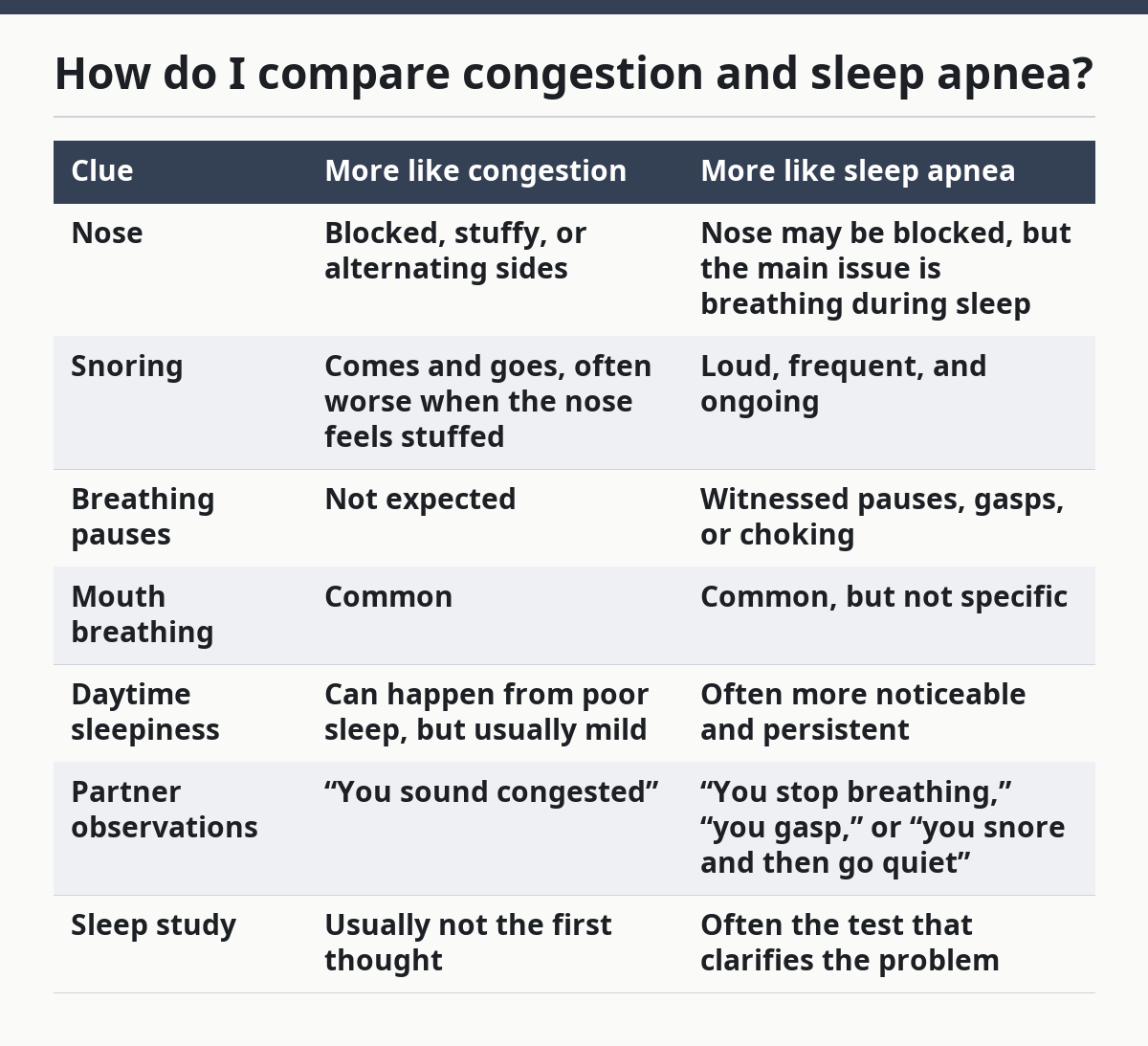
The table is useful because it keeps the focus on the signs that separate simple blockage from sleep-related breathing trouble. The biggest red flag is a witness who sees the breathing stop, even for a short time. A second strong clue is daytime sleepiness that feels out of proportion to a normal bad night.
Pregnancy rhinitis can make the nose swell and force mouth breathing, which can make snoring louder. That still does not explain pauses in breathing. When the picture is mixed, the question is not “Which one is it?” but “Do the warning signs justify a sleep apnea check?”
What clues matter most?
The most important clues are witnessed pauses in breathing, gasping or choking, and daytime sleepiness that keeps showing up. Those signs are more concerning than snoring alone, even if the nose is also blocked.
A partner’s observations matter because the sleeper often does not notice pauses. If the person in the room says you suddenly go quiet, then take a sharp breath, that is not the same as ordinary snoring. A partner may also notice that the snoring changes after the person rolls onto the back, which can make obstruction worse.
Daytime sleepiness matters because it suggests the night sleep is not doing its job. That can happen for many reasons in pregnancy, so it is not proof of sleep apnea by itself. Still, when sleepiness appears alongside loud snoring and breathing pauses, the pattern deserves medical attention rather than guesswork.
Mouth breathing is useful but limited. It often means the nose is blocked, yet many people with sleep apnea also breathe through the mouth at night. That is why mouth breathing should be treated as one clue among several, not as the deciding sign.
What should I check before the prenatal visit?
The best preparation is a short, specific note of what happens over 3 to 7 nights, including what a partner hears and sees. A clear pattern helps a prenatal clinician decide whether the issue sounds like congestion, sleep apnea, or both.
- Write down the snoring pattern for 3 to 7 nights. Note whether it is every night or only some nights, and whether it gets worse on the back or when the nose feels blocked. Verify whether the sound changes with congestion. A problem sign is snoring that stays loud every night, even when the nose seems less blocked.
- Ask a partner to watch for pauses in breathing. Have the partner listen for 5 to 10 minutes after sleep starts and again later in the night. Verify whether there are silent gaps, gasps, or choking. A problem sign is any repeated pause followed by a sudden breath.
- Notice daytime sleepiness once a day. Record whether you doze off while sitting still, reading, or riding in a car as a passenger. Verify whether the tiredness feels new or stronger than before pregnancy. A problem sign is sleepiness that shows up most days and is hard to explain by one bad night.
- Check for mouth breathing and dry mouth on waking. Look for a dry throat, open-mouth sleep, or a feeling that the nose was blocked most of the night. Verify whether these signs match congestion. A problem sign is mouth breathing plus loud snoring plus breathing pauses.
- Note body position. Write down whether the snoring is worse on the back, left side, or right side. Verify whether position changes the noise. A problem sign is snoring that barely changes with position and still comes with pauses or gasps.
- Record any morning headaches or poor-quality sleep. Morning headaches can happen for many reasons, but they add to the picture. Verify whether the headaches or unrefreshing sleep happen along with the snoring. A problem sign is a cluster of headaches, sleepiness, and witnessed breathing pauses.
- Bring the notes to the prenatal visit. A written list is easier to use than a vague memory. Verify whether the clinician thinks the pattern sounds like uncomplicated congestion or something that needs a sleep study. A problem sign is when the note includes pauses, gasps, or choking and no one has raised sleep apnea yet.
This kind of record does not diagnose anything. It helps sort a common pregnancy complaint from a breathing disorder that can be missed if the focus stays on the noise alone.
When is it more than a stuffy nose?
It is more than a stuffy nose when the snoring is paired with breathing pauses, gasps, choking, or strong daytime sleepiness. Those are the signs that move the problem from comfort issue to possible sleep apnea.
Witnessed pauses in breathing: This suggests the airway may be closing during sleep — bring it up promptly at a prenatal visit and ask whether a sleep study is appropriate.
Gasping, choking, or abrupt snorts: These are classic warning signs that the sleeper may be reopening the airway after an obstruction — do not write them off as “just snoring.”
Marked daytime sleepiness: This can mean nighttime sleep is being broken up by repeated breathing events — mention how often it happens and how it affects the day.
Loud snoring that stays loud most nights: Consistent loud snoring is more concerning than snoring that rises and falls with congestion — ask whether further evaluation is needed.
Snoring with mouth breathing and dry mouth every morning: This can happen with congestion, but in combination with pauses or gasps it raises concern — report the full pattern, not one symptom.
Snoring that worries the partner because the breathing seems to stop: Partner observations matter because the sleeper may not hear the pauses — treat that observation as useful clinical information, not an overreaction.
A sleep study is the test that usually sorts out sleep apnea when symptoms are concerning. The American Academy of Sleep Medicine and the American College of Obstetricians and Gynecologists both discuss sleep-related breathing issues in pregnancy, and the National Heart, Lung, and Blood Institute has patient-facing information on sleep apnea. These are the kinds of sources clinicians use when they decide what to check next.
Which option fits which person?
Congestion is the better fit when the nose is the main problem and the breathing signs are mild. Sleep apnea is the better fit when the snoring comes with pauses, gasps, or daytime sleepiness, even if congestion is also present.
| Option | Best fit | Why it fits | Limitations |
|---|---|---|---|
| Likely nasal congestion | Snoring starts with a blocked nose, changes by night, and does not include witnessed breathing pauses | It matches pregnancy rhinitis and simple airflow blockage | It can hide sleep apnea if the breathing signs are not asked about |
| Possible sleep apnea | Loud snoring plus pauses, gasps, choking, or heavy daytime sleepiness | It matches sleep-related breathing obstruction | It cannot be confirmed by symptoms alone; a sleep study may be needed |
For congestion-driven snoring
- Better when the nose feels blocked most of the night.
- Better when the snoring is not paired with pauses or choking.
- Not a good fit if the partner sees breathing stops.
For possible sleep apnea
- Better when the sound is loud and repeated.
- Better when the partner notices silent gaps.
- Not a good fit to dismiss if the daytime sleepiness is getting worse.
My recommendation is to treat the breathing signs as the deciding factor. If the snoring is loud but the breath stays steady and the problem tracks with a blocked nose, congestion is more likely. If the breath itself seems to stop, sleep apnea moves to the front of the list.
What mistakes should I avoid?
The most common mistake is judging by noise alone. Loud snoring can come from congestion, but it can also come from sleep apnea, and the sound by itself does not separate them.
Another mistake is assuming mouth breathing means “just a blocked nose.” Mouth breathing often comes with congestion, but it also shows up in sleep apnea, so it is only one clue. The correct move is to pair it with the other signs.
A third mistake is ignoring the partner’s report because the sleeper feels “mostly fine.” The sleeper often misses the pauses and gasps that a partner hears. The better alternative is to bring the partner’s observations to the prenatal visit in plain language.
A fourth mistake is waiting for the problem to become severe before mentioning it. Sleep study referral decisions are easier when the symptoms are described early and clearly. The correct alternative is to mention loud snoring, pauses, gasps, and sleepiness as soon as the pattern becomes noticeable.
A fifth mistake is trying to settle the question from symptoms alone when the pattern is mixed. That can leave sleep apnea underrecognized. The better alternative is to ask whether the signs justify formal evaluation.
What should happen next?
The next step is to bring the symptom pattern to a prenatal clinician and ask whether the signs point toward a sleep study. That is the step that clarifies the difference when snoring, congestion, and possible apnea overlap.
This topic is not one to solve with guesswork, because the same pregnancy can cause a blocked nose and a breathing disorder at the same time. A symptom list, a partner’s observations, and the question of whether pauses are present usually give the clearest route forward. If the question is still uncertain after that, formal sleep testing is the tool that sorts it out.
For a broader view of nighttime airway comfort in pregnancy, see the hub on pregnancy breathing, congestion, and nighttime airway comfort.
How can you tell if snoring in pregnancy is normal?
Snoring in pregnancy is more likely to be normal pregnancy-related congestion if it tracks with a blocked nose and does not come with breathing pauses, gasps, or choking. The pattern matters more than the sound alone. If the snoring is new, loud, and paired with daytime sleepiness, bring it up at a prenatal visit.
When is snoring in pregnancy a problem?
Snoring in pregnancy is a problem when it is linked with witnessed pauses in breathing, gasping, choking, or strong daytime sleepiness. Those signs make sleep apnea more likely than simple congestion. The safest move is to describe the pattern to a qualified clinician rather than assuming it is only a stuffy nose.
What are the warning signs of sleep apnea during pregnancy?
The warning signs are loud persistent snoring, witnessed pauses in breathing, gasping or choking during sleep, mouth breathing with dry mouth, and daytime sleepiness that keeps happening. A partner’s observations are especially useful because the sleeper may not notice the pauses. If several of these signs appear together, ask about a sleep study.
Drafted with AI; not yet reviewed by a person.
