
Last updated: November 20, 2026
In short: the best sleep support for pregnancy is the setup that keeps pressure off major blood vessels, reduces strain on the hips and back, and lets you rest without waking up sore or dizzy. Because pregnancy changes circulation and sleep in the same weeks, the safest answer is not one perfect product or one perfect pose; it is a set of positions and supports that fit your trimester, your symptoms, and your clinician’s advice.
If you have pain, fainting, shortness of breath, swelling, bleeding, contractions, or a pregnancy with special instructions, speak with a qualified professional about your own situation before changing sleep position or support gear.
Key takeaways
- Side sleeping is the usual starting point after mid-pregnancy because lying flat on the back can press on major blood vessels.
- The goal is comfort plus blood flow, not a rigid pose all night.
- Support between the knees, under the bump, and behind the back can reduce twist and strain.
- A good setup should feel stable in bed and should not leave you numb, dizzy, or short of breath.
- Some symptoms need prompt medical advice, not a new pillow arrangement.
Who is this for?
This guide is for a pregnant person who wants better sleep without making circulation problems worse. It assumes you already know that pregnancy changes body shape, sleep quality, and comfort, and that you want practical support rather than theory.
The core issue is simple. Around 20 weeks, the uterus can press on the aorta and inferior vena cava if you lie on your back, according to Cleveland Clinic, which can affect blood flow and make some people feel unwell. Cleveland Clinic also says pregnancy lasts about 40 weeks, with three trimesters of about 13 weeks each, and that after 20 weeks it is better not to spend the whole night flat on your back.
That does not mean every minute on your back is unsafe, and it does not mean every side-sleeping setup is comfortable. It means the sleep plan should lower pressure, keep the spine from twisting, and leave room for the body to shift during the night.
This article is not for someone looking for a one-size-fits-all rule. It is also not for a pregnant person with a clinician’s instruction to sleep in a certain way because of a medical condition. In those cases, personal advice matters more than general guidance.
Why does sleep position matter for circulation?
Sleep position matters for circulation because the growing uterus can compress large blood vessels when you lie flat on your back. That pressure can reduce blood return from the lower body, which is why some people feel lightheaded, nauseated, sweaty, or simply uncomfortable in that position.
The two vessels most often discussed are the aorta, the main artery carrying blood out of the heart, and the inferior vena cava, the large vein that returns blood to the heart from the lower body. When these vessels are compressed, the effect is mechanical, not mysterious. Blood has a harder path back to the heart, and the body may react with symptoms that improve when position changes.
Cleveland Clinic’s guidance is practical rather than dramatic: pregnancy is about 40 weeks, or 280 days, and each trimester lasts about three months, or 13 weeks. The first trimester lasts until 13 weeks, and by around 20 weeks it is better not to spend the whole night flat on your back. That timing matters because many people do not notice circulation-related sleep issues until the bump has grown enough to change pressure in bed.
A side-sleeping position can help, but the point is not perfection. A body that stays slightly turned, supported by pillows, and able to shift is usually easier to tolerate than a rigid pose held for hours. If a position leaves you dizzy, breathless, or with more pain, that is a sign to change it and to ask for guidance if symptoms persist.
What sleep position works best?
The best sleep position for circulation is usually a side-lying position, with enough support to keep the body from rolling flat onto the back. That is the usual approach after the middle of pregnancy because it reduces pressure on major vessels and often feels better for the hips and lower back.
A common myth is that side sleeping must be exact, all night, and never change. That is too strict and not useful. The better goal is to start on the side, support the body well, and avoid staying flat on the back for long stretches once pregnancy is past about 20 weeks, according to Cleveland Clinic.
Here is a useful comparison of common sleep positions and how they usually fit the circulation question:
| Position | How it affects circulation | Comfort trade-off | Best use |
|---|---|---|---|
| Left side | Often favored because it avoids back pressure | Can strain the shoulder or hip if unsupported | Good starting position for many people |
| Right side | Also keeps the back off the mattress | May still feel better than back sleeping for some | Useful when the left side gets sore |
| Flat on back | Can press on the aorta and inferior vena cava after about 20 weeks | May bring dizziness, nausea, or breathlessness | Usually not the main sleep position after mid-pregnancy |
| Slightly tilted back | Reduces direct pressure compared with flat supine lying | Needs a firm wedge or support to stay stable | Sometimes easier than fully side-lying |
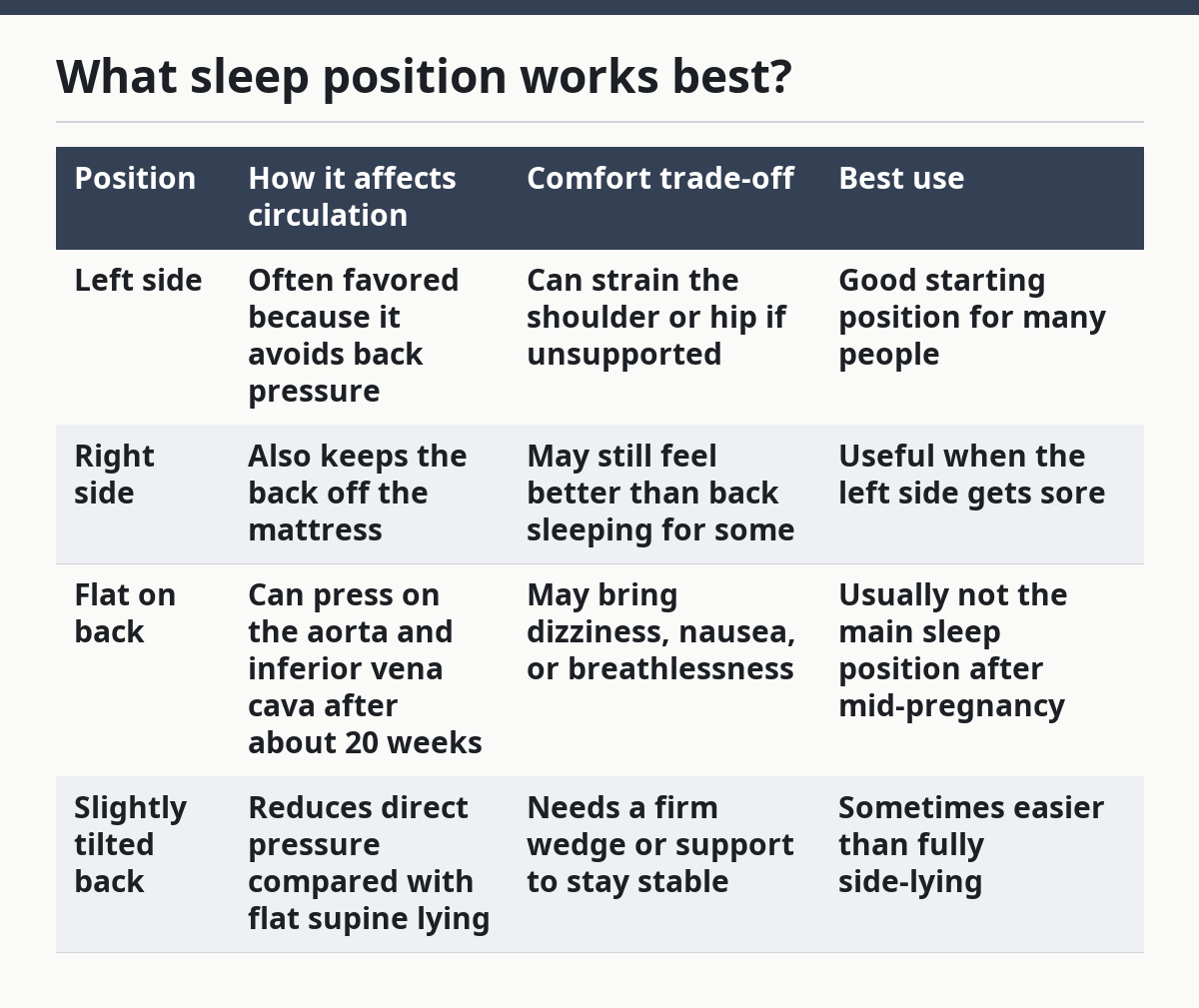
This table is not a prescription. It is a way to think about pressure and comfort together. If a side position hurts your shoulder or hip, the answer is usually better support, not forcing the same angle through the night.
The side that works best can vary. Some people feel better on the left, while others find the right side more comfortable. What matters most is avoiding prolonged flat back sleeping after the point when the uterus can compress major vessels.
How do I set up the bed step by step?
A good sleep setup starts with the side-lying base and then adds support where the body tends to collapse. The aim is to keep the spine neutral, reduce pressure points, and make it easier to stay off the back without effort.
-
Start on your side with your knees slightly bent.
Use a 30 to 45 degree turn from flat back if a full side position feels too abrupt. Verify that your shoulder, hip, and ribs are not stacked in a painful twist. A problem is tingling, a pinched shoulder, or a feeling that you are fighting the mattress. -
Place a pillow or firm cushion between your knees.
Keep the knees separated enough that the top leg does not pull the pelvis forward. Verify that your hips feel level and your lower back is not tightening. A problem is hip pain on the upper side or a sensation that the pelvis is rolling. -
Support the bump from below if it feels heavy.
A small pillow, folded blanket, or wedge under the abdomen can reduce pulling at the front of the pelvis. Verify that the belly feels cradled rather than pushed upward. A problem is pressure under the ribs or more shortness of breath. -
Add a back support if you keep rolling flat.
Tuck a pillow or rolled blanket behind your back so that if you drift backward, the support catches you before you go fully supine. Verify that you can still breathe easily and turn a little in your sleep. A problem is feeling trapped or overheated. -
Keep the head and neck in line with the spine.
Use a pillow height that keeps the neck neutral, not bent hard upward or dropped down. Verify that you wake without neck pain, jaw tightness, or numb hands. A problem is shoulder tension, which often means the pillow is too high or too low. -
Raise the upper body only if flat lying causes discomfort.
A small incline can help some people feel less pressure, but it should not force the pelvis into an awkward angle. Verify that breathing feels easier and the lower back is not arching. A problem is sliding down the bed, which can increase strain. -
Check the setup after you lie down for a few minutes.
Stay still long enough to notice whether dizziness, nausea, or heaviness appears. Verify that the body feels supported without effort. A problem is any repeated symptom that improves only when you change position. -
Review the setup again if you wake in a bad position.
Night movement is normal, so the question is not whether you moved, but whether the setup lets you return to a safer position easily. Verify that turning does not cause sharp pain or breathlessness. A problem is waking often because the supports are bulky or unstable.
This is a support routine, not a rigid checklist. The best arrangement is the one you can return to half asleep without strain.
Which supports help most?
The most useful supports are the ones that reduce twist and keep pressure off sore spots. In practice, that usually means a knee pillow, a bump support, and sometimes a back wedge or body pillow.
A body pillow can help because it gives a single long surface to hug, between the knees, and along the back all at once. A wedge can help when you need a smaller lift under the bump or upper body. A regular bed pillow can work too if it is firm enough to hold position through the night.
Here is the trade-off that many generic guides miss: more padding is not always better. Too many soft layers can create a sagging bed shape, which may twist the spine or make turning harder. Too much height under the head can strain the neck and make breathing feel more effortful.
Support choice also depends on pain location. If the hips hurt, the knees and pelvis need help. If the back feels strained, a back wedge may matter more. If the bump feels heavy, the front of the abdomen may need support so the pelvis does not tip forward.
The wrong support is the one that creates a new problem while solving the old one. If a pillow gives pressure relief but leaves you sliding downhill, waking with shoulder pain, or feeling hot and trapped, it is not the right setup. Better support should reduce effort, not add another job to the night.
What mistakes make sleep and circulation worse?
The most common mistakes are small, but they add up across a full night of sleep. Each one either increases pressure on the back, twists the hips, or makes the bed harder to adjust.
Using a flat-back setup after about 20 weeks: this can increase pressure on the aorta and inferior vena cava, according to Cleveland Clinic — switch to a side-lying or slightly tilted setup instead.
Choosing a pillow stack that is too high: this can strain the neck and make breathing feel off — use only enough height to keep the neck neutral.
Letting the top knee fall forward without support: this can twist the pelvis and worsen hip pain — place a pillow between the knees.
Ignoring dizziness or nausea in bed: this can mean the position is not working for circulation — change position and speak with a qualified professional if the symptom keeps returning.
Building a support system that is hard to escape from: this can make turning at night stressful — use supports that guide your body, not trap it.
Assuming one side is mandatory: this can create discomfort and poor sleep for no good reason — use the side that is tolerable unless you have been given different instructions.
These mistakes are easy to make because the body changes through pregnancy. What feels good at 16 weeks may feel wrong at 28 weeks. The setup should change as the bump grows and as sleep pressure shifts.
When should I stop using a self-set sleep plan?
A self-set sleep plan should stop being the main answer when symptoms suggest something more than ordinary discomfort. In those cases, the issue is not just support; it is the need for qualified medical advice.
Dizziness that happens when you lie on your back: this can fit with vessel compression — change position and seek professional advice if it keeps happening.
Shortness of breath that feels worse in bed: this may mean your position is not tolerable or that something else needs assessment — do not keep forcing the same setup.
Pain, swelling, or numbness that does not ease when you change position: this can point to a problem beyond simple support — get evaluated.
Bleeding, contractions, or fluid leakage: these are not sleep-position issues — contact a qualified professional right away.
A pregnancy with specific medical instructions about rest or positioning: general advice may not fit your case — follow the plan you were given and ask for clarification if needed.
Repeated waking with a racing heart, chest discomfort, or severe lightheadedness: this is not something to troubleshoot with pillows — seek prompt medical advice.
The consequence of waiting too long is that a fixable circulation or pregnancy issue can be mistaken for ordinary sleep trouble. A pillow can help comfort. It cannot replace assessment when symptoms are persistent, severe, or unusual.
What changes in the first trimester, second trimester, and late pregnancy?
The main change across pregnancy is that comfort problems often start small and then grow as the uterus becomes larger. Pregnancy lasts about 40 weeks, or 280 days, and Cleveland Clinic says each trimester lasts about 13 weeks. That gives a rough map for when support needs may change, even though every body is different.
In the first trimester, the sleep problem is often nausea, breast tenderness, or waking often, not vessel pressure. In that phase, a pregnant person may still tolerate many positions, so the priority is comfort and sleep continuity. A support pillow can still help, but the circulation issue is usually less central than it becomes later.
By the second trimester, especially after about 20 weeks, back sleeping becomes more of a concern because the uterus can press on the aorta and inferior vena cava. That is when side sleeping and back support become much more important. It is also when many people start looking for a more permanent pillow setup rather than swapping cushions each night.
In later pregnancy, the same principles still apply, but space gets tighter. The bump is heavier, the hips may ache more, and turning in bed can take more effort. At that stage, the best setup is often the simplest one that still keeps pressure off the back and helps the body turn without strain.
This is why generic advice often fails. A setup that works at 14 weeks may not work at 34 weeks, and the reverse is also true. The right answer is not “one pillow forever”; it is adapting the support to the trimester and the symptom pattern.
FAQ
Is it bad to sleep on my back during pregnancy?
After about 20 weeks, it is better not to spend the whole night flat on your back, according to Cleveland Clinic. The reason is that the uterus can press on the aorta and inferior vena cava in that position. If you wake on your back, just turn onto your side rather than treating it as a disaster.
Which side is better, left or right?
Both side positions are generally more workable than flat back sleeping after mid-pregnancy. One side may feel better than the other depending on hip pain, shoulder pain, reflux, or how the baby lies, but there is no universal comfort rule in the facts given here. The practical test is which side lets you rest with fewer symptoms.
Do I need a special pregnancy pillow?
No special pillow is required, but support that keeps the knees, bump, and back comfortable can help. A body pillow, wedge, or regular pillow can all serve that role if they reduce twisting and let you stay off your back more easily. The best choice is the one you can use without making the bed awkward.
What if I keep waking up on my back anyway?
That is common, and it does not mean you have done something wrong. The useful step is to make the back-rolling position less likely by placing a support behind you and by starting the night on your side. If waking on your back comes with dizziness, nausea, or breathlessness, talk with a qualified professional.
When should I ask for medical help instead of changing pillows?
Ask for help if you have bleeding, contractions, fluid leakage, persistent dizziness, chest discomfort, shortness of breath that worries you, or symptoms that do not improve when you change position. Those are not just sleep-comfort issues. A pillow can help with posture, but it cannot sort out a medical problem.
Sources
- Cleveland Clinic, Pregnancy: Gestation, Trimesters & What To Expect (checked 20 Nov 2026)
- Cleveland Clinic, Facebook (checked 20 Nov 2026)
Drafted with AI; not yet reviewed by a person.
