
Last updated: November 19, 2026
Quick answer: When pregnancy sleep symptoms could mean labor is starting at night, the clearest clue is a pattern of regular contractions, back pressure, mucus changes, or water breaking. Talk to a qualified professional about your own situation, because the same symptoms can also come from late-pregnancy discomfort, not labor. For general labor timing and warning-sign guidance, see the American College of Obstetricians and Gynecologists and the NHS.
Key Takeaways
- Nighttime symptoms suggest labor more when they repeat in a pattern than when they happen once.
- Track timing, changes, and returns to separate sleep symptoms from labor signs.
- Mucus changes and water breaking can both happen overnight, but they are not the same.
- Call labor and delivery when the symptoms show a labor pattern you cannot easily explain, especially if they are regular, getting stronger, or paired with fluid or bleeding.
This guide sorts the overlap between pregnancy sleep symptoms and early labor symptoms, and shows what patterns matter more than one bad night. It also explains when to call labor and delivery, so you can tell restless sleep from a real timing pattern.
What this page covers, and what it does not
This applies to someone in late pregnancy who wakes at night with cramps, pressure, or repeated bathroom trips and wants to know if labor pains are starting. It assumes you already know the basics of pregnancy sleep changes, and it does not try to sort out every emergency signal.
The research base is broad but uneven: 1,022 PubMed records match this query for 2016–2026; the 100 most relevant were read and every median, range, and share below is computed across those records, using PubMed (NCBI) on 2026-11-09. In that sample, the median publication year was 2022.
A lot of the literature is review-heavy, which matters because it means there is plenty of synthesis and not much direct trial work. Of the 100 most relevant records, 31 were tagged Review, 16 Systematic Review, 6 Meta-Analysis, 4 Randomized Controlled Trial, 2 Clinical Trial, and 2 Observational Study, all from PubMed (NCBI). That is a reminder to keep the claims modest.
For broader context on sleep-related pregnancy signals, see the hub on pregnancy sleep health signals and symptom checks and the related guide on when to call labor and delivery.
What this page does not do:
- It does not sort out every urgent symptom.
- It does not tell you how to diagnose labor on your own; if you are unsure, consult your maternity team. See ACOG and the NHS for labor warning signs.
- It does not replace the advice given by your maternity team.
In short: what nighttime symptoms point toward labor?
Nighttime symptoms point toward labor when they come in a pattern, not as one-off discomfort. The pattern usually involves regular contractions, increasing pelvic or back pressure, mucus changes, or fluid leakage that keeps repeating or getting stronger.
Picture this: you’re awake at 2 a.m., your belly tightens, then eases, then tightens again, and you’re trying to figure out whether this is just late-pregnancy misery. The key question is not “Did I sleep badly?” It’s “Is there a labor pattern behind the sleep loss?”
In short: labor is more likely when the symptoms become rhythmic, keep returning, and don’t settle with a change of position or a short rest.
Signs that tend to fit labor better than ordinary sleep disruption:
- Tightenings that come at regular intervals
- A sense of back pressure or cramping that builds
- Mucus that looks different from usual discharge
- A gush or steady leak of fluid
- Symptoms that keep going after you get up, drink, or change positions
The catch is that sleep loss by itself is not a labor test. Late pregnancy can cause insomnia, leg discomfort, heartburn, frequent urination, and a hard time getting comfortable. Those can wake you up for weeks before labor starts.
What regular contractions feel like
Regular contractions are repeated tightening and releasing of the uterus, not a single cramp. In labor, the timing often becomes predictable over a period of hours, and the tightenings tend to feel stronger or closer together rather than random.
Picture this: you time three or four episodes on your phone, and they start to look less like scattered cramps and more like a sequence. That pattern matters more than how dramatic the first one feels.
Look for:
- Start times that can be timed
- Short breaks between episodes
- A repeated wave of pain or pressure
- A pattern that keeps going for 30 minutes or longer
If the episodes stay irregular, shift around a lot, or fade after rest, they are less convincing as labor. That does not make them meaningless. It just means they are not the kind of pattern labor usually builds.
What back pressure and labor pains can add up to
Back pressure can be part of labor, especially if the baby is low in the pelvis or the contractions are felt mostly in the back. It often comes with a deep ache, not just a sharp twinge.
Picture this: you cannot get comfortable in bed, and the ache sits low in your back no matter how many times you turn. When that feeling starts matching a contraction rhythm, it becomes more suspicious.
A useful clue is change over time:
- Pressure that comes and goes with contractions is more suggestive
- Pressure that stays steady all night can come from posture, pelvic strain, or muscle fatigue
- Back pain plus a timing pattern is more concerning than back pain alone
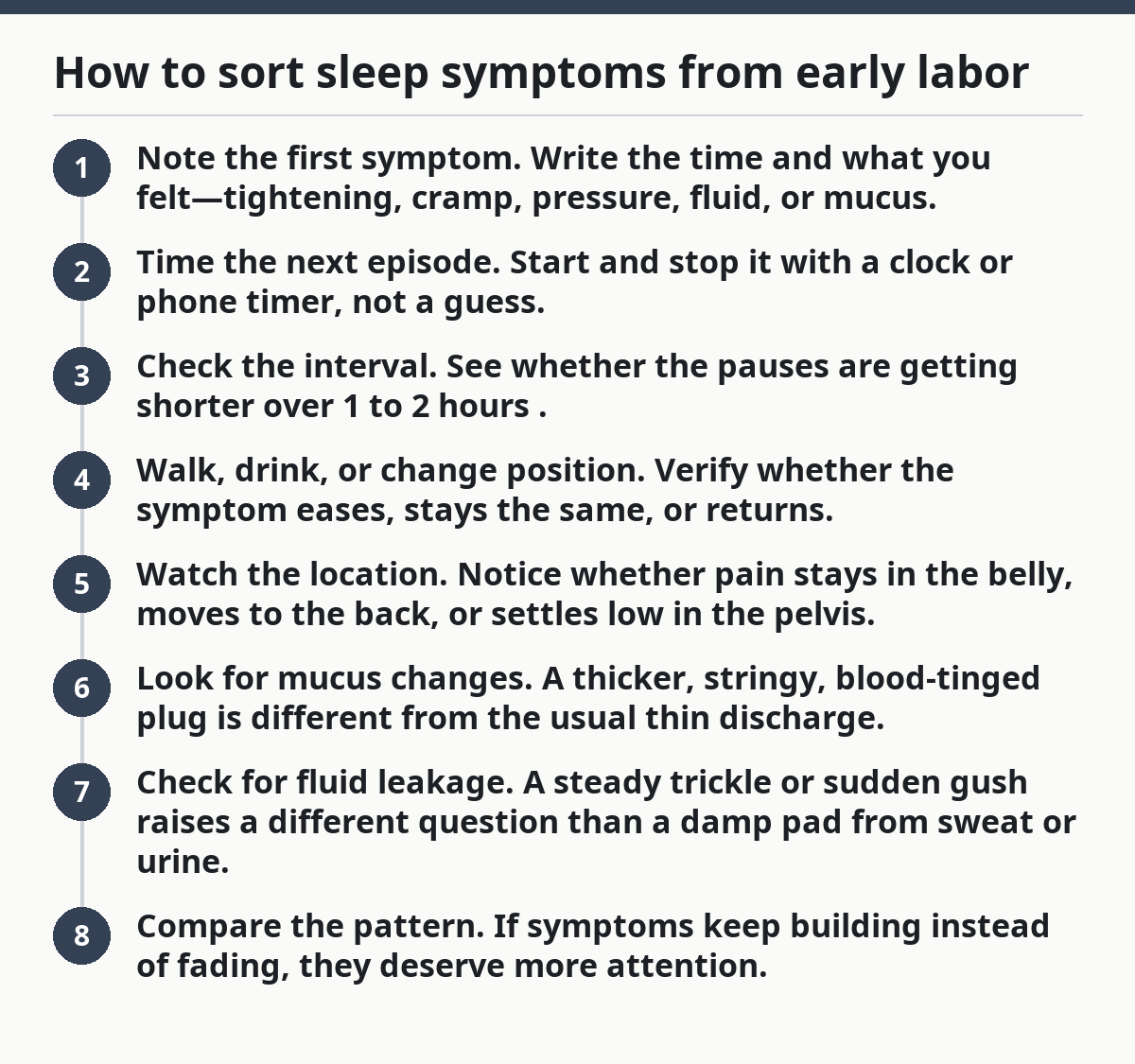
How to sort sleep symptoms from early labor
Sleep symptoms sort into labor or not labor when you track timing, change, and return. That means watching whether the symptom comes back at set intervals, gets stronger, or shows new signs such as mucus or fluid. For labor timing basics, see ACOG and the NHS.
Picture this: you are half-awake, trying to remember whether this is the third cramp in an hour or just another stretch of poor sleep. A simple log is better than memory, because labor patterns often get clearer on paper.
Use this approach:
- Note the first symptom. Write the time and what you felt—tightening, cramp, pressure, fluid, or mucus.
- Time the next episode. Start and stop it with a clock or phone timer, not a guess.
- Check the interval. See whether the pauses are getting shorter over 1 to 2 hours.
- Walk, drink, or change position. Verify whether the symptom eases, stays the same, or returns.
- Watch the location. Notice whether pain stays in the belly, moves to the back, or settles low in the pelvis.
- Look for mucus changes. A thicker, stringy, blood-tinged plug is different from the usual thin discharge.
- Check for fluid leakage. A steady trickle or sudden gush raises a different question than a damp pad from sweat or urine.
- Compare the pattern. If symptoms keep building instead of fading, they deserve more attention.
What indicates a problem is not any single symptom. It is the cluster: repeated timing, increasing intensity, and a change that does not settle with normal rest.
Mucus plug changes, water breaking, and what they mean at night
Mucus changes and water breaking can both happen overnight, and they are not the same thing. The mucus plug is thick cervical mucus; water breaking is a leak or gush of amniotic fluid.
Picture this: you wake up and notice a wet patch or mucus on the toilet paper, then spend the next hour wondering what actually changed. The difference matters because each sign points to a different next step.
Mucus plug clues:
- Thick or jelly-like material
- Stringy discharge
- Pink or blood-tinged mucus
- A change that happens once or over several hours
Water breaking clues:
- A gush or a steady leak
- Fluid that keeps coming back after you wipe
- Dampness that does not behave like normal discharge
The catch is that neither sign proves labor by itself. Some people lose the mucus plug and do not go into labor right away. Some people have fluid leakage that is not obviously a classic gush at first. That is why timing and follow-up matter.
If fluid seems to be leaking, the pattern is more important than the size of the wet patch. A pad that keeps getting wet is a different signal from a one-time spill or sweat from a hot room.
When to call labor and delivery
Call labor and delivery when the symptoms have a labor pattern you cannot easily explain away, especially if they are regular, getting stronger, or paired with fluid or bleeding. This is the place for a real-time check, not a guess.
Picture this: it is night, you are tired, and the symptoms keep returning in a way that no position change seems to stop. A quick call can sort out whether the pattern fits labor or is still too vague.
Use these situations as the line for calling:
- Regular contractions for 1 hour: the timing is stable and getting closer — call for guidance.
- Fluid leaking or a gush: the source is unclear — call now and describe the amount and color.
- Mucus with blood plus contractions: the combination is more suggestive than mucus alone — call and report the pattern.
- Back pressure with a clear rhythm: the pain is no longer random — call and give the timing.
- Symptoms that wake you repeatedly and keep building: the night pattern is changing — call for next steps.
The common mistake is waiting for the pain to feel dramatic. Labor does not always start with a scene; sometimes it starts with a quiet, repeatable rhythm that shows up while you are trying to sleep.
If you are unsure, the safest move is to speak with the maternity line or labor and delivery unit that knows your pregnancy. Their questions are usually focused on timing, fluid, bleeding, fetal movement, and how the contractions behave.
Common mistakes people make at night
People often misread early labor because nighttime makes every sensation feel bigger. Sleep loss blunts judgment, and that makes simple pattern errors more common.
Picture this: you are convinced you just need another hour of sleep, but the symptoms keep circling back. The mistake is not always missing labor; sometimes it is spending too long trying to label one symptom in isolation.
Here are the most common errors:
- Treating one cramp as the whole story. One episode means little; the pattern matters more. The better move is to time the next few episodes.
- Assuming all back pain is labor. Back strain and pelvic pressure can mimic labor and last all night. The better move is to check whether the pain comes in waves.
- Ignoring fluid because it was a small leak. Water breaking does not always look dramatic. The better move is to note whether the wetness returns after wiping.
- Blaming mucus changes on normal discharge. Thick, blood-tinged mucus deserves a closer look than routine discharge. The better move is to compare it with your usual pattern.
- Waiting for sleep to improve first. Labor can start while you are exhausted, and fatigue does not rule it out. The better move is to focus on timing, not on how sleepy you feel.
- Trying to decide only by pain level. Strong pain is not required for early labor, and mild labor can still be real. The better move is to track regularity and change over time.
When the usual sleep advice does not fit
Usual sleep advice does not fit when the symptom is moving toward a labor pattern instead of a comfort problem. If the issue is timing, pressure, or leaking fluid, pillow changes and bedtime routines are not the main question anymore.
Picture this: you have tried turning over, drinking water, and waiting it out for an hour, but the symptoms keep following a schedule. That is not the same problem as ordinary insomnia.
Situations that need a different approach:
- The symptom repeats on a clock: the pattern suggests labor physiology, not simple restlessness.
- The pressure becomes rhythmic: back or pelvic pressure that comes with contractions is different from general discomfort.
- The discharge changes color or texture: mucus plug loss can be normal, but blood-tinged mucus with contractions needs attention.
- There is fluid leakage: wetness that keeps returning should not be handled like routine sleep disruption.
- Symptoms keep building overnight: worsening through the night is a stronger clue than symptoms that fade.
This is where a generic sleep plan stops helping. The right next step is not another pillow or another cup of tea; it is a labor check-in with the people covering your pregnancy.
What a good nighttime labor check looks like
A good nighttime check is brief, specific, and based on a time pattern rather than a feeling. It should leave you with a clearer answer within minutes, not a longer guess.
Picture this: you call and the person asks about timing, fluid, bleeding, and whether the contractions are regular. That is the right shape of the conversation, because it turns a vague sleep complaint into a usable labor screen.
A strong check usually includes:
- When the symptom started
- How long each episode lasted
- Whether the pauses shortened over 1 to 2 hours
- Whether there is mucus, bleeding, or fluid
- Whether the pain is in the belly, back, or pelvis
- Whether the symptom eased with rest or kept returning
A rough log is still better than memory at 3 a.m.
FAQ
Can labor start with sleep disruption at night?
Yes, labor can start with sleep disruption at night if the sleep loss comes with a labor pattern. Repeated contractions, back pressure, mucus changes, or leaking fluid matter more than the wakefulness itself. Sleep trouble alone is common in late pregnancy and does not prove labor.
What nighttime symptoms mean labor may be starting?
Nighttime symptoms that mean labor may be starting include regular contractions, increasing back pressure, mucus plug changes, and water breaking. The key clue is repetition or progression over time. A one-time cramp or a bad night of sleep is much less suggestive than a pattern that keeps building.
Should i call my doctor if sleep problems come with contractions?
Yes, if sleep problems come with contractions that are regular, stronger, or paired with fluid or mucus changes, a call to labor and delivery makes sense. The right detail to report is the pattern, not just the fact that you are awake. A qualified professional can help sort out whether the timing fits early labor.
Drafted with AI; not yet reviewed by a person.
