
Last updated: November 19, 2026
Quick Answer: choose a maternity support belt with firm belly and pelvic support, adjustable straps, breathable fabric, and enough room to stay comfortable from daytime wear into the evening. If pain is strong, uneven, or changing fast, speak with a qualified professional about your own situation. The steps below will help you compare a maternity support belt, a support belt, and a maternity band without guessing.
Key Takeaways
- A maternity support belt should spread weight across your lower belly and pelvis, easing long periods of standing and walking.
- Match support level, fit, and wear time to when soreness shows up most.
- Fabric and fit matter more than brand because they affect heat, pressure, and visibility under clothes.
- Start with short wear blocks, then increase only if the belt still feels comfortable and doesn’t create new pressure points.
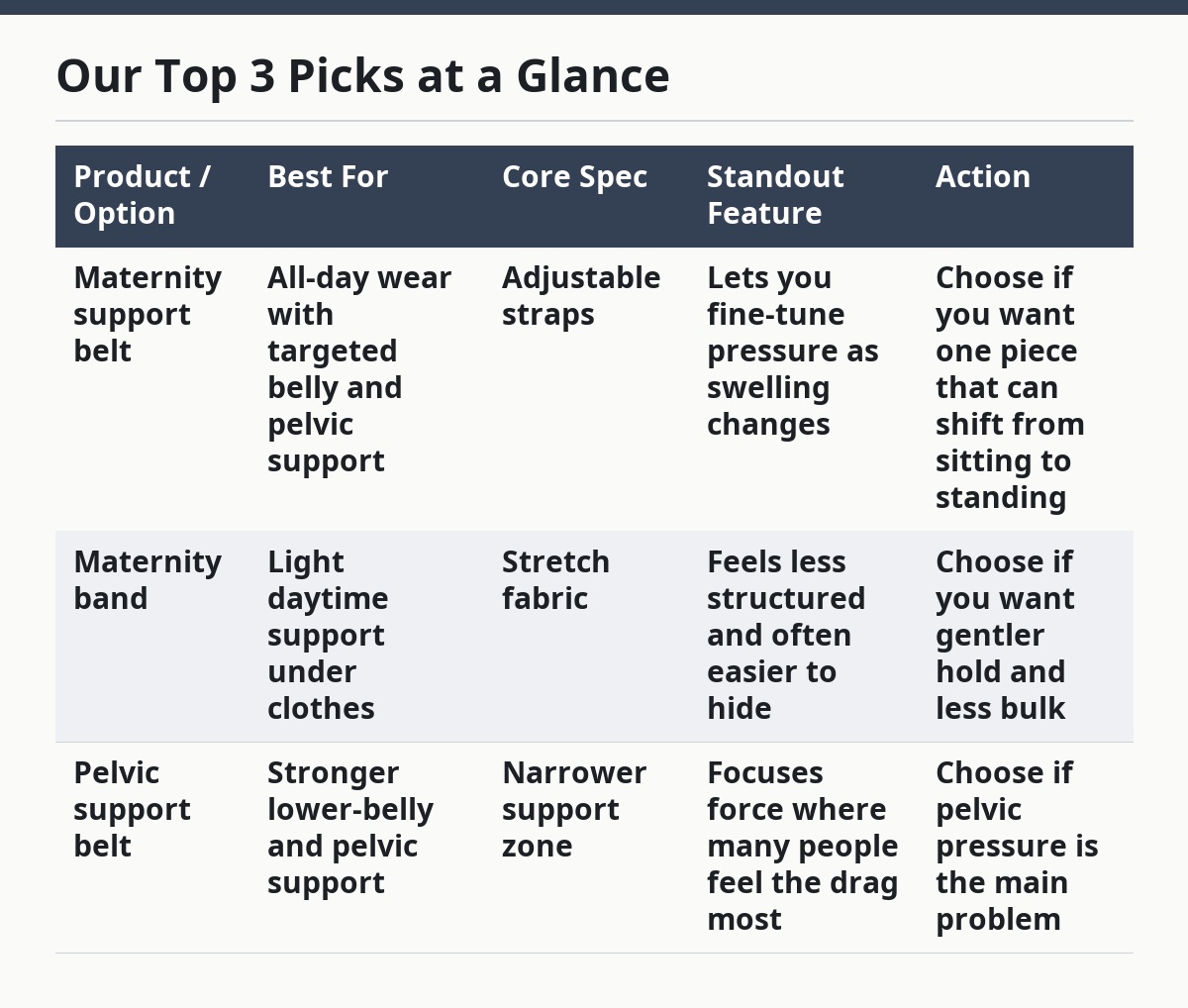
Our Top 3 Picks at a Glance
| Product / Option | Best For | Core Spec | Standout Feature | Action |
|---|---|---|---|---|
| Maternity support belt | All-day wear with targeted belly and pelvic support | Adjustable straps | Lets you fine-tune pressure as swelling changes | Choose if you want one piece that can shift from sitting to standing |
| Maternity band | Light daytime support under clothes | Stretch fabric | Feels less structured and often easier to hide | Choose if you want gentler hold and less bulk |
| Pelvic support belt | Stronger lower-belly and pelvic support | Narrower support zone | Focuses force where many people feel the drag most | Choose if pelvic pressure is the main problem |
| Product / Option | Best For | Core Spec | Standout Feature | Action |
|---|---|---|---|---|
| Maternity support belt | Daytime comfort and evening soreness | Adjustable straps | Balanced belly and pelvic support | Buy if you need one option for work, errands, and later-day soreness |
| Maternity band | Light support under loose clothing | Stretch panel | Low bulk | Buy if your main issue is mild heaviness, not strong pull |
| Pelvic support belt | Lower pelvic pressure | Narrow support panel | More focused compression | Buy if the lower pelvis hurts more than the upper belly |
What a maternity support belt should do for you
A maternity support belt should spread weight across your lower belly and pelvis so standing, walking, and late-day movement feel less tiring. That’s the basic job. It should not feel like a hard brace or a squeeze that makes breathing, sitting, or bending harder.
The point is support, not force. Many belts use adjustable straps so you can change tension as the day goes on.
For a quick evidence check, PubMed shows 16,996 matching records for this broader subject from 2016–2026; the 100 most relevant were read and the medians and shares below were computed from those records on 2026-11-06 using the search pregnancy[Title/Abstract] AND support[Title/Abstract] AND humans[MeSH Terms], with the window widened because the exact topic had too little published on it. Source: PubMed (NCBI).
That broader literature generally treats support gear as comfort gear rather than a cure, but responses vary. If symptoms feel unusual, or if you are unsure what fit is safe for you, consult a professional. Studies suggest benefit can vary by person, fit, and wear schedule.
- Look for a belt that supports the lower abdomen and pelvic area.
- Avoid anything that rides up under the ribs.
- Ask whether the fabric breathes well enough for 8-hour wear days.
- Check for adjustable straps rather than fixed tension.
How do I choose the right maternity support belt?
You choose it by matching support level, fit, and wear time to the part of the day that hurts most. That means the right belt for afternoon standing may not be the right one for late-night soreness if it traps heat or shifts when you sit.
Picture this: you’re already tired by lunch, your belly feels heavy, and every extra step makes the end of the day harder. The right belt should help with that load without turning into another thing you have to fight against.
Use this order.
- Start with your main pain zone. If the pull is low in the pelvis, choose a pelvic support belt; if the belly feels heavy, choose a broader maternity support belt. Verify where the pressure lands when you stand. If the belt only lifts the front and leaves the sides unsupported, the fit is off.
- Match the structure to your day. For desk work and short errands, a lighter maternity band may be enough; for long standing or walking, a firmer belt usually works better. Check whether the belt stays put for at least a full morning. If it creeps upward, it will annoy you later.
- Pick breathable fabric first. A soft knit, mesh panel, or moisture-friendly blend matters if you wear it for several hours. Verify that the fabric does not feel hot after 15 minutes of standing. If it traps heat early, nighttime soreness can feel worse because your skin is already irritated.
- Choose adjustable straps over fixed compression. Adjustable straps let you loosen the belt when you sit and tighten it when you walk. Verify that you can change tension with one hand. If you need to wrestle with it in a bathroom stall, the design is not helping.
- Check how it behaves when seated. Sit, slouch, and lean forward in the fitting room if that’s allowed. A good belt should not fold sharply into the abdomen. If it pinches after 5 minutes of sitting, it will probably bother you all day.
- Look at edge finish and seams. Smooth seams reduce rubbing on the lower belly and side hips. Verify that no hard seam sits directly over a tender spot. If the edge scratches, that’s a wear-time problem, not a small flaw.
- Think about evening soreness, not just morning comfort. A belt that feels great for an hour can still leave you sore if it encourages overuse or is too tight. Verify that you can take it off cleanly and feel no marked pressure lines. If you get numbness, tingling, or worse discomfort, stop using that fit and get professional guidance.
What fabric and fit details matter most?
Fabric and fit matter more than the brand name because they control whether the belt disappears under clothing or becomes a source of heat and pressure. A belt with the wrong cut can feel fine standing up and awful the moment you sit down.
Picture this: you’re trying to get through the second half of the day without tugging at your waist every ten minutes. The details that seem small—elastic quality, seam placement, strap width—decide whether the belt stays useful or turns annoying.
A few details deserve real attention.
- Width of support panel: Wider panels spread pressure better for many people.
- Stretch direction: A belt that stretches only one way may shift less, but it can also feel stiff.
- Closure type: Hook-and-loop fasteners are easy to adjust, but they can wear out or catch on clothing.
- Lining texture: Smooth lining tends to feel better against bare skin.
- Size range: A belt that barely fits on day one is a bad bet for the changing shape of pregnancy.
One common miss is buying the smallest size because it feels “supportive.” Too-small fit can push pressure upward and create more soreness later. Big mistake.
If your belly size changes a lot across the day, the safer choice is a belt with adjustable straps and a generous size range. If your skin is sensitive, a softer lining is worth more than extra stiffness.
How long should you wear it during the day?
You should wear it in short blocks at first, then extend use only if it still feels comfortable and does not create new pressure points. The goal is relief during standing, walking, and chores—not constant squeezing from morning to night.
Picture this: you put the belt on before work, forget it’s there for a while, then realize it’s been helping until the last meeting. That is the kind of pattern you want. A belt should support your day, not become a hard shell.
Use a simple wear schedule.
- Put it on for the part of the day when soreness usually starts.
- Remove it during meals if sitting feels tight.
- Loosen it before long car rides if it pushes into the abdomen.
- Recheck the fit after swelling changes later in the day.
- Wash or air out the fabric often enough that heat and sweat do not build up.
The best approach is a good belt that can flex across the day. The catch is that it still needs breaks. Constant wear can turn a helpful tool into a nuisance, especially if the fit is too firm.
If the belt leaves deep marks, causes skin irritation, or makes it harder to breathe deeply, that fit is too aggressive. If it only helps when you’re moving, that’s normal for many people and not a sign it has failed.
What should I watch for at night?
A belt should usually come off or loosen up well before sleep if it leaves your abdomen sore, hot, or restricted. Nighttime soreness often reflects a long day of load-bearing, so the fix is usually better daytime support, not tighter night wear.
Picture this: you finally lie down and notice the ache that was easy to ignore at noon is now louder. The answer is not to force the belt to do overnight duty. The answer is to use it earlier and in a way that leaves your body calmer by bedtime.
Watch for these signs:
- The belt leaves a clear compression line across the lower abdomen.
- Your skin feels hot, itchy, or rubbed raw.
- The belt shifts when you change sides.
- You wake feeling more compressed than supported.
- The fit changes sharply after sitting for several hours.
On the flip side, a lighter maternity band can sometimes be a better daytime choice if a firmer belt makes evening soreness worse. That usually means the structure is too much for your body or the support is landing in the wrong spot.
Night soreness also changes when the belt is too narrow. A narrow panel may feel fine for an hour and then create one hot pressure point. That is a design issue, not a personal failure.
When should you stop using a maternity support belt?
You should stop using it when the belt creates symptoms that suggest the fit or the situation is wrong for that body and that day. A belt is for comfort support, not for forcing through warning signs.
Picture this: you’re reaching for the belt because standing hurts, but the belt itself starts making you feel worse. That is the moment to stop and reassess.
Shortness of breath while wearing it: the belt is too tight or sits too high — loosen it or stop using it and speak with a qualified professional.
Numbness, tingling, or sharp pain: pressure may be compressing tissue or nerves — remove it and do not keep tightening.
Skin irritation that lasts after removal: the fabric or seam placement is irritating the skin — switch to a softer lining or a different cut.
Pelvic or abdominal pain that worsens instead of easing: the belt may be the wrong support pattern — stop using it and ask about a better fit.
The belt rides up under the ribs: the size or shape is wrong — choose a different panel height or a maternity band instead.
It only feels tolerable when over-tightened: the design is not giving useful support — move to a belt with better strap adjustment.
If symptoms feel severe, sudden, or different from your usual soreness, do not treat the belt as the answer. Consult a professional.
Common mistakes people make with support belts
The biggest mistake is buying for compression instead of support. Compression alone can make the day feel more controlled, but it often creates heat, pressure, and more discomfort by evening.
Picture this: you want one quick fix, so you pick the firmest option on the shelf. Then the belt starts sliding, pinching, or making sitting miserable. That is how the wrong choice wastes money and time.
Here are the mistakes that show up most often.
- Wearing it too low: the belt slides and stops supporting the belly. The fix is to position it so the lower belly and pelvis share the load.
- Buying too small: pressure shifts upward and worsens discomfort. The fix is a size that fastens without strain.
- Ignoring fabric heat: sweat and rubbing build up fast. The fix is breathable fabric and smooth seams.
- Using the same tension all day: swelling and posture change. The fix is adjustable straps and regular readjustment.
- Expecting it to solve every ache: some pain comes from sleeping position, activity, or a separate issue. The fix is to treat the belt as one tool, not the whole plan, and consult a professional if symptoms do not settle.
A belt that helps in the morning but fails by 3 p.m. is still telling you something useful: the fit or model is wrong for your routine. That feedback is worth more than a fancy label.
Where the standard guidance does not apply
Standard guidance changes if your soreness is one-sided, rapidly worsening, or clearly not tied to movement and posture. It also changes if the belt makes you feel worse within minutes instead of helping after adjustment.
Picture this: you’re shopping as if every belly ache is the same, but your body is giving a different signal. That’s where a one-size rule breaks down.
Use a different approach in these cases.
- If the belt keeps slipping because your shape changes a lot during the day, choose one with stronger adjustable straps and a wider fit range.
- If the lower pelvis is the main issue, a pelvic support belt may fit better than a broad maternity band.
- If you run hot or have sensitive skin, prioritize mesh panels and soft lining over firmer structure.
- If sitting is your worst time, check the belt while seated, not just standing.
- If you already know a certain seam, closure, or height bothers you, avoid that design even if the rest looks good.
The real rule is simple: the belt should help the day, not fight it.
Drafted with AI; not yet reviewed by a person.
