

Last updated: November 19, 2026
Quick answer: in about 7 to 14 nights of tracking, pregnancy sleep problems may mean anxiety rather than a sleep schedule issue if racing thoughts, body tension, and repeated night waking keep showing up. Pregnancy sleep problems can be anxiety, not just a bad bedtime routine. This page looks at the signal, not a diagnosis or a treatment plan; if you’re unsure, consult a qualified professional such as your prenatal care team or a mental health clinician. Below, the sections separate anxiety clues from schedule or environment clues, and they show when qualified help makes sense.
Key takeaways
- Anxiety-linked sleep trouble often shows up as a busy mind, tight muscles, and waking up wired.
- A sleep schedule problem usually looks more like timing, light, noise, or naps throwing sleep off.
- A journal, breathing exercises, and a simple relaxation routine can help you spot the pattern.
- Sleep loss that comes with panic, low mood, or feeling unsafe deserves a professional conversation.
- For a starting point, the American College of Obstetricians and Gynecologists notes that mental health concerns in pregnancy should be discussed with a clinician.
Who this is for, and what it assumes
This is for you if you’re pregnant, sleep is getting worse, and you can’t tell if the problem is your schedule or your anxiety. It assumes you already know the basics of sleep hygiene and want to sort out the why behind the bad nights.
There are 565 PubMed records matching this subject for 2016–2026, and the 100 most relevant were read; the figures below are computed across that sample and were computed on 2026-10-29 using PubMed (NCBI), with 16 ClinicalTrials.gov trials read in the same way.
Why mention the sample at all? Because this topic refuses neat labels. The set included review articles, systematic reviews, meta-analyses, observational studies, and a randomized controlled trial, so the literature still leans toward synthesis rather than one tidy answer.
- Your main issue may be “I can’t fall asleep because my mind won’t shut off.”
- Your main issue may instead be “my room is bright, noisy, or hot.”
- When you’re having panic symptoms, persistent dread, or daytime anxiety too, this page fits — but it should not be your only step.
- Chest pain, fainting, severe shortness of breath, or thoughts of harming yourself mean urgent help, not a sleep-first fix.
What anxiety looks like in pregnancy sleep problems

Anxiety-linked sleep trouble usually starts before sleep, then keeps going after you wake. You may notice racing thoughts, bedtime worry, jaw clenching, a tight chest, or a stomach that feels knotted before you even get into bed.
Picture this: the room is quiet, you’re exhausted, and sleep should come easily. Instead, your mind keeps circling birth fears, money worries, work, or what-ifs about the baby; the bed turns into a thinking chair.
What separates this from a schedule issue is the body load. A timing problem often shifts sleep hours; anxiety changes how your body responds to sleep itself. You may lie down and feel alert, not sleepy.
- Common anxiety clues include:
- repeated “what if” loops
- tension in the jaw, shoulders, or hands
- a fast heart beat at bedtime
- waking at the same time each night with a full mind
- trouble settling again after a night waking
Sleep loss can impersonate anxiety, too. One rough stretch can make anyone feel keyed up. So the pattern matters more than one night.
How do I tell anxiety from a sleep schedule issue?
Look at timing, triggers, and body symptoms over 7 to 14 nights. A schedule issue tends to follow naps, late caffeine, irregular bedtime, or too much light and noise. Anxiety tends to follow worry, dread, or a body that stays in “on” mode even when the room is right.
Keep a plain journal by the bed. Write down what happened before sleep, during the night, and after waking; that simple record can show whether the problem starts with environment, behavior, or anxious arousal.
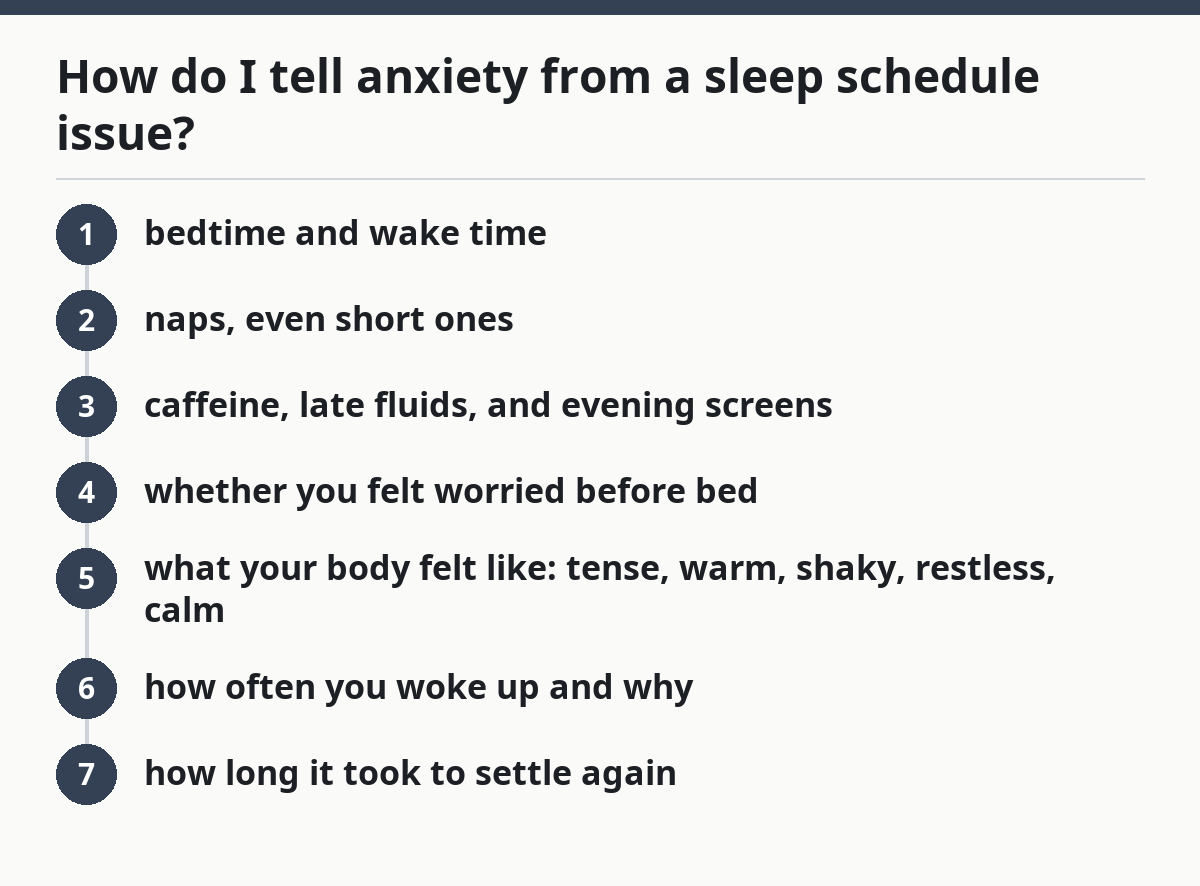
Use a journal for 7 to 14 nights and track:
- bedtime and wake time
- naps, even short ones
- caffeine, late fluids, and evening screens
- whether you felt worried before bed
- what your body felt like: tense, warm, shaky, restless, calm
- how often you woke up and why
- how long it took to settle again
- Signs that lean toward a sleep schedule issue:
- sleep shifts after late naps or irregular bedtimes
- the room is too hot, bright, or noisy
- sleep improves when the environment changes
-
the main problem is timing, not fear
-
Signs that lean toward anxiety:
- worry starts before sleep, not just during it
- your body feels wound up even when you’re tired
- waking happens with a rush of thoughts
- the same fears keep returning night after night
Honestly, many people have both. A messy schedule can make anxiety louder, and anxiety can make a decent schedule stop working.
What to do first when anxiety may be part of it
Use a relaxation routine the same way each night. It’s a practical first test. It does not have to be fancy, and it works best when it is boring enough to repeat, such as 10 to 20 minutes of the same sequence: dim lights, slow breathing, a short stretch, then bed.
Picture this: you stop trying to “force sleep” and instead lower the noise around it. You sit somewhere comfortable, keep your phone face down, and repeat one short routine several nights in a row.
Try this sequence:
- Dim the room lights **30 to 60 minutes** before bed; make sure you can read comfortably without strain. If you still feel alert under bright light, the room is too stimulating.
- Put away work, money, and baby-planning tasks for the night; make sure no problem-solving is left open. If you keep rehearsing tomorrow’s to-do list, anxiety is still in charge.
- Do **breathing exercises** for **5 minutes**: inhale gently, exhale longer than you inhale, and keep the pace slow. Make sure your shoulders drop and your jaw unclenches. If your breathing feels harder or you feel dizzy, stop and rest normally.
- Write a **3-line journal** note: what you’re worried about, what can wait until morning, and one thing that felt okay today. Make sure the page feels shorter after writing, not longer. If the list grows, the worry is still active.
- Use one calming cue, like the same pillow, blanket, or scent-free lotion, every night. Make sure it signals “bed” rather than “work.” If it becomes associated with stress, replace it.
- Get into bed only when sleepy, not just because the clock says it is time. Make sure your eyes feel heavy or your head nods. If you feel wired, stay out of bed for a few minutes and repeat the routine.
- After a night waking, keep light low and avoid scrolling. Make sure you are not feeding the wakefulness loop. If you are awake and tense for a long stretch, the problem is no longer just bedtime.
That routine gives you clues. If sleep improves when your mind calms down, anxiety was probably part of the problem. If nothing changes and the environment is already quiet, anxiety or another sleep issue may be doing more of the work.
Which symptoms point to anxiety instead of a schedule problem?
Anxiety is more likely when sleep trouble comes with daytime anxiety symptoms too. Those can include constant worry, irritability, muscle tightness, feeling jumpy, trouble concentrating, or a sense that your body never fully shuts down.
Picture this: the lights are off, but your body acts like it is on alert. You keep checking the clock, replaying conversations, or bracing for bad news, and the night feels like a long wait instead of rest.
Watch for these patterns:
- Racing thoughts at bedtime: the mind keeps hopping from one fear to the next.
- Physical tension: shoulders, jaw, hands, or stomach feel braced.
- Night waking patterns: you wake up with worry, not just to pee or shift positions.
- Bedtime dread: part of you starts fearing bedtime itself.
- Daytime spillover: the same worry shows up in the morning.
A schedule issue can still cause night waking, but it usually leaves fewer emotional fingerprints. Anxiety leaves fingerprints everywhere.
When to stop trying to sort it out alone
Because sleep loss can be a simple timing problem at first, you may be tempted to keep tweaking bedtime on your own. Stop treating it as a simple sleep-schedule problem when sleep loss is tied to broader anxiety, safety concerns, or a worsening mood. Pregnancy can bring normal worry, but persistent distress is not something to shrug off; if you’re not sure, consult a qualified clinician.
Picture this: you’ve changed the room, the routine, and the bedtime, yet the nights keep bringing dread or panic. Then the question is no longer “What sleep trick am I missing?” It is “What else is driving this?”
Panic symptoms at night: a racing heart, shaking, or a sense of doom can mean more than a rough bedtime — contact a qualified clinician soon.
Sleep trouble plus daytime anxiety: if worry follows you through the day, the sleep problem may be part of a larger anxiety pattern — ask for a mental health screen.
Low mood or hopelessness: sadness, numbness, or loss of interest can travel with sleep problems — bring it up promptly with your prenatal care team.
Fear of sleeping or bedtime itself: if bed has become a trigger, the problem is no longer only habit or timing — get help before the pattern hardens.
Thoughts of self-harm or feeling unsafe: this is urgent — seek immediate help from local emergency services or a crisis line now.
Pregnancy trials on this topic are still limited: 16 trials were registered on ClinicalTrials.gov, 6 were completed, 4 had unknown status, 3 were recruiting, 2 were enrolling by invitation, and 13 of 16 were in Phase Na. The median planned enrolment was 108 participants, which is a reminder that the evidence is still developing.
Why the sleep environment still matters
A bad sleep environment can copy anxiety, and anxiety can make a decent room feel wrong. Light, heat, noise, and an uncomfortable bed can all keep you awake, and then the wakefulness itself can make your mind race.
Picture this: you check the room before bed and realize the fan is loud, the light leaks around the curtain, or your pillow leaves you propped too high. Those issues can keep you alert even if your mood is fine.
Check the basics before assuming the problem is emotional:
- room is dark enough for sleep
- noise is steady or reduced
- temperature feels comfortable
- mattress and pillows do not create new pain
- phone and bright screens are out of reach
One practical clue: if changing the room improves sleep within a few nights, the environment was doing real work. If the room is already calm and the mind still won’t settle, anxiety deserves more attention.
What the research picture says, without overselling it
The research field is active, but it does not hand out simple answers. The 100 most relevant PubMed records had a median publication year of 2021, and the abstracts sometimes mention doses such as a median 650 mg and study lengths such as a median 26 weeks — figures that describe the papers, not a recommended dose or a treatment plan.
Picture this: you search for a clean answer and find a pile of reviews, a few systematic reviews, and only a tiny number of trials that directly test one clear approach. That is what the literature looks like here.
Two useful links if you want to check the source types yourself:
- PubMed, National Library of Medicine
- ClinicalTrials.gov, U.S. National Library of Medicine
- ACOG: Mental Health
- NHS: Sleep problems during pregnancy
That mix matters because it means advice should stay cautious. Research suggests sleep and anxiety are often linked in pregnancy, but the best next step depends on the pattern in your nights, not on a single paper.
FAQ
Can anxiety cause insomnia during pregnancy?
Yes, anxiety can be part of why sleep breaks down in pregnancy. It often shows up as racing thoughts, body tension, and night waking, though a sleep schedule issue can happen at the same time. If the pattern keeps repeating for more than a short stretch, bring it to a qualified professional.
How do I calm pregnancy anxiety at bedtime?
A short, repeatable routine usually works better than trying to “force” sleep. Try dim lights, 5 minutes of slow breathing, and a 3-line journal note that parks tomorrow’s worries until morning. If bedtime still feels loaded with dread after several nights, the anxiety may need more support.
When should I talk to someone about anxiety and sleep during pregnancy?
Talk to someone when sleep trouble comes with panic, daytime anxiety, low mood, or feeling unsafe. Also speak up if the problem keeps going despite a calmer room and a steadier bedtime for 1 to 2 weeks. A prenatal care team, midwife, or mental health professional can help sort out what is driving it.
Drafted with AI; not yet reviewed by a person.
