

Last updated: November 19, 2026
Quick Answer: For most people, 1 pregnancy sleep support item is enough to start: a body pillow, a wedge pillow, or a knee pillow. Pregnancy sleep products and support gear can help with side-sleeping, pillow placement, and pressure relief when a growing belly, hip pain, or reflux keeps you awake. The right setup is usually a mix of position support, mattress help, and small gear — not one magic product. In short: this guide shows what each product does, what to skip, and how to choose without overbuying in pregnancy sleep products and support gear — The Complete Guide.
Key Takeaways
- Most pregnancy sleep gear is about support and comfort, not fixing sleep itself.
- The best setup usually starts with one body pillow or wedge, then adds only what you still need.
- Some products help with back, hip, or belly support; others mostly add bulk.
- If you have a health issue or unusual pain, talk with a qualified professional about your own situation.
- A lot of product lists skip the trade-offs. This one does not.
What pregnancy sleep gear is for — and what it is not
Pregnancy sleep gear is there to make sleep position easier, reduce pressure points, and help you stay settled longer, not to treat a sleep disorder or a medical problem. If you are unsure whether symptoms are normal, consult a qualified professional before buying more gear. The research base is modest: 20 PubMed records matched the query for pregnancy, sleep, products, and humans for 2016–2026, and the 20 most relevant were read; the median publication year was 2022 and 5 (25%) were reviews, all computed from PubMed records on 2026-11-06 using the selection rule: pregnancy[Title/Abstract] AND sleep[Title/Abstract] AND products[Title/Abstract] AND humans[MeSH Terms], date type publication date, window 2016–2026, sort relevance. See also the NHLBI sleep health overview and ACOG guidance on pregnancy discomforts.
That matters because a lot of product marketing sounds more certain than the evidence is. The better question is not “What fixes pregnancy sleep?” It is “What makes a side-sleeping setup easier to tolerate for this body, this bed, and this stage of pregnancy?”
Picture this: you’re 24 weeks along, you roll onto your side, your hip aches, and your belly feels like it’s pulling you forward. You do not need a warehouse of gear. You need 1 or 2 support points that keep your shoulders, belly, and knees from fighting each other.
Who this applies to

This guide applies to pregnant people who are trying to sleep on a side more comfortably and want to compare pillows, wedges, mattress toppers, and small support items before buying them. It assumes you already know the basics: sleep is harder, side-sleeping is often more comfortable later in pregnancy, and comfort changes from week to week.
It also assumes you are not trying to self-diagnose a medical problem. If you have severe pain, shortness of breath, swelling that worries you, bleeding, contractions, or a known sleep disorder, a qualified clinician should be part of the conversation. Gear can help with comfort. It cannot sort out a medical cause. For general pregnancy care, see the NHS pregnancy guide.
The practical goal is simple: reduce strain on the hips, ribs, lower back, knees, and belly without turning the bed into a pile of foam.
- Best use case: ordinary pregnancy discomfort, fitful position changes, pressure on the pelvis, or reflux that feels worse when flat.
- Not a fit: unexplained pain, or symptoms that feel out of proportion to posture alone.
- Main assumption: you can already sleep in a bed and want support, not a special device.
Which pregnancy sleep products are worth considering first?
The first products worth considering are the ones that change body angle or support the space between joints. That usually means a body pillow, a wedge pillow, a knee pillow, or a mattress topper before anything more specialized.
A body pillow gives long support from head to knees, so your top leg does not collapse across your pelvis. A wedge is smaller and can fit under the belly, behind the back, or under the upper torso. A knee pillow is a compact spacer that keeps the thighs from pressing together. A topper changes the bed feel itself, which can matter if the mattress is too hard or sagging.
More gear is not always better. Big pillows can crowd a narrow bed, shift during the night, or trap heat. A soft topper can feel good for a week and then make turning harder because you sink too far.
- Body pillow: best when you want one long support piece and have room in bed.
- Wedge pillow: best when you want targeted lift under the belly or upper body.
- Knee pillow: best when your hips complain most when your knees touch.
- Mattress topper: best when the base mattress is the real problem.
The body pillow choice
A body pillow is the broadest fix because it supports several contact points at once. The long shape can help you stay partly on your side without twisting your spine, and it often works even if your bed is small.
The downside is that it takes space and can feel awkward if you move a lot. Some full-length pillows also get warm fast, and if the fill is too soft, the pillow may flatten under the belly or knees instead of holding shape.
Who Should Skip This: people in a narrow bed who already feel crowded, or anyone who wants a small, movable support piece instead of a large one. A wedge pillow is often the better fit.
Buy this if: you are a side sleeper who wants one long support piece and does not mind extra bed space.
Skip this if: you share a compact bed and need something that tucks away easily.
The wedge pillow choice
A wedge pillow is the most targeted option because it lifts one area without changing the whole bed. It can go under the belly, behind the back, or under the upper torso if reflux makes lying flat miserable.
The trade-off is that placement matters a lot. If the angle is wrong, the wedge can push on your ribs, slide out from under you, or create a hard edge where your body wants softness. A wedge also does not solve knee pressure by itself.
Who Should Skip This: people who want all-over support or who keep rolling and need a longer contact surface. A body pillow usually covers more ground.
Buy this if: you want a small, adjustable support for belly lift or upper-body elevation.
Skip this if: you need hip-to-knee alignment more than a single lift point.
The knee pillow choice
A knee pillow is a simple spacer, usually used between the knees or thighs. It can reduce the feeling of bone-on-bone pressure and may help the top leg stop tugging the pelvis forward.
The catch is that it does only one job. If your lower back, belly, or upper body also needs help, a knee pillow alone may feel too limited. It can also slide if the cover is slick or the shape is too small for your build.
Who Should Skip This: people whose main complaint is upper-body strain or belly heaviness. A wedge pillow or body pillow will do more.
Buy this if: your hips hurt most when your knees touch and you want a small, low-bulk fix.
Skip this if: you need support for more than one pressure point.
How do you set up sleep support step by step?
You set it up by matching the gear to the pressure point, then checking whether your body settles without extra twisting. The point is not to build a perfect nest. The point is to make one stable side-sleeping position easier to keep for longer.
Picture this: you wake up three times a night, shift from side to side, and every pillow you pile on slides somewhere else. Start smaller than you think, then add only what solves a real problem.
- Start with your main sleep position. Lie on your side with your shoulders and hips stacked, then notice where the strain starts first — belly, hips, lower back, or upper ribs. Verify that the pain point is specific; if it feels deep, severe, or unusual, that is a warning sign, not a pillow problem.
- Place the first support at the pressure point that hurts most. Use a body pillow along the front of the body, a wedge under the belly, or a knee pillow between the knees. Keep the support in direct contact with the spot that hurts, not floating nearby. If you have to hold the pillow in place with your hands, the setup is not doing enough.
- Check pelvis alignment. Your top knee should not drop far forward and twist your lower back. A simple check is whether your hips feel level after 2–3 minutes. If one hip starts to feel pinched, the pillow may be too soft or too low.
- Add belly lift only if needed. If the belly feels like it is pulling you down, tuck a small wedge under the lower abdomen rather than stacking several pillows. Verify that the support lifts without pressing into the ribs. If breathing feels restricted, the angle is wrong.
- Adjust head and neck height. Keep the neck in line with the spine by matching the pillow loft to shoulder width. If your head tilts down or cranes up, the whole setup is off. A stiff neck in the morning is often a pillow-height problem, not a pregnancy problem.
- Test turn ease before bed. Roll from one side to the other and see whether the gear moves with you or fights you. A good setup lets you change sides in one smooth motion. If you need to wrestle the pillow, it will probably wake you more at night.
- Keep the bed surface in mind. On a very soft mattress, a wedge or body pillow may sink too much; on a very firm mattress, you may need a topper to reduce pressure points. Check whether your shoulder and hip sink evenly. If one side feels jammed, the mattress is part of the problem.
- Change one thing at a time. Swap one pillow position, one topper, or one spacer at a time so you know what helped. If you change everything at once, you cannot tell what is worth keeping. That makes future nights harder, not easier.
A setup you can repeat without thinking is easier to live with. A pile of “maybe” pillows is a sign to simplify, not add more.
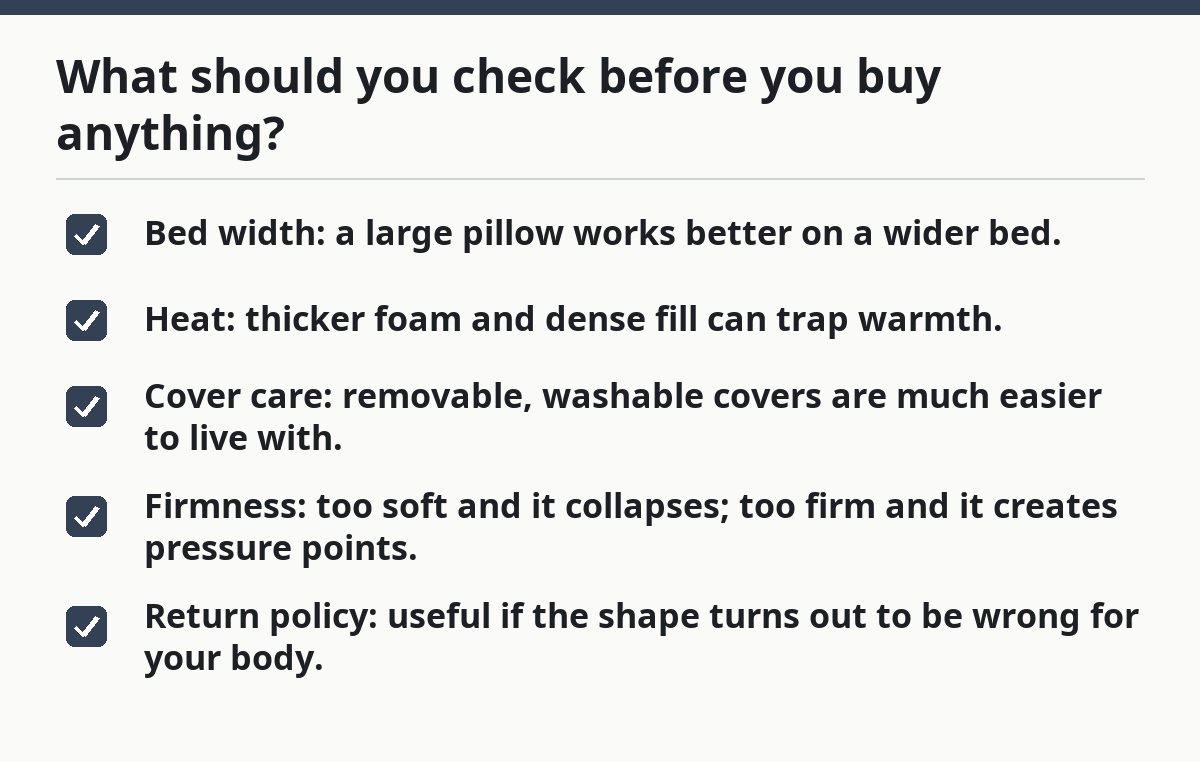
What should you check before you buy anything?
You should check fit, firmness, heat, bed size, and cleaning before you buy, because those five details decide whether a product works in real life. Marketing photos rarely show the part that matters: whether the item stays in place after 2 hours of turning.
A few numbers help here. Many pregnancy support pillows are bulky enough to dominate a narrow bed, while a wedge is intentionally compact and easier to reposition. If the cover can be removed, check whether the cleaning step is simple enough for weekly use; if it is not, sweat and spills become a daily annoyance.
Picture this: the pillow looks perfect online, but your mattress is already soft, your partner sleeps close, and the pillow turns the bed into a traffic jam. That is why the space around the product matters as much as the product itself.
- Bed width: a large pillow works better on a wider bed.
- Heat: thicker foam and dense fill can trap warmth.
- Cover care: removable, washable covers are much easier to live with.
- Firmness: too soft and it collapses; too firm and it creates pressure points.
- Return policy: useful if the shape turns out to be wrong for your body.
If reflux is part of the problem
If reflux is waking you up, a wedge under the upper torso may help some people feel less pressure when lying down. The angle matters more than the brand name. Too much lift can strain the neck, while too little does nothing.
The wrong move is to stack random pillows until your chest is high and your head is bent forward. That can create neck pain and still leave you sliding downhill. A single stable wedge is usually cleaner than a loose tower.
Who Should Skip This: anyone whose main issue is hip or pelvis pain rather than upper-body discomfort. A body pillow or knee pillow is a better match.
Buy this if: you notice symptoms that worsen when you lie flatter and want a targeted angle change.
Skip this if: your main problem is lower-body pressure, not upper-body elevation.
What are the common mistakes people make?
The most common mistakes are buying for the photo, not the body, and expecting one product to solve every pregnancy sleep complaint. That usually leads to too much foam, too little space, and the feeling that the bed is somehow working against you.
Picture this: you keep adding pillows because one spot still hurts, but each new layer makes turning harder. That is how support gear turns into clutter.
- Buying the biggest pillow first: the result is a crowded bed and awkward turning. The better move is a smaller support that targets the exact pressure point.
- Using a wedge in the wrong place: the result is rib pressure or a sliding setup. The better move is to place it where the lift is needed, not where it looks neat.
- Ignoring the mattress: the result is that a soft or sagging bed keeps pulling you out of alignment. The better move is to check whether a topper or a firmer base would help more.
- Choosing based on loft alone: the result is neck strain or shoulder compression. The better move is to match pillow height to your shoulder width and sleep posture.
- Treating warmth as a small issue: the result is waking up sweaty and moving more. The better move is to look for breathable covers and less bulk.
- Expecting gear to explain pain: the result is delayed care for a real medical problem. The better move is to treat new, severe, or unusual pain as something to discuss with a qualified professional.
A product that works in a store can still fail in a bed. Real use is about movement, heat, and the shape of your mattress.
When does the standard setup not apply?
The standard setup does not apply when symptoms point beyond comfort or when the usual side-sleeping advice does not fit your body. Pregnancy gear is for support, not for sorting out everything that keeps you awake.
Breathing feels harder when you lie down: that is not a pillow shopping problem — it can point to something that needs medical attention, especially if it is new or getting worse. The right next step is qualified care, not more foam.
Severe or one-sided pain shows up at night: that may be more than position strain. A wedge or body pillow may not be enough, and the pain should be assessed.
Snoring comes with breathing pauses or gasping: that can suggest a sleep-breathing issue. Support gear may change comfort, but it does not solve airway problems.
Swelling, bleeding, contractions, or dizziness appear: those are not normal gear problems. Stop trying to fix the bed and seek qualified help.
Any product makes pain worse within minutes: the shape or pressure is wrong for you. Do not force a fit; switch to a different support style or get guidance.
A clear pattern matters. Gear should make sleep easier to enter and easier to keep. If it consistently makes symptoms worse, it is the wrong tool.
How do you choose between a pillow, a topper, and smaller support gear?
You choose by asking what needs changing: position, pressure, or the mattress itself. A pillow changes body angle. A topper changes the bed feel. Smaller support gear fills the gaps a larger pillow misses.
If the bed already feels decent and you mainly need side-sleep support, a body pillow or wedge is the cleanest start. If the mattress is too hard or the shoulder and hip ache even before you add support, a topper can matter more than another pillow. If only one area hurts, a compact pillow is usually easier to live with than a large one.
You do not need to buy everything at once. Start with the least intrusive item that solves the biggest complaint. That is often the difference between a bed that helps and a bed that annoys you.
- Choose a pillow when the problem is body position.
- Choose a topper when the problem is mattress feel.
- Choose a wedge when you need targeted lift.
- Choose a knee spacer when joint pressure is the main issue.
What should a beginner buy first?
A beginner should usually start with one support piece, not a full kit. The most practical first buy is often a body pillow if you want broad help, or a wedge if you want a smaller, more flexible option.
That first choice should be based on the complaint you hear most in your own body. Belly pull, hip pressure, back twist, or reflux-like discomfort each point to a different shape. If you are unsure, the smaller and more adjustable option is easier to resell, return, or repurpose.
Picture this: you are standing in a store or scrolling online at midnight, trying to solve a sleep problem with one click. The better move is to ask, “What single change would make tonight a little less miserable?”
A reasonable starter setup looks like this:
- one body pillow for full-length side support, or
- one wedge for belly or upper-body lift, plus
- one knee pillow if the hips still feel strained.
That is enough for many people. Anything beyond that should answer a specific problem, not a vague hope.
Questions people ask before buying pregnancy sleep gear
Do I need a special pregnancy pillow?
No, not always. A regular body pillow, wedge, or knee pillow can do the job if it fits your body and your bed. The important part is support shape, not the pregnancy label on the box.
Is a wedge better than a full-body pillow?
A wedge is better for targeted lift, while a full-body pillow is better for broad support. If you need help with just one area, the wedge is easier to manage. If your whole side chain hurts, the body pillow usually does more.
What if I sleep hot?
Then breathable covers and less bulk matter more than fancy shapes. Dense foam and oversized pillows can trap heat, so look for a setup that stays cooler and does not cover half the bed. Heat is a common reason people stop using support gear.
Can one product fix back, hip, and belly pain at once?
Sometimes it helps more than one spot, but not always. A body pillow can support several areas at once, yet some people still need a second small piece under the knees or belly. If one product leaves you twisting, add only one more support point.
When should I talk to a qualified professional?
You should do that when the pain feels severe, new, one-sided, or comes with breathing trouble, bleeding, contractions, dizziness, or other symptoms that do not look like ordinary position strain. Gear can help with comfort, but it should not replace assessment when symptoms look off.
The bottom line
Pregnancy sleep gear works best when it solves one clear problem: body alignment, pressure relief, or mattress feel. The strongest choice is often the simplest one that lets you settle on your side without extra twisting.
If you want a broad fix, start with a body pillow. If you want a smaller, more precise solution, start with a wedge. If the mattress itself is the issue, change the bed feel before buying more pillows. And if symptoms are unusual, severe, or getting worse, get qualified help instead of trying to pillow your way through it.
Drafted with AI; not yet reviewed by a person.
