

Last updated: November 20, 2026
Quick answer: if when pregnancy sleep symptoms may be a sign of a UTI or bladder infection comes with burning during urination, strong nighttime urgency, pelvic pain, urine changes, or fever, a urinary tract infection (UTI) or bladder infection becomes more likely than a normal “pregnancy peeing at night” pattern. Speak to a qualified professional about your own situation, because pregnancy changes the stakes and symptoms can overlap.
PubMed shows 568 records matching this query for 2016–2026; the 100 most relevant were read and every median, range, and share below is computed across those records, with the sample computed on 2026-11-10. ClinicalTrials.gov lists 5 registered trials for this term; the first 5 were read and every share, median, and range below is computed across them.
Key takeaways
- A UTI in pregnancy is more suspicious when sleep loss comes with pain, burning, fever, or urine that looks or smells different.
- Waking once to pee is common in pregnancy, but repeated urgency with discomfort points in a different direction.
- Fever, flank pain, blood in urine, or a sick feeling raises concern beyond a simple bladder irritation pattern.
- Nighttime symptoms alone do not prove infection; the pattern matters.
- Pregnancy is not the time to guess if urinary symptoms are “just normal.”
What should make me think UTI?

A UTI should move higher on the list when nighttime waking is paired with urinary symptoms that feel different from routine pregnancy pressure. Burning with urination is a classic clue, and pelvic discomfort or a heavy, sore feeling low in the pelvis adds more concern.
Urine changes matter too. Cloudy urine, strong odor, blood, or urine that looks visibly different can fit a bladder infection, though none of these signs proves it by itself. Nighttime urgency that feels intense or sudden, rather than just “I need to go because the uterus is pressing on my bladder,” is another clue.
The mechanism is simple: infection irritates the lining of the bladder and urinary tract, so the bladder signals “empty me” more often and at smaller volumes. That can wake a person from sleep several times in one night, especially if the bladder is already under pressure from pregnancy.
A generic article often leaves out the key difference: normal pregnancy sleep disruption usually makes you wake to urinate, but a UTI often makes the urination itself hurt or feel abnormal. That difference is why the symptom pattern matters more than any single sign, and it is why a clinician should assess symptoms that do not fit the usual pattern NIDDK, ACOG.
How is bladder infection different from normal pregnancy peeing?
A bladder infection usually adds discomfort, while normal pregnancy urinary frequency usually does not. Both can wake someone at night, so the difference is in the details around the trip to the bathroom.
Here is the simplest side-by-side view:
| Feature | More like normal pregnancy urinary frequency | More like UTI or bladder infection |
|---|---|---|
| Urgency | Mild to moderate | Sudden, strong, hard to ignore |
| Burning with urination | No | Often present |
| Pelvic discomfort | Usually no | Often present |
| Urine changes | Usually absent | Cloudy, strong odor, blood, or other change |
| Fever | No | A warning sign |
| Night waking | May happen once or a few times | May happen with repeated urgency and discomfort |
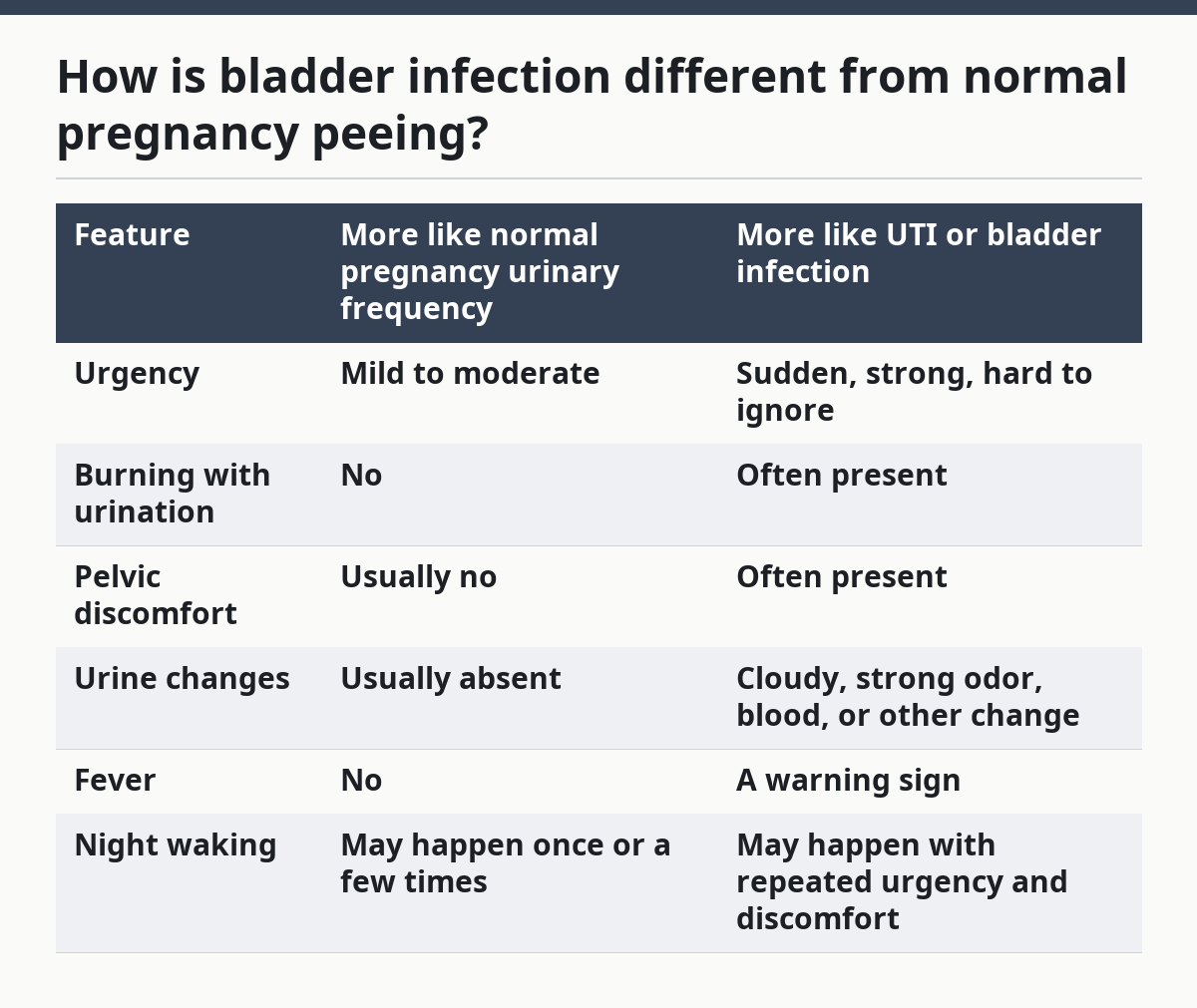
The trade-off is that pregnancy can blur the picture. A full bladder, pressure on the bladder, and short sleep all increase bathroom trips, so frequency alone is not enough. If the bathroom trip is paired with pain, burning, fever, or urine changes, the balance shifts toward infection.
The public-health sources that matter here are the same ones clinicians use in practice, including guidance from the U.S. National Institute of Diabetes and Digestive and Kidney Diseases and obstetric guidance from professional groups such as the American College of Obstetricians and Gynecologists. The point is not to self-diagnose; it is to know which symptom pattern deserves attention, and to consult a professional if you are unsure.
What symptoms matter most at night?

The most useful nighttime clues are burning, urgency, pelvic pain, fever, and urine changes. Sleep disruption by itself is common in pregnancy, but those extra symptoms are what make infection harder to ignore.
Burning with urination is one of the clearest signs because it points to irritated urinary tissue, not just bladder pressure. Pelvic pain or soreness low in the abdomen can mean the bladder is inflamed. If the need to pee is happening over and over, even when only a little urine comes out, that pattern also fits a bladder infection more than a simple pregnancy bathroom habit.
Fever changes the picture again. Fever is not a normal sleep symptom from pregnancy bladder pressure, and it can mean the infection is moving beyond the bladder. Back pain or flank pain can also matter because it can suggest kidney involvement, which is more serious than a lower urinary tract infection.
In this sample, PubMed records skewed toward reviews and higher-level summaries rather than one neat answer: of the 100 most relevant records, 32 are tagged Review, 12 are tagged Systematic Review, 8 are tagged Meta-Analysis, 6 are tagged Randomized Controlled Trial, and 2 are tagged Observational Study. That mix is one reason symptom checking matters more than hunting for one dramatic sign.
When should urinary symptoms be checked urgently?
Urinary symptoms should be checked urgently when fever, flank pain, vomiting, or a clearly unwell feeling joins the sleep disruption. Those signs can mean the infection is not staying in the bladder.
Use these warning situations as the line where this stops being a “wait and see” problem:
- Fever with urinary symptoms: This can mean the infection is more than irritation — get prompt medical attention.
- Flank or back pain: This can point toward kidney involvement — seek urgent evaluation.
- Blood in urine: This can happen with infection or another urinary problem — do not dismiss it as pregnancy alone.
- Inability to pass urine normally: This can signal obstruction or severe irritation — get help quickly.
- Worsening pelvic pain with burning: This can mean the infection is progressing — speak to a clinician promptly.
- Feeling shaky, weak, or significantly unwell: This can mean the body is handling more than a simple bladder issue — get assessed.
This is the section where a generic article often overreaches. It is not safe to say that every urinary symptom is mild, and it is not safe to say every fever is “just a virus.” In pregnancy, the safer move is to treat these signs as real until a clinician says otherwise, and to seek professional advice NHS.
What should I do first if I suspect a UTI?
The first step is to get the symptoms assessed rather than trying to sort them out only from sleep notes. That usually means describing the pattern clearly: when the waking started, whether urination burns, whether the urine changed, whether pain is in the pelvis or back, and whether fever is present.
A useful self-check is to write down the last 24 hours in plain terms:
- Note each time sleep was broken by urgency or pain.
- Record whether urination burned, stung, or felt normal.
- Watch for urine changes such as cloudiness, odor, or blood.
- Check for pelvic pain, pressure, or back pain.
- See whether fever, chills, or feeling unwell appeared.
- Notice whether the urge returns soon after emptying the bladder.
- Bring that pattern to a qualified professional, because symptoms in pregnancy are best interpreted in context.
PubMed’s median publication year in the 100-record sample is 2023, which shows this is an active topic, not an old one. ClinicalTrials.gov also shows a small but current trial footprint here: 2 of 5 trials are completed, 2 of 5 are recruiting, 1 of 5 is not yet recruiting, 4 of 5 are at Na, 1 of 5 is at Phase3, and the median planned enrolment is 42 participants. That does not tell a reader what to do on the spot, but it does show that the question is still being studied.
What mistakes do people make?
People usually make the same few mistakes, and each one can blur the picture.
Assuming all nighttime peeing is normal pregnancy: This can delay attention to burning, fever, or urine changes. The better alternative is to separate “frequency only” from “frequency plus discomfort.”
Ignoring urine changes because sleep is already bad: This can make a bladder infection look less urgent than it is. The better alternative is to treat cloudy urine, blood, or a strong odor as part of the symptom set, and to check with a clinician if those changes appear.
Blaming pelvic pain on the baby alone: Pressure is common, but pain with urination or fever changes the meaning. The better alternative is to pair the pain with the urinary symptoms, not isolate it.
Waiting for symptoms to become dramatic: UTIs can start with small clues and then worsen. The better alternative is to get the pattern checked before it becomes a bigger problem.
Trying to self-sort by “how many times” alone: Frequency matters, but it does not tell the whole story. The better alternative is to look for the combo of urgency, pain, fever, and urine changes.
The median dose figure appearing in the PubMed abstracts is 650 mg, and the median study duration figure is 26 weeks. Those numbers reflect what appears in abstracts, not a recommended dose or a rule for care, so a pregnant reader should consult a clinician rather than use them as a treatment guide.
When does the standard “pregnancy peeing” explanation not apply?
The standard explanation does not fit well when symptoms are painful, feverish, or visibly abnormal. Night waking can be common in pregnancy, but sleep loss plus burning, pelvic pain, or urine changes points away from a simple bladder-pressure story.
This is also the point where standard guidance has to be modified for individual risk. A person with repeated urinary infections, kidney problems, or other pregnancy complications may need a lower threshold for assessment than someone with only mild frequency. The exact threshold varies by person, which is why a clinician’s view matters.
The PubMed and ClinicalTrials.gov numbers make another point: this is not a one-size-fits-all topic. In this sample, 32 are reviews and 12 are systematic reviews, while only 6 are randomized controlled trials and 2 are observational studies. On ClinicalTrials.gov, only 5 trials matched the term in the first read. That mix means the safest advice is pattern-based, not formula-based.
If this page sits beside a broader hub on pregnancy sleep symptoms and health signals, this is the piece that helps a reader sort “normal bathroom waking” from “possible bladder infection” without guessing.
What sleep-related clues can point to a bladder infection in pregnancy?
Sleep-related clues that point toward a bladder infection are waking up because of a sudden, urgent need to urinate plus burning, pelvic discomfort, or urine changes. A bladder infection usually adds a painful or abnormal feel to the bathroom trip, not just a need to go. Fever makes the concern stronger and moves the situation beyond ordinary pregnancy sleep disruption.
When should urinary symptoms be checked urgently?
Urgent checking is warranted when urinary symptoms come with fever, flank or back pain, vomiting, blood in urine, or a worsening sense of illness. Those signs can suggest that the infection is no longer limited to the bladder. In pregnancy, it is better to have a clinician assess the pattern than to assume the symptoms are only from nighttime bladder pressure.
Drafted with AI; not yet reviewed by a person.
