

Last updated: November 19, 2026
Quick Answer: in 3 nights, a simple symptom log can often show whether pregnancy reflux at night, not insomnia, is the more likely cause of waking with burning, sour taste, or throat irritation.
Key Takeaways
- Pregnancy reflux at night is more likely when sleep trouble comes with stomach acid moving up the esophagus.
- Reflux can wake you when lying down makes stomach acid reach the esophagus more easily.
- The timing around meals and acid-type symptoms often helps separate reflux from insomnia.
- Track symptoms for several nights, then review the pattern with a qualified professional.
This page helps you tell the difference between pregnancy sleep problems and reflux at night, and it also flags the moments when qualified prenatal care matters more than more pillow tricks.
What this usually means
Pregnancy reflux at night is often the better explanation when sleep trouble comes with stomach acid moving up the esophagus, not just a busy mind. PubMed shows 565 matching human records for 2016–2026; 2021 is the median publication year in a 100-record sample read on 2026-10-29. The sample was sorted by relevance, and the counts below come from the 100 most relevant records, using the search method described in the brief.
Picture this: you fall asleep fine, then wake up 1–3 hours later with a burn behind the breastbone, a bitter taste, or a dry cough. That pattern points more toward reflux symptoms than classic insomnia, which more often looks like trouble falling asleep, light sleep, or waking early without acid signs.
Sleep disruption in pregnancy can come from both problems at once. The truth is, reflux can fragment sleep, and broken sleep can make you notice every body sensation more.
- Reflux signs: burning chest discomfort, sour or bitter taste, burping, throat clearing, night cough.
- Insomnia signs: long sleep latency, racing thoughts, repeated waking without acid symptoms.
- Mixed pattern: you fall asleep, wake with a burn, then stay alert for the rest of the night.
If you want the broader map of sleep-related symptoms, the hub page on pregnancy sleep symptoms and health signals is the right next stop.
How pregnancy reflux at night wakes you up
Pregnancy reflux at night wakes you up when stomach acid reaches the esophagus more easily in the lying-down position. The lower esophageal sphincter is the muscle ring that usually keeps stomach contents where they belong; when it relaxes, acid can move upward and sting the esophagus.
Picture this: you lie flat after a late dinner, then your throat feels raw and your chest burns. That is a different kind of night than staring at the ceiling with a calm stomach and an active mind. Pregnancy changes pressure in the abdomen, and late meals add more volume to the stomach, so reflux symptoms often show up after bedtime.
The catch is that reflux does not always feel like “heartburn,” so the clue may be cough, hoarseness, a lump-in-throat feeling, or repeated swallowing instead.
- Common reflux clues at night: burning behind the breastbone, sour taste, throat clearing, cough, worse symptoms after lying down.
- Common insomnia clues: no acid taste, no burning, no cough from throat irritation, but persistent wakefulness.
- Sleep timing clue: symptoms that appear after a late snack or meal are more suspicious for reflux than insomnia.
The good part? That pattern is usually easier to separate than people think once you track timing and symptoms for a few nights. For background on reflux symptoms, see the NIDDK GERD overview and NHS heartburn and acid reflux.
How do I know if pregnancy sleep trouble is reflux?
You can often tell by the symptom pattern, especially the timing around meals and the presence of acid-type symptoms. Late meals, heavy meals, and lying flat can all make reflux more likely, while insomnia usually does not produce burning chest discomfort or throat symptoms.
Picture this: you keep a simple note on your phone for 3 nights. You write down when you ate, when you lay down, what woke you, and what you felt in your chest, throat, or mouth. That small record can make the difference between “I can’t sleep” and “I’m probably dealing with reflux plus fragmented sleep.”
Use the checklist below as a comparison, not a diagnosis.
| Clue | More like reflux | More like insomnia |
|---|---|---|
| What wakes you | Burning, sour taste, throat irritation | Alertness, worry, no acid symptoms |
| Timing | Often after late meals or when lying flat | Can happen at any point in the night |
| Body symptoms | Chest burn, cough, hoarseness | Restlessness, muscle tension, racing thoughts |
| Night pattern | Better upright, worse flat | Can stay awake even in a comfortable position |
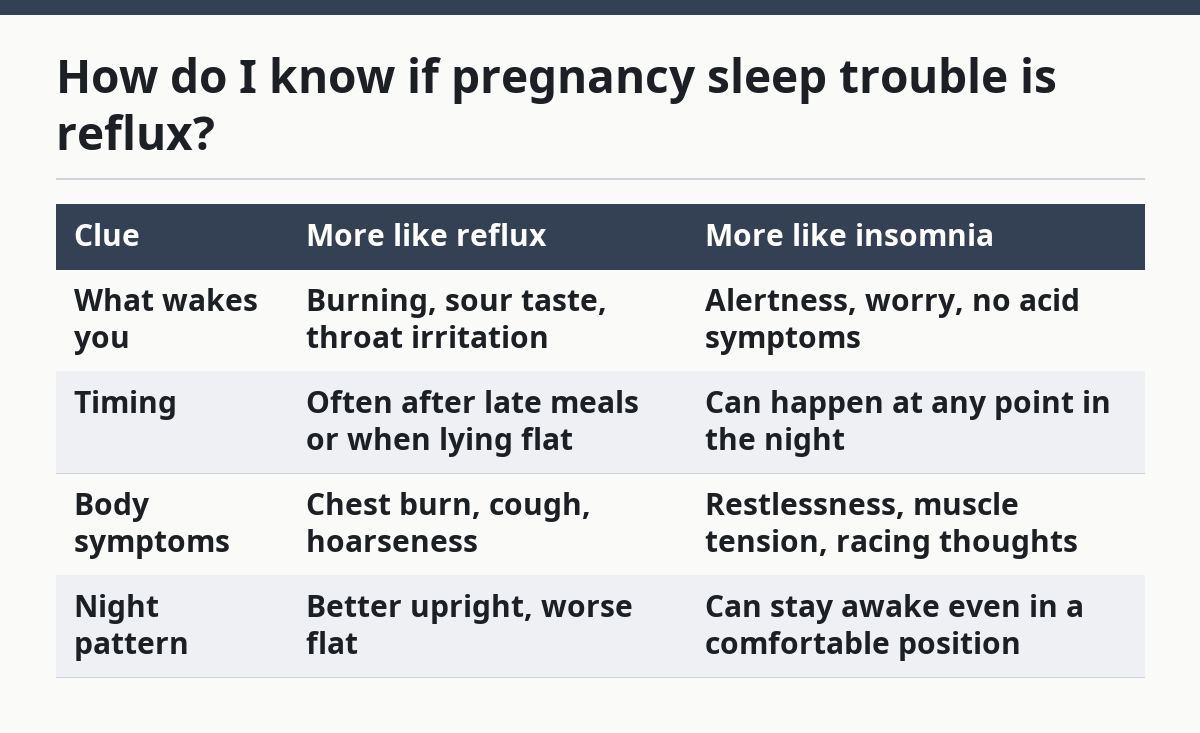
If the pattern keeps repeating, the likely issue is not “just insomnia.” It may be reflux disturbing sleep, or both problems together.
Quick comparison at a glance
- More like reflux: symptom starts after bed, after food, or after lying flat.
- More like insomnia: the main problem is sleep onset or repeated alertness without acid symptoms.
- Mixed picture: burning and wakefulness happen together, and both need attention.
What to check before you assume it is insomnia
Check the timing, the symptom type, and the position you were in before the wake-up. Those three details usually separate reflux from insomnia better than guessing does.
Picture this: you have a bad night and assume stress did it. Then you realize the same thing happens after tomato sauce, fried food, or a late dessert. That is not proof of reflux, but it is a useful clue.
Before you call it insomnia, look at these factors:
- Meal timing: Did you eat within about 2–3 hours of lying down?
- Meal size: Was it a large meal, a greasy meal, or something acidic?
- Position: Were you flat on your back or nearly flat when symptoms started?
- Throat symptoms: Did you cough, clear your throat, or notice a sour taste?
- Chest symptoms: Was there a burn behind the breastbone or upper stomach discomfort?
- Pattern across nights: Does the same pattern show up after similar meals?
- Awareness level: Did you wake with body symptoms, or were you simply unable to drift off?
A problem shows its face in the details. If you have three or more reflux clues on the same night, reflux deserves a serious look.
One simple tracking sheet
- Time eaten
- Time lay down
- Main symptom
- Body position
- What helped, if anything
No fancy app needed. A plain note is enough for a clinician to read the pattern.
What helps separate reflux from insomnia in real life?
The best way to sort them out is to match symptoms with triggers over several nights, then review the pattern with a qualified professional. That does not mean every night with heartburn is dangerous; it means the pattern deserves attention because pregnancy reflux at night can look like “random insomnia” from the bed.
Picture this: you’ve had three bad nights, and each one followed a late meal and a sour taste in your mouth. That pattern points in one direction. If the bad nights happen with no burning, no cough, and no throat symptoms, insomnia moves higher on the list.
Use this step-by-step approach:
- Write the bedtime and meal time. Note both times to the nearest 15 minutes; verify whether symptoms began within 2–3 hours of eating; a problem is a repeated wake-up after late food.
- Record the symptom. Name the exact feeling—burning chest discomfort, sour taste, cough, throat clearing, or plain alertness; verify whether acid-type symptoms are present; a problem is a wake-up with no body clues at all.
- Check your position. Note whether you were flat, propped, or upright before bed; verify whether lying down made symptoms worse; a problem is feeling better only after sitting up.
- Look for food triggers. Mark heavy, spicy, acidic, or high-fat meals; verify whether the same foods show up before symptoms; a problem is a repeated pattern after the same meal type.
- Track the wake pattern. Write whether you wake once, several times, or can’t fall asleep at all; verify whether reflux wakes you after sleep starts; a problem is wakefulness without any acid sensation.
- Note throat and cough signs. Record hoarseness, throat irritation, or night cough; verify whether they cluster with burning or sour taste; a problem is a cough that keeps returning at night.
- Bring the notes to care. Show the pattern to a qualified prenatal clinician; verify whether the notes point to reflux, insomnia, or both; a problem is trying to guess from memory alone.
This is not about perfect detective work. It is about getting enough evidence to ask the right question.
When this is not the right pattern to brush off
Stop assuming it is simple insomnia if you have chest pain, trouble breathing, repeated vomiting, blood, or symptoms that are getting worse. Those are not the usual “annoying but common” reflux clues.
Picture this: you wake with burning and chalk it up to pregnancy. Then the pain spreads, you feel short of breath, or you vomit repeatedly. That is not a bedtime comfort issue. It needs prompt assessment.
- Chest pain that is severe or unusual: may not be ordinary reflux — seek urgent medical advice.
- Trouble breathing: can signal a different problem — get urgent care now.
- Vomiting that keeps happening: can lead to dehydration — contact a qualified clinician quickly.
- Blood in vomit or black stools: possible bleeding — seek immediate medical help.
- Symptoms that suddenly change or intensify: may need evaluation — do not keep treating it as routine sleep trouble; consult a professional.
On the flip side, mild reflux-like symptoms that come and go after meals are common in pregnancy, but common does not mean harmless if they keep stealing sleep.
Common mistakes that hide reflux
The biggest mistake is calling every bad night insomnia and ignoring the meal-and-position link. That choice can waste days or weeks.
Picture this: you buy a new pillow, sleep the same way, and keep waking with a burn. The pillow was never the main issue. The timing of food and the acid symptoms matter more.
- Mistake: treating all wake-ups as stress. Consequence: reflux stays unnoticed. Correct move: check for burning, sour taste, and cough; if symptoms keep repeating, consult a professional and cite a source such as the NHS heartburn and acid reflux.
- Mistake: eating late and lying down right after. Consequence: more reflux symptoms at night. Correct move: note the 2–3 hour gap before bed.
- Mistake: focusing only on sleep onset. Consequence: you miss wake-ups caused by acid. Correct move: record what wakes you, not just what keeps you up.
- Mistake: ignoring throat symptoms. Consequence: reflux looks like “just a dry throat.” Correct move: count cough, hoarseness, and throat clearing as clues.
- Mistake: assuming one bad night proves insomnia. Consequence: you miss the repeating pattern. Correct move: watch for 3 nights or more of the same trigger.
A small symptom log beats a vague memory almost every time.
What about antacids or a bed wedge?
An antacid or a bed wedge may be part of the conversation, but neither is a substitute for checking the cause of the sleep disruption. These are common reflux tools, yet the right choice depends on your pregnancy history and other symptoms.
Picture this: you are tempted to buy the first thing that promises relief. That is understandable. The catch is that reflux at night and insomnia need different kinds of attention, and some symptoms should be reviewed before you reach for anything.
A bed wedge is a firm incline for the upper body, and it is different from just stacking extra pillows, which can bend the neck and shift overnight. An antacid is a medicine that neutralizes stomach acid; use in pregnancy varies by product and by person, so a qualified professional can help with what is appropriate for your situation. For medication safety, see the FDA pregnancy and breastfeeding guidance and ACOG patient guidance.
If your pattern is mostly burning, sour taste, or throat symptoms after meals, reflux belongs on the short list. If the pattern is quiet stomach, restless mind, and no acid clues, insomnia may be doing the main damage. Many people have both.
The plain verdict
- Think reflux first when the wake-up includes burning, sour taste, cough, or throat irritation.
- Think insomnia first when the main problem is alertness without acid symptoms.
- Think both when sleep is broken and the reflux signs keep showing up.
FAQ
How do I know if pregnancy sleep trouble is reflux?
Reflux is more likely when sleep trouble comes with burning, sour taste, cough, or throat irritation. The timing matters too: symptoms that start after late meals or when you lie down fit reflux better than insomnia. If you keep seeing the same pattern for several nights, bring it to a qualified prenatal clinician.
Can reflux wake you up at night during pregnancy?
Yes, reflux can wake you up at night during pregnancy. Lying flat can make stomach acid move into the esophagus more easily, and that can trigger burning, throat symptoms, or a cough that breaks sleep. If the wake-up keeps repeating or feels severe, it deserves medical review.
What helps pregnancy reflux at bedtime?
Bedtime reflux often improves when the pattern is changed, not just the pillow. The key clues are meal timing, body position, and trigger foods, and any medicine question belongs with a qualified professional because pregnancy changes what is appropriate. If symptoms are severe, worsening, or paired with chest pain or breathing trouble, get urgent care.
Drafted with AI; not yet reviewed by a person.
