

Last updated: November 19, 2026
Quick Answer: 7 common pregnancy sleep symptoms to watch for are trouble falling asleep, waking often, lighter sleep, vivid dreams, snoring, reflux at night, and restless legs. Pregnancy Sleep Symptoms and Self-Checks is a practical way to sort normal discomfort from symptoms that need attention. If sleep feels sharply worse, comes with pain, bleeding, shortness of breath, or severe headache, speak to a qualified professional about your own situation.
Key takeaways
- Sleep changes can begin early, sometimes around 4 to 6 weeks pregnant, when other early symptoms also start.
- A simple self-check works best when it tracks pattern, timing, triggers, and warning signs.
- Most sleep complaints in pregnancy are uncomfortable rather than dangerous, but a few need medical review.
- The goal is not to “fix” sleep at home in every case; the goal is to sort ordinary pregnancy sleep shifts from symptoms that need care.
Who is this for?

Therefore, this guide is for a pregnant person who is noticing sleep changes and wants a practical way to sort normal discomfort from symptoms that deserve attention. It assumes the pregnancy is already confirmed or strongly suspected, and it assumes the reader wants a self-check, not a diagnosis.
Pregnancy lasts about 40 weeks and is divided into three trimesters, each about 13 weeks long, according to Cleveland Clinic. Early pregnancy symptoms usually start around 4 to 6 weeks pregnant, according to the NHS, so sleep changes can show up before the pregnancy feels real in other ways. About 70% of expecting mothers get morning sickness, according to BabyCenter, and nausea alone can wreck sleep.
This guide is not for someone who has severe chest pain, fainting, heavy bleeding, or a symptom that feels urgent. Those are not “sleep issues” to sort out alone. A qualified professional should review any sleep symptom that comes with breathing trouble, one-sided pain, a bad headache, vision change, or reduced fetal movement later in pregnancy.
The core question is simple: is this a common sleep symptom, a pattern that can be tracked, or a warning sign? The answer depends on timing, intensity, and what else is happening in the body.
What sleep symptoms are common in pregnancy?
Specifically, common pregnancy sleep symptoms include trouble falling asleep, waking often, lighter sleep, vivid dreams, snoring, reflux at night, nausea that peaks in bed, bathroom trips, and restless legs. These are often tied to hormone shifts, a growing uterus, pressure on the bladder, and discomfort that changes from trimester to trimester.
A pregnancy is not one steady phase. It lasts 40 weeks, or 280 days, and Cleveland Clinic notes that full term is 39 weeks and 0 days through 40 weeks and 6 days. That matters because sleep symptoms often change across the three trimesters rather than staying the same.
| Sleep symptom | Common pattern | What it may point to | Why it matters |
|---|---|---|---|
| Trouble falling asleep | Takes a long time to settle | Discomfort, nausea, worry, reflux | Often annoying, not always dangerous |
| Waking many times | Multiple brief awakenings | Bathroom trips, position changes, heartburn | Can drain energy fast |
| Snoring or noisy breathing | New or louder than usual | Nasal congestion or airway narrowing | Worth mentioning if it is new or severe |
| Restless legs | Urge to move legs, worse at rest | Common pregnancy discomfort | Can disrupt the whole night |
| Night nausea | Worse when lying down | Morning sickness can happen any time | May interfere with food and fluids |
| Heartburn at night | Burning after lying flat | Reflux | Can be worse after late meals |
| Bad dreams | Vivid, upsetting dreams | Sleep fragmentation and stress | Not usually a danger sign by itself |
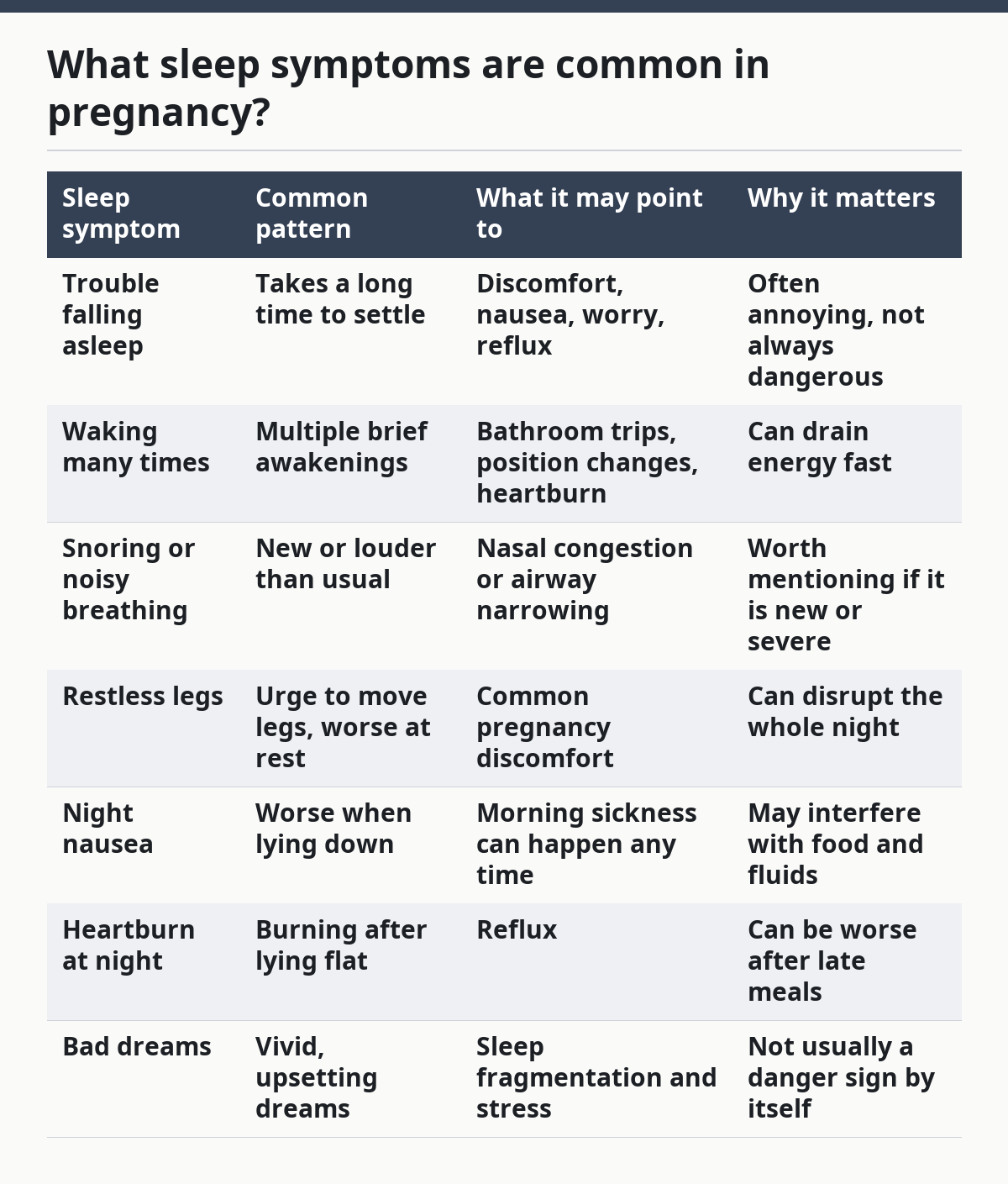
The useful part is not the label. The useful part is whether the symptom is new, how often it happens, and whether it comes with anything else. A single rough night is common. A pattern that repeats for days, or a symptom that appears with pain or dizziness, needs more attention.
How should a self-check be done?
Therefore, a pregnancy sleep self-check should track the symptom, the timing, the trigger, and the warning signs. The goal is to collect a clear picture over 3 to 7 nights, not to guess from one bad evening.
- Name the main sleep problem. Write down one clear issue, such as “trouble falling asleep,” “waking to pee,” or “night nausea.” Verify that the symptom is specific and not a general feeling of being tired. If the note stays vague, the pattern will be hard to judge.
- Record when it started. Note whether it began around 4 to 6 weeks, later in the first trimester, or after a specific change. Verify whether it is new for this pregnancy or something that existed before. A symptom that starts suddenly after a quiet stretch deserves more attention than one that has drifted in slowly.
- Track the timing across the night. Mark whether the problem happens at bedtime, after midnight, or near morning. Verify the clock pattern, because reflux often shows after lying flat, while bathroom trips can cluster through the night. If the symptom is worse every night at the same point, the trigger may be mechanical rather than random.
- Check the body signs attached to it. Notice nausea, pain, shortness of breath, itching, swelling, headache, or dizziness. Verify whether the sleep problem stands alone or arrives with other symptoms. If more than one body system is involved, the issue is less likely to be just a sleep habit.
- Look at food, fluid, and position before bed. Note late meals, large drinks, spicy foods, or lying flat soon after eating. Verify whether the symptom changes when the evening routine changes. If the sleep problem tracks meals or posture, that points toward reflux or discomfort rather than a new disease by itself.
- Check how much the symptom disrupts function. Write whether the next day brings fogginess, missed work, crying spells, or inability to rest. Verify the impact, not just the feeling. A symptom that is mild but annoying is often different from one that prevents sleep most nights, but if you are unsure or it is getting worse, consult a qualified professional and follow NHS guidance on persistent symptoms.
- Ask whether anything feels urgent. Look for bleeding, fluid leakage, severe headache, chest pain, fainting, or reduced fetal movement later in pregnancy. Verify that none of these are present if the sleep symptom feels ordinary. If any are present, the self-check stops and professional care becomes the next step.
A self-check is useful because it turns a messy night into usable information. It also stops the common trap of saying “I slept badly” when the real issue is heartburn, nasal congestion, anxiety, or frequent urination. That distinction changes what happens next.
Overall, a short factual note is often the most useful, because it keeps the pattern clear without adding extra guesswork. “Trouble falling asleep, 3 nights in a row, worse after late dinner, no pain, no bleeding” tells more than a long story.
Which sleep changes fit each trimester?
Meanwhile, sleep changes often shift as pregnancy moves through the three trimesters, and the pattern can be different in each one. Early pregnancy often brings nausea and fatigue, later pregnancy often brings body pressure and more bathroom trips, and the final stretch can make getting comfortable much harder.
A full-term pregnancy lasts between 39 weeks and 40 weeks, according to Cleveland Clinic. Only about 5% of babies are born on their estimated due date, according to Cleveland Clinic, so sleep symptoms near the end of pregnancy may not line up neatly with the calendar.
The first trimester can bring early symptoms that start around 4 to 6 weeks, according to the NHS. Sleep can suffer because nausea is active when the stomach is empty or full, and because fatigue can feel heavy but still not lead to restful sleep. Some people also sleep more during the day and then struggle at night.
The second trimester often improves for some people, but not all. If nausea settles, sleep may still be disturbed by heartburn, vivid dreams, or a need to change position more often. That does not mean something is wrong; it means the source of the sleep problem has changed.
The third trimester often brings the most obvious mechanical sleep trouble. A larger uterus can make lying flat harder, bathroom trips increase, and the body may feel more restless. This is also the time when a new symptom can be easy to dismiss as “just pregnancy,” which is why warning signs matter more, not less.
When is it a warning sign?
So a pregnancy sleep symptom is a warning sign when it appears with other symptoms, changes quickly, or feels severe rather than merely annoying. A sleep complaint by itself is often not dangerous, but the context can make it serious.
| Symptom pattern | What it may mean | What to do |
|---|---|---|
| Sleep trouble plus bleeding | Could point to a pregnancy complication | Seek qualified medical advice promptly |
| Sleep trouble plus severe headache or vision change | Could signal a condition that needs review | Get urgent professional assessment |
| Sleep trouble plus chest pain or shortness of breath | Could involve the heart or lungs | Treat as urgent and get help now |
| Sleep trouble plus strong one-sided pain | Could be something beyond routine pregnancy discomfort | Contact a professional promptly |
| Sleep trouble plus reduced fetal movement later in pregnancy | May need same-day review | Do not wait for the next routine check |
Bleeding with sleep disturbance: This is not a normal sleep symptom — it can signal a pregnancy problem that needs prompt assessment, so contact a qualified professional right away.
Severe headache with poor sleep: This can mean the sleep issue is part of a bigger problem, not the cause itself — get medical review, especially if vision is also different.
Shortness of breath at rest: This is more than pregnancy restlessness — it needs urgent attention because sleep is not the right place to ignore breathing trouble.
Fever or feeling acutely unwell: This suggests illness rather than a simple sleep change — seek care, since infection can affect both sleep and pregnancy.
Reduced fetal movement later in pregnancy: This is not explained by a bad night’s sleep — contact a professional the same day for advice.
The key point is that “common” and “safe” are not the same thing. Pregnancy often causes ordinary sleep problems, but a new or severe symptom should not be explained away just because pregnancy is involved.
What mistakes do people make with pregnancy sleep symptoms?
Likewise, people often make the mistake of treating every sleep problem as normal pregnancy discomfort, and that can delay care when the symptom is actually a warning sign. The safer approach is to sort symptoms by pattern, not by guesswork, and to consult a qualified professional when a symptom is new, severe, or hard to explain.
One common error is assuming all tiredness means poor sleep. Pregnancy fatigue can be intense, especially early on, but tiredness alone does not tell you why sleep is bad. The better move is to check whether the issue is nausea, reflux, bathroom trips, pain, or worry.
Another error is using the same explanation for every trimester. A symptom that fits early pregnancy may not fit late pregnancy. For example, nausea around 4 to 6 weeks can be very different from new shortness of breath near term.
A third mistake is ignoring the timing. If a symptom appears after lying flat or after a large late meal, the trigger may be clear. If it happens with headache, swelling, or bleeding, the trigger is not simply “being pregnant,” and the consequence of waiting can be serious.
A fourth error is taking the “sleep symptom” label too literally. Snoring, leg discomfort, or repeated waking may look like insomnia, but each one has a different pattern. Treating them all the same can waste time and blur the real cause, so professional advice is sensible when the pattern does not fit.
A fifth mistake is not writing anything down. Memory gets fuzzy after several broken nights. A short note over 3 to 7 nights is much better than one anxious guess.
A sixth mistake is assuming a due date defines when symptoms should start or stop. Cleveland Clinic notes that only about 5% of babies are born on their estimated due date, so late pregnancy symptoms do not need to line up neatly with a calendar box. The body does not always follow the date.
What can be checked against other symptoms?
Because of that, a pregnancy sleep symptom should be compared with the rest of the picture, because the meaning changes when another symptom is present. This is the fastest way to tell ordinary discomfort from something that needs a professional eye.
| Sleep symptom | More likely ordinary when… | More concerning when… |
|---|---|---|
| Trouble falling asleep | It follows reflux, a full bladder, or a bad position | It comes with pain, bleeding, or breathlessness |
| Night waking | It happens from bathroom trips or position changes | It comes with dizziness, fainting, or fever |
| Vivid dreams | It is the only new symptom | It comes with anxiety that feels overwhelming or unsafe |
| Snoring | It is mild and new | It is loud, paired with gasping, or tied to breathing trouble |
| Restless legs | It is uncomfortable but isolated | It comes with weakness, swelling, or severe distress |
This comparison helps because sleep symptoms rarely exist on their own. They sit on top of nausea, heartburn, fatigue, and body changes. When the accompanying symptoms are mild and explain the night, the sleep problem is often part of routine pregnancy change. When the accompanying symptoms are severe, the sleep issue stops being a “sleep question” and becomes a medical one.
That is also why a self-check should include one simple question: “What else is happening?” If the answer is nothing except discomfort, the situation is often simpler. If the answer includes bleeding, strong pain, or trouble breathing, the situation is not simple anymore.
What does the research pattern suggest?
In particular, the research pattern suggests that this topic is active, recent, and spread across many kinds of studies, but it does not create one single rule for every pregnant person. PubMed shows 568 matching human studies published from 2016 to 2026 for this topic, and the 100 most relevant records had a median publication year of 2023, using the method computed on 2026-11-10 from PubMed (NCBI).
Because that sample was mostly review-based, the field includes a lot of synthesis alongside direct studies: 32 of the 100 records were tagged Review, 12 were tagged Systematic Review, 8 were tagged Meta-Analysis, 6 were tagged Randomized Controlled Trial, and 2 were tagged Observational Study, all from PubMed (NCBI). The spread suggests that readers should expect a broad evidence base, but not a single fixed answer for every sleep symptom.
Since ClinicalTrials.gov listed 5 registered trials for this term, the question is still being studied. Of those 5, 2 were completed, 2 were recruiting, and 1 was not yet recruiting, with 4 of 5 at Na and 1 of 5 at Phase 3. The median planned enrolment was 42 participants, with a range from 31 to 600 participants.
That does not mean the topic is settled. It means the question is still being studied, and the safest advice remains symptom-based rather than promise-based. Research can suggest patterns, but it does not replace a personal review when a symptom looks unusual.
How should the results be interpreted with a professional?
Therefore, a self-check is meant to inform a conversation, not replace it. The most useful result is a clean description of the symptom, its timing, and any warning signs, because that lets a qualified professional decide whether the issue sounds routine or needs more work.
Pregnancy is a time when symptoms can overlap. Morning sickness, which about 70% of expecting mothers get according to BabyCenter, can affect sleep, appetite, and hydration all at once. Reflux, bladder pressure, and anxiety can do the same. The mechanism is not mysterious: a changing body changes the way nights feel.
A professional review matters most when the symptom is new, worsening, or paired with other body changes. It also matters when the symptom is severe enough to keep sleep broken most nights. A short note can help here: what the symptom is, when it happens, what makes it better or worse, and whether anything urgent is present.
The right question is not “Is this normal?” because pregnancy has a wide normal range. The better question is “Does this pattern need a closer look?” That shift keeps the focus on safety rather than on guessing.
FAQ
Is it normal to sleep badly in early pregnancy?
Yes, sleep can change early in pregnancy, sometimes around 4 to 6 weeks according to the NHS. Nausea, frequent bathroom trips, and fatigue can all disrupt sleep before the pregnancy is obvious in other ways. The pattern matters more than the label, so new sleep trouble with pain, bleeding, or shortness of breath should be checked.
How do I know if my sleep problem is just pregnancy?
A sleep problem is more likely to be routine pregnancy discomfort when it follows a clear trigger such as nausea, reflux, or position changes and there are no other warning signs. It is more concerning when it is sudden, severe, or paired with bleeding, headache, vision change, chest pain, or reduced fetal movement later in pregnancy. A short symptom log over 3 to 7 nights helps separate the two.
Should I worry if I wake up many times at night?
Not always, because waking often is common in pregnancy and can happen from bathroom trips, reflux, or discomfort. The concern rises when the waking comes with pain, fever, breathing trouble, or a feeling that something is not right. If the sleep loss is happening most nights and daytime function is dropping, a professional review is sensible.
Does snoring in pregnancy always mean something is wrong?
No, snoring can happen because pregnancy changes the nose and airway. It becomes more concerning if it is new and loud, includes gasping, or comes with daytime sleepiness that is severe. That pattern deserves a conversation with a qualified professional rather than simple reassurance.
When should I stop doing a home self-check and ask for help?
Stop the self-check if there is bleeding, chest pain, fainting, strong headache, breathing trouble, fever, or reduced fetal movement later in pregnancy. Those are not just sleep problems. They need prompt review because the sleep symptom may be part of something more serious.
Sources
- Cleveland Clinic, Pregnancy: Gestation, Trimesters & What To Expect (checked 19 Nov 2026)
- NHS, Signs and symptoms that might mean you’re pregnant – NHS (checked 19 Nov 2026)
- BabyCenter, BabyCenter – The Most Accurate & Trustworthy Pregnancy & Parenting Information – BabyCente (checked 19 Nov 2026)
Drafted with AI; not yet reviewed by a person.
