

Last updated: November 19, 2026
In short: yes, bladder habits can sometimes help you wake up less at night during pregnancy, but they do not fix every reason for night peeing. The safest approach is usually to work on bladder training and urge control gently, while also speaking to a qualified clinician about your own symptoms if the waking is sudden, painful, or getting worse.
Key takeaways
- Bladder habits can help if the problem is part habit, part urgency, or a pattern of “just in case” bathroom trips.
- Pregnancy changes the bladder in ways that habit training cannot fully override.
- The goal is not to hold urine for long stretches; the goal is to reduce unnecessary waking without straining.
- A bathroom schedule can help some people, but overdoing it can backfire and make urgency feel sharper.
- Get checked if the pattern changes fast, hurts, burns, or comes with fever, leaking, or blood.
Does bladder training help at night in pregnancy?

Bladder training can help some pregnant people wake up less at night, but it usually works best when nighttime waking is partly a learned habit or a mild urgency pattern rather than a pure physical need. Pregnancy pressure on the bladder, hormone shifts, and changes in fluid movement all limit how much a schedule alone can do.
The relevant question is not “Can the bladder be trained like a muscle?” It is “Can habits change how often the brain sends you to the toilet?” For some people, yes. For others, the bladder is simply being compressed, and no amount of timing fixes that. The source base is also mixed: a PubMed search for pregnancy and nighttime human studies from 2016–2026 found 164 matching records on PubMed (NCBI) as of 2026-11-10; the 100 most relevant records were read, and the computed figures below come from that wider sample, not from this exact question. Of those 100, 5 were Randomized Controlled Trials, 5 were Reviews, 3 were Observational Studies, and 2 were Systematic Reviews, all as tagged by NLM on PubMed.
The practical takeaway is plain: bladder habits are worth trying if the night waking seems patterned and not painful, but they are not a cure-all. If the waking is new, severe, or paired with symptoms that suggest a urinary problem, a clinician should be part of the conversation. The NHS bladder training guide and the NIDDK page on overactive bladder are good background reading on how timed voiding and urge control are used in general: NHS bladder training and NIDDK overactive bladder.
How do bladder habits work?
Bladder habits work by separating a real urge from an automatic response to discomfort, fear of leakage, or a long-standing routine. The bladder sends a signal when it is filling, but the brain also learns when to pay attention to that signal. A bathroom schedule and urge control aim to make those signals less bossy at night.
The term often used is timed voiding, which means going to the bathroom on a planned schedule instead of waiting until the urge feels urgent. In pregnancy, that usually means a gentle schedule, not a strict one. A strict plan can leave you straining to “train” through a real need, which is the wrong direction.
One detail matters more than people expect: the bladder is not the only reason you wake. A person can wake for another reason, notice a full bladder, and then blame the bladder alone. That is why habit changes help some readers and do little for others. A general bladder-training plan can be useful, but it should not be treated like a one-size-fits-all fix for pregnancy sleep.
What is the safest way to try it?
The safest way to try bladder training during pregnancy is to use a gentle schedule, watch for patterns, and stop if the plan makes urgency worse or causes pain. The aim is fewer unnecessary trips, not heroic bladder holding.
- Start with a 2- to 3-night diary. Write down the time you went to bed, each wake-up, whether you felt urgent, and whether you passed a small or normal amount. Verify whether the waking is clustered at the same hours. A problem sign is pain, burning, or a sudden big change from your usual pattern.
- Set one planned bathroom visit before sleep. Go once after your bedtime routine, then stop “double checking” every few minutes. Verify that the visit feels calm, not rushed. A problem sign is returning to the toilet repeatedly out of fear rather than need.
- Use a gentle interval goal during the day. Pick a simple pattern, such as waiting a little longer before each non-urgent visit, rather than emptying the bladder at every mild sensation. Verify that the urge remains manageable. A problem sign is strong pressure, leaking, or an inability to finish a task because you are thinking about the bathroom.
- When an urge hits, pause for a short reset. Stand still, breathe slowly for a minute, and notice whether the urge eases. Verify whether the feeling drops from urgent to moderate. A problem sign is worsening cramping, lower belly pain, or a feeling that urine will leak if you move.
- Avoid the “just in case” habit late at night. If you woke for another reason, ask whether you truly need to go or whether you are reacting to the wake-up itself. Verify that this does not lead to wetting, pain, or panic. A problem sign is repeated trips with almost no urine each time.
- Keep the schedule consistent for several days. Habits change over days, not minutes. Verify whether the number of wake-ups settles, stays the same, or gets worse after 3 to 7 days. A problem sign is no improvement at all plus more stress around sleep.
- Track what is different on worse nights. Note late evening drinks, long naps, coughs, constipation, or a busier day. Verify whether one factor keeps showing up. A problem sign is no pattern at all, which suggests the cause may be more physical than habitual.
This approach is modest on purpose. It does not ask you to hold your bladder for hours, and it does not assume the bladder is the whole problem. The point is to reduce automatic waking, not to force the body into silence.
What habits help most?
The habits that help most are the ones that calm urgency without creating strain. A bathroom schedule, urge control, and a simple bedtime routine tend to work better than aggressive bladder holding.
A useful comparison looks like this:
| Approach | What it does | Main upside | Main drawback |
|---|---|---|---|
| Timed voiding | Bathroom visits on a set pattern | Reduces “just in case” trips | Can feel rigid if the schedule is too tight |
| Urge control | Short pause, breathe, wait for the urge to pass a little | Helps separate real need from habit | Does not help if the bladder is truly full |
| Free-form bathroom trips | Go whenever you feel like it | Simple | Can reinforce frequent waking |
| Forcing long holds | Delay for a long stretch | Sometimes lowers trip count | Can increase discomfort and is not a good pregnancy default |
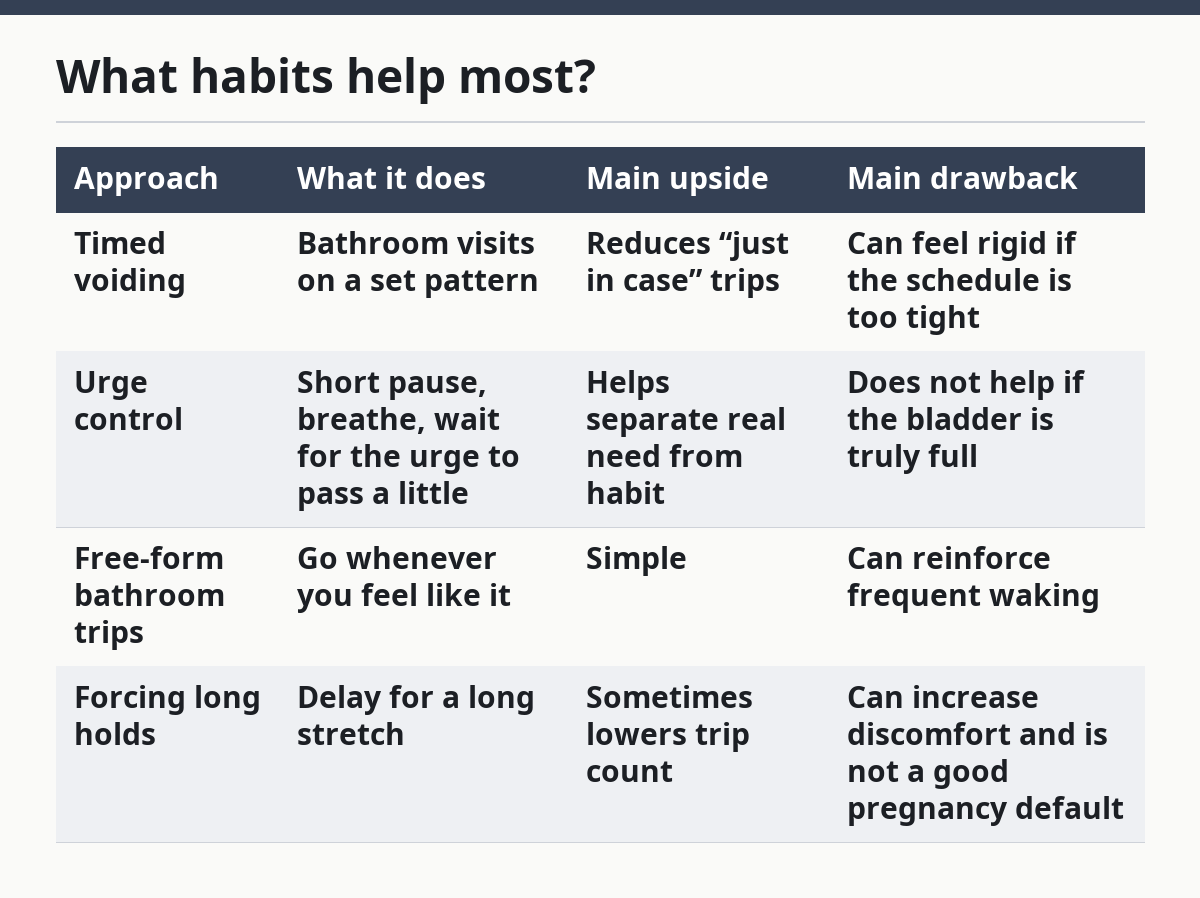
The phrase “safe habit change” matters here. Safe means no straining, no pain, and no pattern of ignoring a body signal that feels strong or unusual. It also means not turning a sleep problem into a bladder conflict. Many people do better with small changes, like one planned night-time trip before sleep and a calmer response to mild urges, than with a hard schedule.
The figure that can be checked in the literature summary is the median publication year of the 100 most relevant PubMed records: 2022, with abstract dose figures ranging from 11 to 10,000 mg across 11 figures stated and abstract study-duration figures ranging from 2 to 156 weeks across 81 figures stated, all computed from PubMed (NCBI) records on 2026-11-10. Those figures do not tell you what dose or duration to use here; they show that the broader evidence base is uneven and not centered on one clean pregnancy-night question.
When should you stop trying this?
You should stop self-managing and get qualified help when the bladder pattern looks less like a habit and more like a medical symptom. Pregnancy is not the time to “push through” warning signs.
Burning, pain, or fever: these are not training problems — they can point to infection or another urinary issue, so bladder training should pause and a clinician should assess the symptoms.
Blood in the urine: this is not a normal response to a bathroom schedule — it needs medical review rather than more bladder holding.
Sudden new urgency or a sharp change in nighttime waking: a fast shift is less likely to be a habit and more likely to be a new body issue — ask for medical guidance.
Leakage that is new, heavy, or hard to control: this can mean the bladder is under more stress than habit changes can address — a clinician can help sort out what is going on.
Back pain with urinary symptoms: this is beyond routine bladder training — it deserves prompt evaluation because the problem may not be simple urgency.
Repeated tiny voids with a constant urge: this can mean the bladder is irritated rather than merely overtrained — stop the schedule and get checked.
You are losing sleep badly even after several days of gentle habit changes: the approach is not doing enough — it is time to reassess instead of tightening the plan.
These are not academic cautions. They are the points where habit work stops being the right tool. If a pattern is painful, abrupt, or clearly worsening, a qualified professional should help decide what is driving it.
What mistakes make it worse?
The most common mistake is treating bladder training like a contest. That usually backfires. Pregnancy bladder habits work best when they are mild and consistent, not strict and punitive.
Another mistake is cutting bathroom trips too aggressively. That can leave you distracted, tense, and more aware of urgency, which often makes sleep worse rather than better. A gentler interval is more likely to hold for more than 1 or 2 nights.
A third mistake is using “nocturia” as if it means the same thing for everyone. Nocturia is the medical term for waking from sleep to urinate, but in pregnancy the cause can be mixed. A habit problem, a pressure problem, and a sleep problem can overlap.
A fourth mistake is ignoring the rest of the night routine. If the wake-up is being driven by stress, pain, constipation, or a noisy room, bladder work alone will not solve it. The right alternative is to look for the trigger that starts the wake-up, then decide whether the bladder is the main issue or just the last thing you notice.
A fifth mistake is assuming “less water” is the answer. That is a different question and can create its own problems, so it should not be used as a blunt fix for every bathroom trip. The safer move is to change habit patterns, not force dehydration.
When is bladder training the wrong tool?
Bladder training is the wrong tool when the problem is more than routine urgency. A schedule can help with mild habit-driven waking, but it cannot replace medical assessment when the symptoms look abnormal.
It also stops being useful when the person is already in pain or trying to hold against a strong physical need. In that setting, the plan is no longer about retraining a routine; it is about figuring out why the bladder is angry. Pregnancy changes can make the bladder feel smaller or more reactive, and no timed voiding plan can override that completely.
The best expectation is modest: some people get fewer unnecessary wake-ups, some get no change, and some need a different explanation entirely. That is why this topic belongs under pregnancy nighttime bathroom routines rather than under a promise of “fixing” night peeing. The hub page for that broader set of sleep and bathroom routines is the right place for the bigger picture.
How should you judge whether it is working?
Bladder training is helping if the night wake-ups become less automatic, less urgent, or less frequent over several days. The sign you want is not a perfect night; it is a pattern that feels more predictable and less disruptive.
A good result usually looks like a smaller number of “just in case” trips, less panicked urgency, and a calmer bedtime routine. A poor result looks like more tension, more bathroom checking, or a stronger sense that you are always thinking about your bladder. If the plan is making sleep worse after several days, the approach needs to change.
The main test is practical: do you feel more in control, or more trapped by the schedule? If you feel less trapped, the habit work is probably useful. If you feel trapped, the bladder is likely not the whole story.
Is bladder training safe during pregnancy?
Bladder training is generally used as a gentle habit strategy, but pregnancy makes the margin narrower, so it should stay mild and comfortable. It should not involve painful holding, straining, or ignoring warning signs. A qualified clinician should guide the plan if symptoms are new, severe, or accompanied by pain, fever, blood, or leakage.
How do I know if night peeing is habit or a real need?
Habit-driven waking often feels automatic, happens at similar times, and leads to small amounts of urine or repeated “just in case” trips. A real need is more likely when the urge feels strong, urgent, painful, or different from your usual pattern. If you are not sure, a short diary for 2 to 3 nights can show whether the pattern looks behavioral or physical.
Drafted with AI; not yet reviewed by a person.
