
Last updated: November 20, 2026
Quick answer: one or more night trips to pee can be common in pregnancy, but if nighttime urination in pregnancy changes in pattern or comes with pain, fever, burning, blood, or strong thirst, it should be discussed with a qualified clinician. During pregnancy, the bladder and kidneys can be under more pressure, but urinary changes do not all mean the same thing. For an overview of this topic, see pregnancy sleep and bladder comfort in pregnancy, and read the NHS guidance on needing to pee more often in pregnancy.
The evidence base is broad: 2,231 PubMed records match this subject for 2016–2026, and the 100 most relevant were read; every median, range, and share below is computed across those records, with the search widened because the full subject had too little published on it, so these figures describe the wider subject rather than this exact question, computed on 2026-11-20. For a reader who wants the sleep-and-bladder overview, this guide sits under the pregnancy sleep and bladder comfort hub.
Key takeaways
- Waking once or more at night to pee can happen in pregnancy without meaning disease.
- A new pattern matters more than a single busy night.
- Pain, burning, fever, blood, or unusual thirst makes the picture less likely to be simple pregnancy pressure.
- A UTI and dehydration can both change urination, but they do not look the same.
- If the change is abrupt, severe, or paired with feeling unwell, it needs professional review.
Who this is for
Because the question is how to tell if nighttime urination in pregnancy is normal or a sign of something else, this guide is for a pregnant reader who is trying to tell the difference between a common bladder change and a warning sign. It assumes you already know the basics of pregnancy and want to judge the pattern of nighttime urination, not self-diagnose from a single symptom; if you are unsure, consult a qualified clinician or NHS pregnancy advice.
Nighttime urination is common, and pregnancy can slightly reduce bladder capacity, make kidneys less efficient at concentrating urine, and lower the hormone that reduces nighttime urine production, according to Summit Health. That means a larger urine output at night does not automatically point to trouble, but the cause matters if the pattern changes over days, not just one night.
This is not the right page to use if you have severe pain, fever, heavy bleeding, or you feel acutely unwell. In those situations, the question is no longer “is this normal?” It is “what is causing it?” and that needs a qualified professional.
Why pregnancy makes nighttime urination common
Therefore, pregnancy makes nighttime urination common because the body is changing how much urine is made and how much the bladder can hold. Summit Health notes that pregnancy can slightly reduce bladder capacity and make kidneys less efficient at concentrating urine, which can increase nighttime urine production.
That change is usually mechanical and hormonal, not dangerous by itself. Cleveland Clinic says nighttime urination is a common complaint among all people, and it adds that getting up more than that, or needing to rise every 30 minutes to an hour, may mean frequent urination.
However, that does not mean every pregnancy is the same. Some people feel the change early, some later, and some notice it more when the bladder is already crowded. The point is the pattern: common pregnancy urination tends to be repetitive and familiar, while a new or abrupt shift can point to something else.
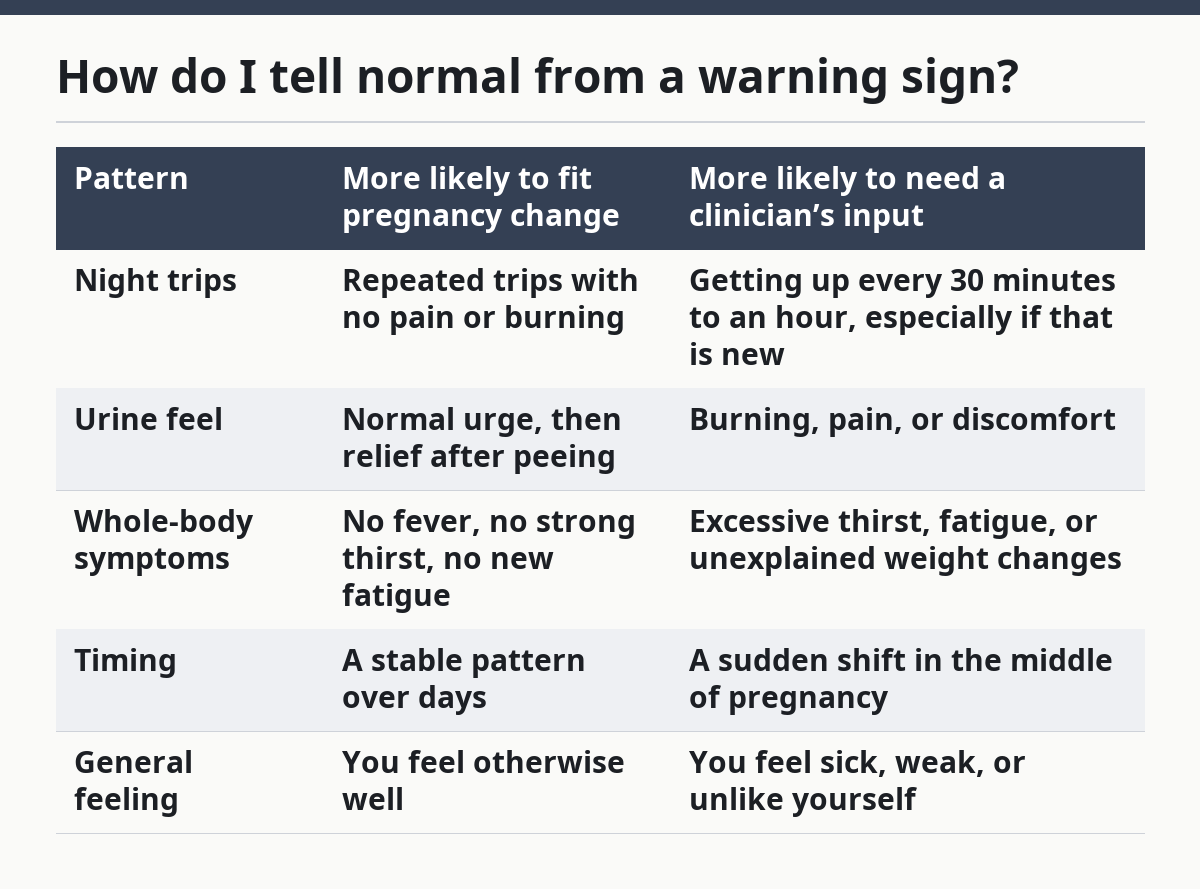
How do I tell normal from a warning sign?
Because the pattern matters more than the total count, normal pregnancy urination is usually a steady pattern without pain, burning, fever, or other new symptoms. Warning signs are changes in how it feels, how often it happens, or what comes with it.
A practical way to sort it out is to compare the pattern, not just the count. The table below shows the difference in plain terms.
| Pattern | More likely to fit pregnancy change | More likely to need a clinician’s input |
|---|---|---|
| Night trips | Repeated trips with no pain or burning | Getting up every 30 minutes to an hour, especially if that is new |
| Urine feel | Normal urge, then relief after peeing | Burning, pain, or discomfort |
| Whole-body symptoms | No fever, no strong thirst, no new fatigue | Excessive thirst, fatigue, or unexplained weight changes |
| Timing | A stable pattern over days | A sudden shift in the middle of pregnancy |
| General feeling | You feel otherwise well | You feel sick, weak, or unlike yourself |
Cleveland Clinic says peeing every 30 minutes is not typical, and Summit Health lists excessive thirst, fatigue, or unexplained weight changes among symptoms that can occur with nighttime urination. Those symptoms do not prove one cause, but they make “just pregnancy” a weaker explanation.
The bigger clue is combination. A single extra trip at 2 a.m. can be ordinary. Nighttime urination with burning, fever, or strong thirst is a different story.
What should I check before I assume it is normal?
Before you assume it is normal, the first check is whether the pattern changed from your usual pregnancy baseline. If you were waking once a night and now you are up many times, that shift matters more than the raw number alone.
The second check is how the urination feels. Pain, burning, or a sense that you still cannot empty the bladder after going are not typical comfort symptoms. If urination is accompanied by a feeling of illness, that also shifts the picture.
The third check is whether dehydration could be part of it. Pregnancy can change fluid balance, and excess thirst can appear along with nighttime urination, according to Summit Health. Thirst does not tell you the answer by itself, but it helps separate a bladder-pressure issue from a body-wide fluid issue.
The fourth check is whether any UTI warning signs are present. This page does not replace a UTI-focused guide, but a urinary tract infection is one of the main reasons nighttime urination can stop being “just pregnancy”; see also UTI symptoms in pregnancy and dehydration in pregnancy. The practical rule is simple: if the symptom cluster feels new, uncomfortable, or off-pattern, get it checked rather than guessing.
What causes more bathroom trips during pregnancy?
Meanwhile, more bathroom trips during pregnancy usually come from a mix of bladder pressure, fluid shifts, and kidney changes. The bladder has less room, the kidneys may concentrate urine less efficiently, and nighttime urine production can rise.
That mix is why nighttime urination can show up even when nothing is wrong. It is also why the symptom can be hard to judge from memory alone. In general, most of the literature on this topic is synthesis rather than direct trial evidence, which is one reason the numbers here should be read as context, not as a diagnosis for any one person.
A good general rule is this: pregnancy can explain frequency, but it does not explain pain, fever, or a sudden pattern change. When those show up, the symptom should not be treated as routine; if you are unsure, consult a qualified clinician.
When is frequent urination at night a problem in pregnancy?
However, frequent urination at night is a problem in pregnancy when the pattern is new, unusually intense, or comes with other warning signs. Cleveland Clinic says getting up every 30 minutes to an hour may mean frequent urination, and peeing every 30 minutes is not typical.
Here is the point where the ordinary explanation starts to fail:
- Burning or pain with urination: This can point to a urinary tract problem rather than simple bladder pressure — arrange prompt medical review.
- Fever or feeling ill: This suggests the issue may be broader than pregnancy changes — seek professional care.
- Excessive thirst: This can be part of a fluid or metabolic issue, not just a busy bladder — mention it to a clinician.
- Unexplained fatigue or weight changes: These are not normal bladder symptoms — get assessed.
- Need to urinate every 30 minutes: That is outside the usual pattern described by Cleveland Clinic — do not assume it is harmless.
- Blood in the urine: This is not a routine pregnancy symptom — it needs evaluation.
Summit Health also says to get tested for a UTI as soon as possible when that possibility is on the table. That is important because a UTI can start as a bladder symptom and then become more serious if ignored.
What are the common mistakes?
One common mistake is counting trips without looking at the rest of the pattern. A person may fixate on “three times a night” and miss the more useful clue: pain, fever, or a sudden change. The better alternative is to track the whole symptom, not just the number.
A second mistake is blaming every nighttime bathroom trip on pregnancy and stopping there. That can delay care if the cause is a UTI or another issue. The better alternative is to ask whether the symptom is steady and familiar or new and uncomfortable.
A third mistake is assuming that thirst is just a pregnancy quirk. Excessive thirst can appear with nighttime urination, according to Summit Health, and it should not be ignored if it is marked or new. The better alternative is to treat thirst as part of the pattern, not as background noise, and to speak with a clinician if it is persistent.
A fourth mistake is waiting for the symptom to “settle down” when it is getting worse. The longer the pattern goes on, the harder it can be to tell simple pregnancy pressure from something else. The better alternative is to ask for help sooner if the pattern is escalating.
A fifth mistake is trying to self-label the issue from a single search result. Urination can change because of bladder pressure, dehydration, or a UTI, and those do not have the same meaning. The better alternative is a clinical review when the symptom cluster is not clearly ordinary.
FAQ
How many times is normal to pee at night when pregnant?
There is no single number that fits every pregnancy. A few night trips can be common, and pregnancy can change bladder capacity and urine production, according to Summit Health. What matters more is whether the pattern is stable, painless, and not paired with warning signs like burning, fever, or strong thirst.
When is frequent urination at night a problem in pregnancy?
Frequent urination at night is a problem when it is new, severe, or comes with pain, burning, fever, blood, or feeling unwell. Cleveland Clinic says getting up every 30 minutes to an hour may mean frequent urination, and that pattern is not typical. A qualified clinician should review the cause if the symptom is changing.
What causes more bathroom trips during pregnancy?
More bathroom trips during pregnancy can come from bladder pressure, reduced bladder capacity, and kidney changes that affect how urine is concentrated. Summit Health notes that pregnancy can also lower the hormone that reduces nighttime urine production. Those changes can be normal, but they do not rule out a UTI or another issue if symptoms shift.
Sources
- Summit Health, “Why Do I Pee So Much at Night? Causes and When to See a Doctor”
- Cleveland Clinic, “Frequent Urination: Causes, What It Means & How To Stop”
- NHS, “Need to wee”
- PubMed (NCBI), records matched and sampled on 2026-11-20
Drafted with AI; not yet reviewed by a person.
