
Last updated: November 19, 2026
Key Takeaways
- A practical overnight setup is left-side sleeping, upper-body elevation, and a 2–3 hour gap after the last meal.
- Pregnancy can increase reflux pressure because of hormonal changes and abdominal crowding.
- Adjust the hours before bed more than the mattress or pillows alone.
- Avoid stacking soft pillows under the head only; aim for real torso support.
Pregnancy heartburn can make bedtime miserable, but the usual fix is a combination of timing, position, and upper-body elevation. This guide on How to Sleep with Heartburn During Pregnancy explains the core steps to reduce acid reflux when you lie down, and you should speak with a qualified professional about your own symptoms if the burning is severe, new, or keeps waking you.
Heartburn in pregnancy is common, and practical bedtime changes usually focus on reducing reflux when you are horizontal. The advice below is based on general physiology and clinical guidance from sources such as the American College of Obstetricians and Gynecologists and the NHS, not on a guaranteed one-size-fits-all cure.
Who this advice is for — and who should get help first
This applies to pregnant people who get heartburn mostly at night and want to sleep through it with simple changes like left side sleeping, head elevation, and earlier meals. It assumes the reader already knows the basics of pregnancy discomfort and is looking for a practical bedtime plan, not a diagnosis.
It does not apply cleanly if chest pain is not clearly linked to meals, if swallowing is painful, if vomiting is frequent, or if the burning feels different from the heartburn you have had before. Those patterns can overlap with reflux, but they can also point to something that needs a clinician’s judgment rather than a pillow adjustment. The same caution applies if symptoms are severe enough to interfere with sleep for several nights in a row or if antacids no longer seem to help.
The available medical literature on pregnancy reflux includes reviews, observational studies, and some trials, so practical advice is usually built from physiology and symptom management rather than a large number of sleep-specific pregnancy studies. That mix matters because a bedtime strategy for pregnancy heartburn is usually based on how reflux behaves during pregnancy, not on a dedicated test of every pillow and sleeping angle.
This section is for the reader who wants a plan they can try tonight, with realistic expectations. It is not for someone hoping for a guaranteed fix or for someone who needs a tailored plan because another pregnancy symptom is driving the sleep problem.
How to sleep with heartburn during pregnancy, step by step
A workable overnight setup usually combines left-side sleeping, a raised upper body, and a 2–3 hour gap between the last meal and lying down. That combination aims to reduce acid reflux while you are horizontal, when gravity stops helping the stomach stay where it belongs.
- Finish dinner earlier than usual. Leave at least 2 to 3 hours between your last substantial meal and bedtime, and make that meal smaller than lunch if possible. Verify that you are not going to bed feeling heavy, stretched, or overly full. If you still feel pressure in the upper abdomen 30 minutes after eating, that is a sign the meal was too large or too close to sleep.
- Choose a low-trigger bedtime snack only if you truly need one. If hunger wakes you, keep the snack modest and bland rather than rich, spicy, or acidic. A small amount of plain food is easier to tolerate than a heavy late meal. If a snack makes the burning worse within the next hour, that food choice is a problem, not a solution.
- Lie on your left side. Left side sleeping is commonly recommended because it can reduce reflux for many people by changing how the stomach sits relative to the esophagus. Verify that the burning feels less likely to climb after you turn. If left side sleeping clearly worsens hip pain or leaves you unable to settle, the position is not working as intended and the rest of the setup needs adjustment.
- Raise your upper body, not just your head. A wedge pillow or bed elevation that lifts the torso about 6 to 8 inches is usually more useful than stacking two ordinary pillows under the neck. The point is a gentle slope from shoulders to hips, not a kink at the waist. If your chin tucks hard toward your chest or you slide down in the night, the angle is too steep or the support is wrong.
- Keep the stomach from being compressed. Use loose sleepwear and avoid positions that fold you tightly at the midsection. Verify that the belly is supported but not squeezed. If you feel pressure, shortness of breath, or a sudden increase in reflux after settling in, the setup may be compressing the abdomen instead of easing it.
- Keep antacids in the conversation, not on autopilot. Antacids are often used during pregnancy, but the right choice depends on the ingredient and your own health history, so this is a place to ask a pharmacist, obstetric clinician, or another qualified professional. Verify that you know which product you are using and that it is appropriate for pregnancy. If you are reaching for them every night, that pattern deserves review rather than repetition.
- Stay upright after the last drink. Water is fine, but lying flat right after a large glass can make reflux easier to notice. Give your body 20 to 30 minutes upright after your final sip if you can. If even small amounts of fluid right before bed seem to trigger burning, the timing of bedtime drinks may need to change.
- Build the same routine for several nights. Reflux changes are easier to judge when you use the same angle, side, and meal timing for 3 to 5 nights instead of changing everything at once. Verify whether the waking, burning, or sour taste improves. If nothing changes after several consistent nights, the problem may need medical review rather than more pillow stacking.
The details matter because a wedge pillow can help in one room and fail in another. A flimsy foam wedge that sinks under the shoulders, for example, does not create the same upper-body elevation as a firmer 6- to 8-inch incline at the torso. The same is true for left side sleeping: it is not magic, but it is often one of the least disruptive changes to try first.
For readers comparing options, the safest next step is usually to discuss symptoms and medication choices with a qualified professional, then use that guidance to decide whether simple positioning is enough. If you also use the pregnancy sleep guide hub, this topic fits there as the reflux-specific piece of the larger sleep picture.
Why night reflux gets worse when you lie down
Night reflux gets worse because gravity stops helping, the stomach empties more slowly after a heavy meal, and the lower esophageal sphincter—the muscular valve between the esophagus and stomach—can let acid move upward more easily when pressure rises. In pregnancy, that pressure can be higher because of hormonal changes and the physical crowding of the abdomen.
That is why a daytime habit can become a nighttime symptom. A meal that feels fine at 7 p.m. can still cause trouble at 10 p.m. if you lie flat soon after. The same is true for drinks with a lot of volume, rich sauces, fried food, citrus, tomato-based meals, chocolate, peppermint, and other common triggers. Not every pregnant person reacts to the same foods, so the best clue is what reliably worsens your own symptoms in the next 1 to 3 hours.
A generic article often gets this wrong by treating heartburn like a simple food allergy. It is not. It is often a timing-and-position problem with food acting as the trigger, the amplifier, or both. That is why the practical fix is not one miracle food but a pattern: smaller evening intake, left side sleeping, and upper-body elevation.
This section is also where the trade-off shows up. A very upright setup may reduce reflux, but it can be harder on the neck if the support is badly arranged. A soft nest of pillows may feel comfortable for 10 minutes and then let the torso sink flat enough to undo the benefit. The right setup is the one that keeps you inclined for most of the night without creating a new ache.
What should I change before bed?
You should change the last 2 to 3 hours before bed more than the bed itself. That is usually the fastest way to reduce pregnancy heartburn at night.
Start with dinner size. A large, late meal is a common reflux trigger because it increases stomach volume right when you are preparing to lie down. Then look at the food itself. Tomato sauces, citrus, fried food, heavy cream, garlic-heavy dishes, spicy meals, chocolate, peppermint, and caffeinated drinks are common reflux triggers, though individual patterns vary. A person who tolerates oatmeal may not tolerate pasta with tomato sauce; a person who tolerates soup may not tolerate citrus tea.
Therefore, the next step is to reduce pressure. Tight waistbands, slumped sitting, and bending forward after a meal can all make reflux easier to feel. If you need to sit after eating, sit upright with your shoulders stacked over your hips. If you need to rest, keep the torso supported rather than curled.
Finally, think about the bed itself. A wedge pillow is often more effective than extra ordinary pillows because it creates a single incline instead of bending the neck. Bed elevation under the mattress or bed frame can work too, as long as the slope is stable. The goal is not perfection; it is to make reflux less likely for 6 to 8 hours, which is the stretch that matters overnight.
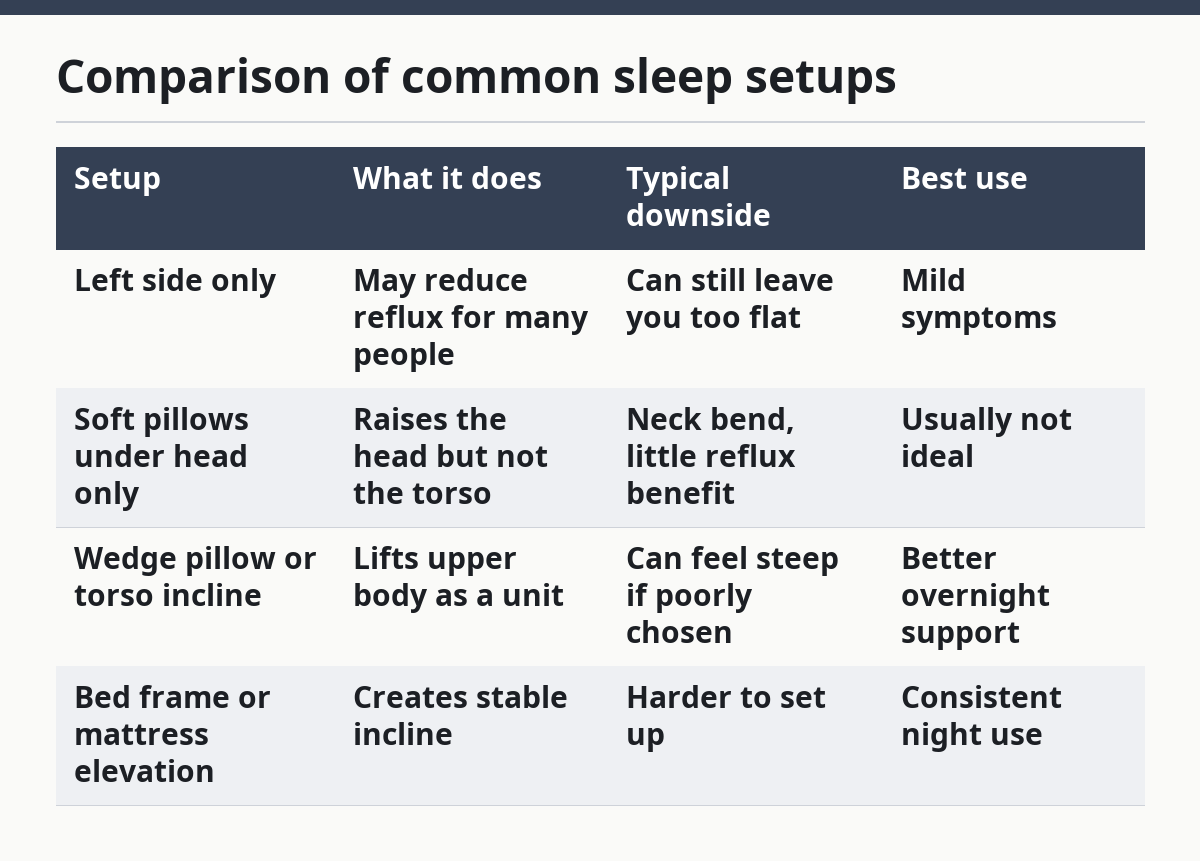
Comparison of common sleep setups
| Setup | What it does | Typical downside | Best use |
|---|---|---|---|
| Left side only | May reduce reflux for many people | Can still leave you too flat | Mild symptoms |
| Soft pillows under head only | Raises the head but not the torso | Neck bend, little reflux benefit | Usually not ideal |
| Wedge pillow or torso incline | Lifts upper body as a unit | Can feel steep if poorly chosen | Better overnight support |
| Bed frame or mattress elevation | Creates stable incline | Harder to set up | Consistent night use |
Common mistakes that keep heartburn awake
One common mistake is using two or three soft pillows under the head only. That bends the neck but leaves the stomach nearly flat, so reflux can continue. The better alternative is true upper-body elevation with a wedge pillow or bed incline.
Another mistake is eating “light” but too late. A small plate of food at bedtime can still be enough to trigger burning if it lands within 30 to 60 minutes of lying down. The better alternative is to leave a 2 to 3 hour gap whenever possible.
A third mistake is assuming all antacids are interchangeable. Different products contain different ingredients, and pregnancy is not the time to guess. The better alternative is to ask a qualified professional which product is appropriate for your situation and to avoid mixing products without guidance.
A fourth mistake is forcing a position that worsens another symptom. Left side sleeping may help reflux, but if it aggravates hip pain or makes you wake every hour, the position is losing more than it gains. The better alternative is to keep the left-side bias when you can, then adjust the torso support so the body can stay there longer.
A fifth mistake is treating worsening symptoms as “just pregnancy.” Heartburn is common in pregnancy, but severe pain, trouble swallowing, repeated vomiting, or symptoms that feel new and different deserve evaluation. The better alternative is to get a professional opinion instead of pushing through another week.
When the standard approach does not apply
The usual sleep setup is not the right tool if the heartburn is paired with red-flag symptoms, because then the issue may be more than ordinary reflux.
Chest pain that is not clearly linked to meals: This may not be simple heartburn — get urgent medical assessment, especially if the pain is severe, spreading, or comes with sweating or faintness.
Repeated vomiting or inability to keep food down: This can point to something beyond bedtime reflux — speak to a qualified clinician promptly.
Painful swallowing or food sticking in the throat: This is not typical bedtime reflux — it needs evaluation rather than just position changes.
Heartburn that is new, severe, or rapidly worsening: Pregnancy can change reflux patterns, but a sharp change deserves review — do not keep escalating home measures alone.
Antacids are needed most nights for more than a short stretch: Ongoing dependence suggests the plan is not enough — ask a pharmacist or obstetric clinician about safer next steps.
Sleeping changes make symptoms worse instead of better: If a wedge, left side sleeping, or earlier meals clearly increase distress, that approach is not a fit — stop forcing it and reassess.
What a good result looks like
A good result is not zero heartburn every night. A good result is less burning, fewer wake-ups, and less need to sit upright in the middle of the night. For many people, success looks like being able to lie on the left side with the upper body raised 6 to 8 inches, then stay asleep longer even if mild reflux still shows up occasionally.
The improvement should feel practical, not dramatic. If the setup helps on two nights but collapses on the third because the pillow slips or dinner was too late, the plan is too fragile. If the setup works only when every condition is perfect, it is worth simplifying. Bedtime routines do best when they are repeatable.
If you have been trying the same changes for several nights and the result is still poor, the next step is not more pillow improvisation. It is a conversation with a qualified professional about symptoms, triggers, and whether medication or a different assessment is appropriate. That is especially true in pregnancy, where the aim is to protect sleep without ignoring a problem that needs care.
Does sleeping on your left side help heartburn when pregnant?
Yes, left side sleeping often helps reduce pregnancy heartburn for many people. It may make it harder for acid reflux to move upward when you are lying down, though the effect varies by individual. If left side sleeping worsens another symptom, such as hip pain, the position may need to be modified.
Should I raise my head for pregnancy heartburn?
Yes, but upper-body elevation works better than head-only elevation. A wedge pillow or bed incline that lifts the torso about 6 to 8 inches is usually more useful than stacking pillows under the neck. The goal is to keep the stomach lower than the chest without straining the neck.
What should I avoid eating before bed during pregnancy?
Avoid the foods that reliably trigger your own symptoms, especially if they appear within a few hours of lying down. Common triggers include spicy food, tomato-based dishes, citrus, chocolate, peppermint, fried food, and large rich meals.
Drafted with AI; not yet reviewed by a person.
