

Last updated: November 19, 2026
In short: yes — when pregnancy sleep symptoms could be a sign of anxiety, dehydration, or low blood sugar at once, night waking, sweating, shakiness, and hunger can appear together. Because pregnancy lasts about 40 weeks and symptoms shift across all three trimesters, the safer read is often “more than one thing may be going on,” not “pick one cause and ignore the rest.” Please speak with a qualified professional about your own situation.
Key takeaways
- The same sleep problem can have more than one driver in pregnancy.
- Night waking does not tell you the cause by itself.
- Anxiety can sit on top of dehydration or low blood sugar.
- A pattern matters more than one isolated symptom.
- If symptoms repeat, worsen, or feel hard to explain, get advice from a qualified professional.
What makes one symptom point to three causes?

One sleep symptom can fit anxiety, dehydration, and low blood sugar because these problems overlap in the body and at night. The medical literature on this topic includes many human records across recent years, and the main takeaway is the same: the evidence supports looking at patterns, not assuming one cause from one symptom.
That mix matters because the literature is not built around a single clean answer. The body at night is doing several jobs at once: blood sugar can fall between meals, fluid needs can show up as thirst or dryness, and anxiety can keep the brain in a lighter sleep state. The result can be the same phone-note symptom list: night waking, sweating, shakiness, and hunger.
This is why a generic “it’s just pregnancy sleep” answer can be wrong. It can also be too narrow to blame only one factor. A mixed cause is often a reasonable first question: which symptoms arrive together, which ones repeat, and which ones calm down after food, fluid, rest, or reassurance.
How do I think about overlapping causes at night?
The easiest way to think about overlapping causes is to sort symptoms into clusters, not into one label. A simple pattern table can help when the same 2 to 4 symptoms keep showing up across a 13-week trimester, or across more than one night in a row.
| Symptom pattern at night | What it can fit | Why the overlap matters |
|---|---|---|
| Night waking with racing thoughts | Anxiety | Sleep may break first, then worry grows because you are awake |
| Night waking with thirst or dry mouth | Dehydration | Fluid needs can disturb sleep and make you notice your body more |
| Night waking with shakiness and hunger | Low blood sugar | Hunger and shakiness often travel together, especially after a long gap without food |
| Night waking with sweating plus worry | Anxiety, low blood sugar, or both | Sweating is not specific, so the pattern around it matters more than the single symptom |
| Night waking with all four together | Mixed causes | More than one cause may be stacking at once |
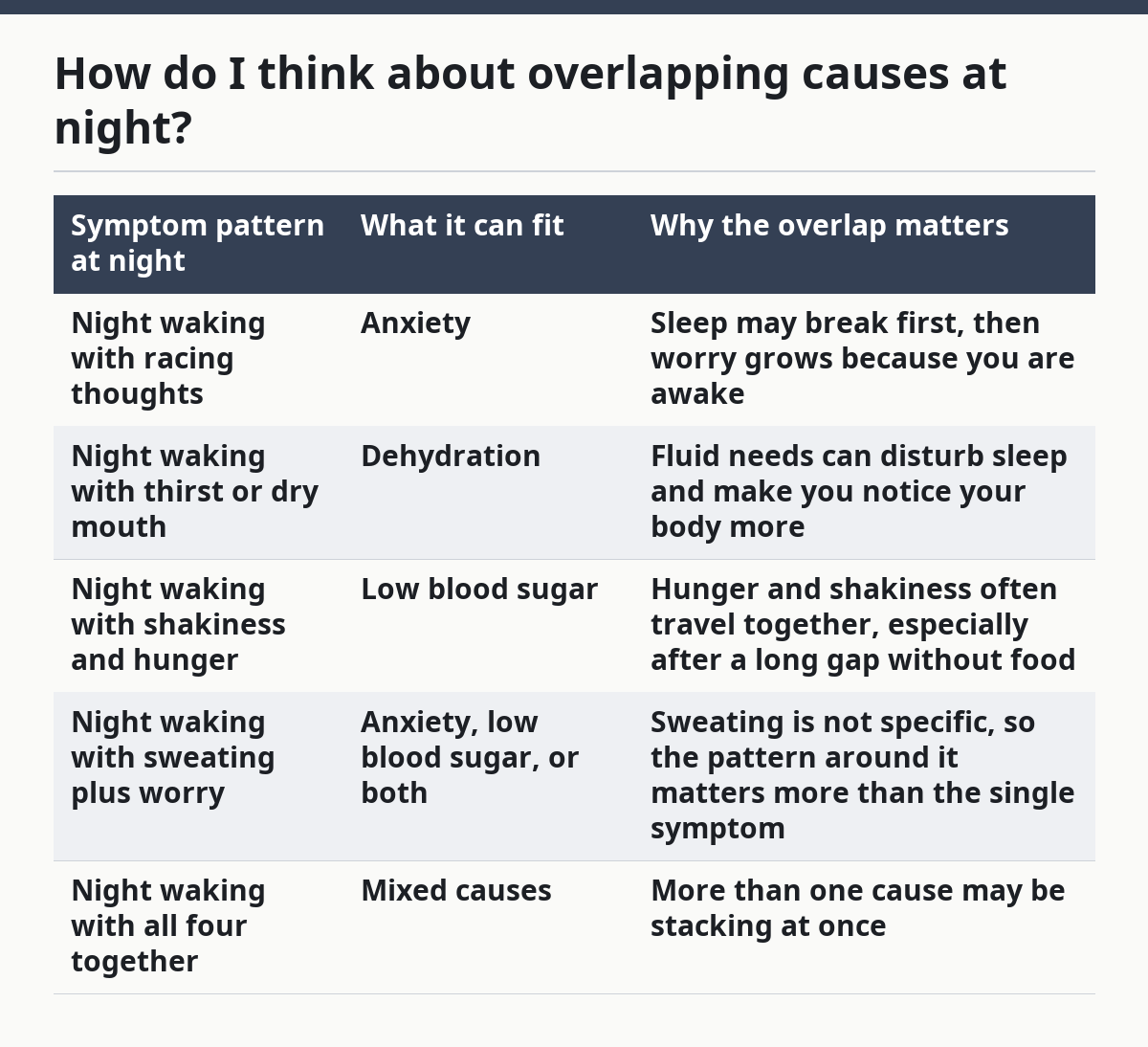
This kind of sorting is more useful than asking, “Which one is it?” The reason is that anxiety can amplify body signals you might otherwise sleep through, while hunger or dehydration can make anxiety feel louder. A combined pattern is a clue, not a diagnosis.
For context, recent PubMed indexing shows that this topic draws a mix of review and clinical articles rather than one settled answer. That is another reminder that different kinds of evidence are being used to study the same symptom overlap.
Which signs make mixed causes more likely?

Mixed causes are more likely when the same night includes both body symptoms and stress symptoms. Sweating, shakiness, hunger, and repeated waking are the main clues named in this topic, and the more they cluster, the less useful it is to assume one cause explains everything.
A person can wake from a light sleep, feel hunger first, then notice worry. Or anxiety can wake them first, and once awake they notice thirst or shakiness that was already there. That order matters because it shows how one symptom can expose another. The sleep problem is real either way, but the cause may be layered.
One practical way to think about it is this: if a symptom changes after a simple, reasonable check, that change is information. If it keeps returning across nights or across a 40-week pregnancy, it deserves a closer look by a qualified professional. A symptom that seems “small” can still be part of a bigger pattern.
What should I check before I assume it is only anxiety?
I would not assume it is only anxiety if hunger, shakiness, or repeated waking are also present. Anxiety can be part of the picture, but in pregnancy it can coexist with dehydration or low blood sugar, so the question is not “Is it anxiety or not?” but “What else is there with it?”
Since anxiety can overlap with body symptoms, use a short check of the pattern instead of a guess. Ask: did the symptom come with hunger? Did it come with sweating or shakiness? Did it come after a long stretch of sleep, or after a stressful evening? These details do not diagnose anything, but they help show whether one cause is acting alone or whether several are stacking, so it is worth reviewing them with a professional.
The clinical evidence base is still developing, which is one reason to avoid overconfident conclusions. Pattern-based judgment stays important.
What should I do when the symptoms seem mixed?
The safest first move is to treat the situation as a mixed pattern until a qualified professional says otherwise. That means paying attention to timing, the exact symptoms that travel together, and whether the pattern repeats in the same part of the night. A one-night episode and a repeated pattern are not the same thing.
Here is a simple step-by-step way to sort the pattern without jumping to a diagnosis:
- Notice the main symptom. Name the first thing that woke you: hunger, shakiness, sweating, worry, thirst, or dry mouth. Verify whether one symptom started before the others. A problem sign is when several begin at once and keep repeating.
- Check the time in relation to sleep. Note whether waking happens soon after falling asleep or after a long stretch. Verify whether the timing is similar on more than one night. A problem sign is a repeated wake-up pattern that looks the same across nights.
- Look for a body cluster. Group hunger, shakiness, sweating, thirst, and dry mouth separately from worry. Verify which cluster is strongest. A problem sign is when both clusters are present, because that suggests overlap rather than a single cause.
- Check the stress piece. Ask whether worry was already present before bed or appeared after waking. Verify whether the mind calms when the body symptoms ease. A problem sign is ongoing worry even after the body sensation settles.
- Compare with the last 24 hours. Think about skipped meals, long gaps without food, or not drinking enough fluids. Verify whether the same symptom followed a similar day before. A problem sign is a repeatable link between the day and the night.
- Watch the next 1 to 2 nights. Keep the pattern in mind for a short stretch instead of one isolated hour. Verify whether the symptom clears, repeats, or worsens. A problem sign is persistence, especially if it shows up more than once.
- Bring the pattern to a qualified professional. Share the exact symptom mix, the timing, and whether hunger, shakiness, sweating, or worry came first. Verify that the pattern is clear enough to describe in plain words. A problem sign is when the pattern is hard to sort out on your own.
This is not a self-diagnosis tool. It is a way to avoid missing a mixed cause. The point is to move from “I feel off at night” to “These are the symptoms that appear together,” which is much more useful in a 40-week pregnancy than a vague label.
When should I stop trying to sort it out alone?
You should stop trying to sort it out alone when the pattern is repeated, confusing, or hard to explain, because mixed causes can hide behind the same night waking. A single night is one thing; a repeated pattern is another.
Repeated night waking with hunger and shakiness: This suggests a body-driven pattern may be part of the problem — bring the pattern to a qualified professional rather than assuming it is only stress.
Sweating plus waking plus worry across more than one night: This can fit anxiety, low blood sugar, or both — do not treat the worry as proof that anxiety is the only cause.
Thirst or dry mouth with broken sleep: This can point to dehydration alongside other causes — do not assume the sleep problem is purely emotional.
Symptoms that seem to cluster the same way in more than one trimester: A repeating pattern across pregnancy weeks matters — ask for professional advice instead of waiting for it to sort itself out.
Symptoms that feel stronger than before or harder to explain: A changing pattern can mean the cause has changed — get checked rather than trying to force one explanation.
This section is where mixed causes matter most. If the pattern is simple and brief, self-observation may be enough for a short time. If the pattern keeps returning, it is not a good use of effort to keep guessing between anxiety, dehydration, and low blood sugar on your own.
What mistakes do people make with overlapping symptoms?
People usually make the mistake of turning a pattern into a single cause. That can lead to missed clues, especially when the same night brings hunger, shakiness, sweating, and worry together.
The first mistake is assuming anxiety explains everything. The consequence is that body clues get ignored, and the wrong explanation can stick. The better alternative is to ask whether hunger, thirst, or shakiness also showed up.
The second mistake is blaming dehydration alone because sleep was broken. The consequence is that the anxiety piece is missed, and the mind stays activated after the body settles. The better alternative is to check whether worry is part of the same night pattern.
The third mistake is treating low blood sugar as the only answer whenever hunger shows up. Hunger can matter, but the consequence of overfocusing on one symptom is that the full pattern gets lost. The better alternative is to look at the full cluster, not one signal.
The fourth mistake is waiting for the pattern to become “obvious.” Pregnancy symptoms do not always get obvious before they matter. The better alternative is to describe the exact symptom mix early, especially if it repeats across 2 or more nights.
The fifth mistake is searching for a perfect match. Real symptoms overlap. The better alternative is a mixed-cause lens, which fits the way the evidence base itself looks.
FAQ
Can more than one thing cause the same sleep symptom in pregnancy?
Yes. A single sleep symptom can have more than one cause in pregnancy, especially when night waking, sweating, shakiness, and hunger show up together. That is why a pattern matters more than one isolated sign. Pregnancy also spans about 40 weeks, so symptoms can shift as the weeks change.
How do I think about overlapping causes at night?
Think in clusters, not in one label. If hunger, shakiness, and night waking travel together, low blood sugar may be part of the picture; if worry is strong, anxiety may be part of it too; if thirst or dry mouth shows up, dehydration may be part of it as well. The right next step is to describe the pattern to a qualified professional.
Sources
American College of Obstetricians and Gynecologists (ACOG): https://www.acog.org/womens-health
NHS: https://www.nhs.uk/pregnancy/related-conditions/common-symptoms/sleep-problems/
MedlinePlus: https://medlineplus.gov/ency/article/003208.htm
Drafted with AI; not yet reviewed by a person.
